
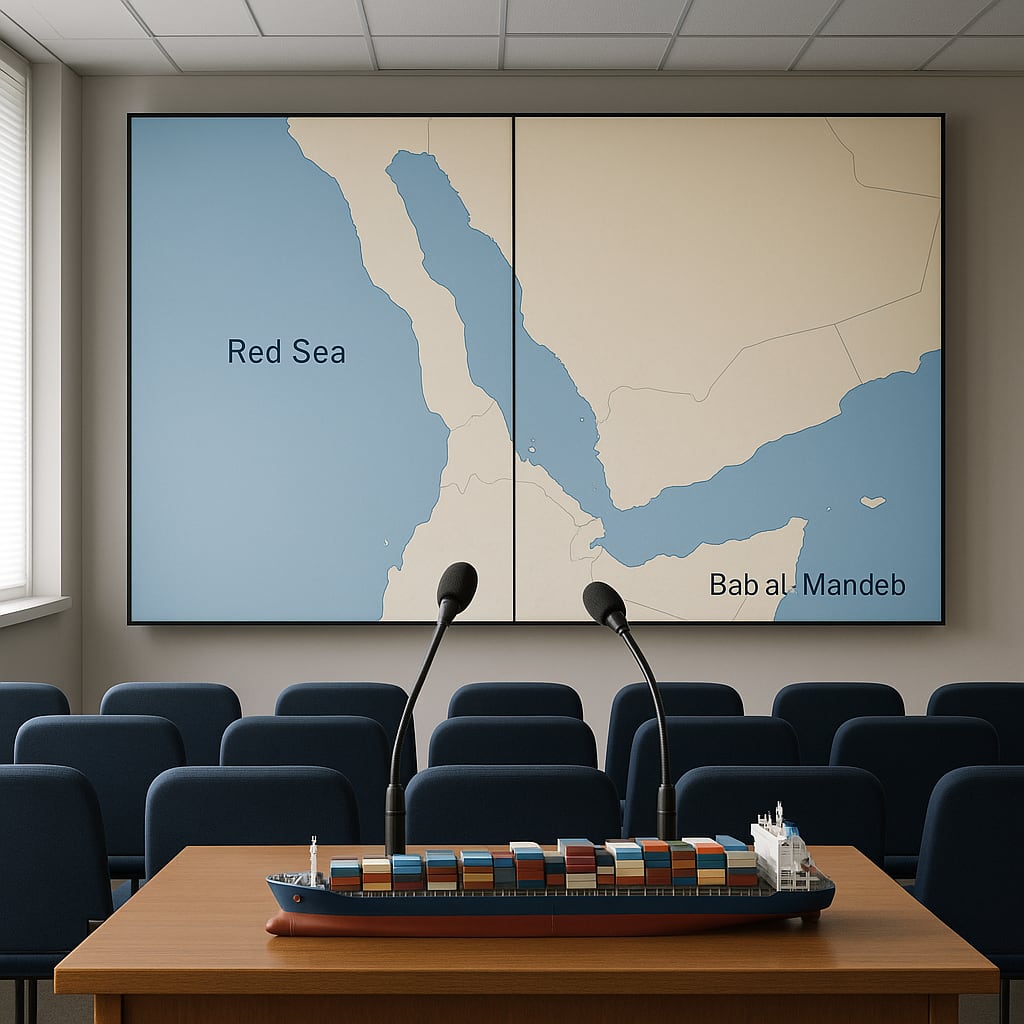
Saudi-backed Yemeni forces report advances near Bab al-Mandeb as Houthis dispute control claims
Narrative Snapshot
Across outlets, the core claim of government gains is widely carried but with varying levels of attribution and caution. France24, The Guardian, and South China Morning Post emphasize the scope and speed of advances under Saudi air cover, naming Dhubab and additional settlements and, in France24’s account, a push “up to” Mocha. BBC and Japan Times stress uncertainty, citing Houthi-run denials and conditional language on control of the strait. TASS adds operational detail about a flanking maneuver not present elsewhere, while Al Jazeera situates the battlefield reports alongside planned Pakistani–Saudi–Turkish consultations.
The framing of stakes splits between maritime security and regional rivalry. SCMP underscores the oil route’s sensitivity and market reaction to prior Houthi gains; the New York Times and several European outlets layer the Iran-armed proxy frame. CGTN elevates Houthi claims of heavy Saudi strikes and parallel Houthi advances in Taiz, and notes Tehran’s call for dialogue. Sky News highlights coalition-reported strike density, while ANSA carries Iranian messaging unrelated to Bab al-Mandeb but indicative of a broader information contest.
What Happened
Yemen’s internationally recognized government says its forces, backed by Saudi air power, advanced along the Red Sea coast and seized positions near the Bab al-Mandeb choke point, including Dhubab. Officials quoted by France24 and The Guardian described a rapid push reclaiming several areas and, per France24, advances “up to” Mocha. The government’s information minister told SCMP that “effective control” over the strait had been secured, though fighting continued. TASS cited an army spokesman describing a flanking maneuver against Houthi positions. Claims over Mocha were immediately contested: Middle East Eye relayed a pro-government assertion of takeover, then aired a Houthi deputy governor’s video from inside the city denying loss of control; BBC similarly reported Houthi-run media denying gains in Dhubab. The Saudi-led coalition announced 324 airstrikes using 100 jets, according to Sky News. CGTN, citing Houthi figures not independently verified, reported 106 strikes in 24 hours and Houthi gains in Taiz, including At Turbah. Al Jazeera noted upcoming Pakistani, Saudi, and Turkish meetings.
Why It Matters
Bab al-Mandeb’s status directly affects Red Sea–Gulf of Aden shipping and energy flows. SCMP links last month’s reported Houthi capture of the narrowest approaches to market jitters; loosening Houthi control, if sustained, would mitigate immediate maritime risk but hinge on ground consolidation. The operation also tests the Saudi-led coalition’s capacity to translate air dominance into lasting territorial control, a central question for any future negotiating leverage. Coverage by the New York Times, France24, and The Guardian reaffirms the conflict’s Iran–Saudi proxy dimension; CGTN notes Tehran’s call for dialogue, while ANSA carries rhetorical posturing from Iran’s IRGC in a separate maritime theater, underscoring a multi-arena narrative struggle. For governments and multilateral bodies, the developments intersect with maritime security mandates, energy market stability concerns, and calculations over crisis diplomacy as the government signals broader ambitions and Houthis advertise counter-gains.
Diverging Narratives
The extent and durability of government gains are disputed in real time. Government and coalition-aligned sources describe a “lightning” coastal advance retaking Dhubab and nearby towns, with France24 and The Guardian naming multiple localities and SCMP relaying an assertion of “effective control” over the strait. Houthi-run media counter that there were no meaningful advances in Dhubab, per the BBC, and Houthi officials publicly deny losing Mocha, with video evidence from the city carried by Middle East Eye. Japan Times captures the verification gap with “if confirmed” language about loosening Houthi grip.
There is also a divergence in operational portrayal. Sky News transmits coalition claims of 324 “high-value” targets struck with 100 aircraft, while CGTN amplifies Houthi-reported tallies of 106 strikes in 24 hours and 1,516 since the escalation began, figures it notes were not independently verified and not confirmed by Saudi Arabia. Simultaneously, while several outlets depict Houthi setbacks along the coast, CGTN and the Bangkok Post report Houthi assertions of fresh gains in Taiz, including At Turbah, creating a picture of simultaneous offensive and counter-offensive rather than a unilateral rout. TASS’s reference to a government flanking maneuver provides granular color but does not resolve the larger dispute over control on key urban fronts.
What Happens Next
Three decision points emerge from the sources. First is consolidation versus contestation along the coast: if government forces can hold Dhubab and adjacent positions and substantiate control “up to” Mocha, as reported by France24 and The Guardian, the SCMP-described maritime risk could ease; if Houthi denials and counter-moves prevail, control of the approaches will remain unsettled. Second is the tempo and transparency of the air campaign: coalition claims of extensive strikes (Sky News) versus unverified Houthi counts (CGTN) will shape both battlefield conditions and external tolerance; formal Saudi confirmation or adjustment of strike narratives would be a key signal. Third is the breadth of the ground campaign: Al Jazeera’s note of planned Pakistani–Saudi–Turkish consultations and the government’s wider offensive aims intersect with Houthi-claimed gains in Taiz (CGTN; Bangkok Post). Analysts should watch for independent verification around Mocha, named localities changing hands, official communiqués after the trilateral contacts, and any shipping advisories reacting to control claims near the strait.