
New York declares statewide disaster emergency over measles; Pennsylvania surpasses 1,000 cases
Narrative Snapshot
Across outlets, the core development is uncontested: New York’s governor declared a statewide disaster emergency as cases concentrated in under‑immunised rural communities rose to 108 this year. International coverage layers in distinct emphases. France24, CBC, and Folha highlight the policy instrument itself—an unusual state-level disaster designation since measles began surging in 2025—and the operational pivot to broaden who can administer MMR shots. The Hindu’s account adds temporal and geographic granularity inside New York and along the Pennsylvania border, while Deutsche Welle and Clarín elevate Pennsylvania’s role as the current epicenter with more than 1,000 infections reported since spring.
Two framing choices shape perceived stakes. Several outlets tie the outbreaks to declining vaccination and a reversal of prior gains after the United States had effectively eliminated measles by 2000, while Telesur extends the lens to a near-3,900 national case count and a pending international review of whether the United States and Mexico retain measles‑free status. RT underscores the order’s fixed end date and the rural, low‑immunization profile of affected communities, implicitly raising questions about political timing and the reach of emergency authorities. The New York Times and Sky News keep the focus on New York’s case trajectory—its highest since 2019—situating the move within a broader national resurgence.
What Happened
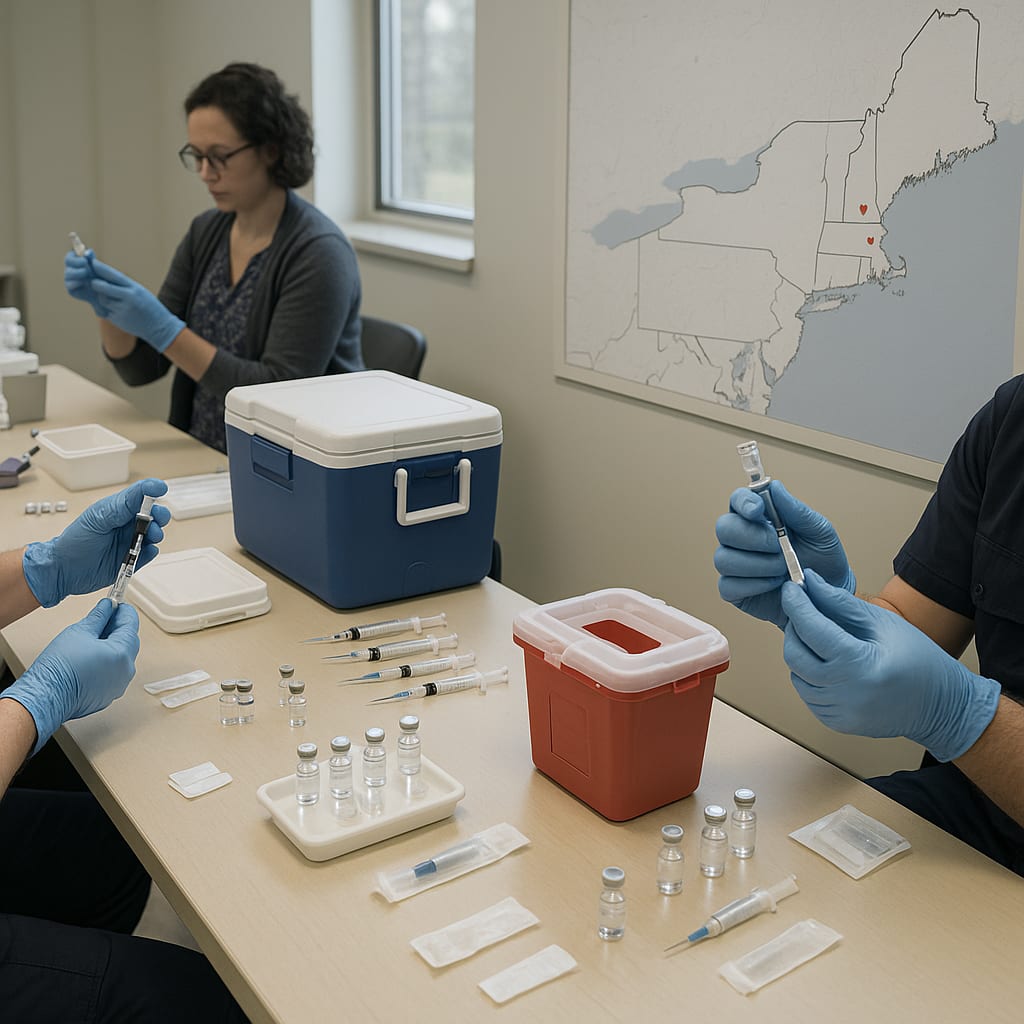
New York Governor Kathy Hochul declared a statewide disaster emergency over measles, citing 108 cases this year, with seven in New York City and 101 elsewhere, the most since 2019. Officials reported that 92 cases have been logged since mid‑July across 18 counties, with clusters in under‑immunised rural areas. The order expands who can administer measles, mumps and rubella vaccines and conduct testing; measures described include authorizing paramedics, advanced emergency medical personnel, pharmacists, and midwives to vaccinate. The executive order is set to remain in force through November 4. Neighboring Pennsylvania has recorded more than 1,000 infections since April, with five reported deaths amid a widening outbreak. Nationally, outlets cite a resurgence that has produced the worst U.S. measles year since 1991, with total cases approaching 3,900, amid declining childhood vaccination rates.
Why It Matters
The move tests how far state emergency powers can be leveraged to rebuild routine immunization coverage and surge preventive services outside traditional clinical settings. By expanding the vaccinator pool to pharmacists, midwives, and emergency medical personnel, New York is operationalizing a whole‑of‑system approach that other U.S. states can adopt as measles cases rise. The outbreak also carries regional and international implications. Pennsylvania’s sustained transmission along the New York border underscores cross‑jurisdictional dependency, while a pending assessment by international health officials on whether the United States and Mexico retain measles‑free status links state actions to continental disease‑control benchmarks. For federal and multilateral actors, the situation is a stress test of surveillance capacity, public trust in immunization, and the durability of elimination designations won after 2000. For decision‑makers, the precedent signals that vaccine‑preventable disease control may increasingly rely on emergency authorities when routine coverage falters.
Diverging Narratives
Outlets converge on the emergency declaration and the 108 New York cases but diverge in scale and reference points. The New York Times frames the state’s tally as the highest since 2019, while multiple outlets position the national picture as the worst since 1991. On Pennsylvania’s burden, The Hindu reports 977 cases as cited by New York officials, whereas Deutsche Welle and Clarín emphasise that infections there have surpassed 1,000; France24 adds that five people have died, elevating severity. Coverage also splits between a state-centric operational focus and a regional or global lens. CBC and Folha stress that this is the first such state declaration since cases surged in 2025 and center on expanded vaccine administration, while Al Jazeera anchors the story in the reversal of the United States’ measles elimination achieved by 2000. Telesur broadens the frame to nearly 3,900 U.S. cases and an upcoming review of the United States’ and Mexico’s measles‑free status, adding institutional stakes. RT uniquely underscores the order’s fixed end date and rural, low‑immunization context, pointing to implementation timelines and political calendar sensitivities without challenging the underlying epidemiology.
What Happens Next
Three decision points will shape trajectories. First, implementation of New York’s expanded vaccinator authorities will determine speed of coverage gains; watch operational indicators such as pharmacy participation and deployment of EMS and midwives to administer MMR, as specified in the emergency measures. Second, Pennsylvania’s outbreak management—amid more than 1,000 cases and five deaths—will hinge on whether case growth in rural counties along the New York border slows; shifts in reported case and fatality trends will signal if current interventions are sufficient. Third, the international assessment of measles‑free status for the United States and Mexico will benchmark whether sustained transmission thresholds have been crossed; the outcome, referenced in Telesur’s reporting, will inform cross‑border coordination priorities. In New York, the executive order’s current November 4 end date is a procedural waypoint; whether authorities extend or retire emergency powers will track with case trends and vaccination uptake.