
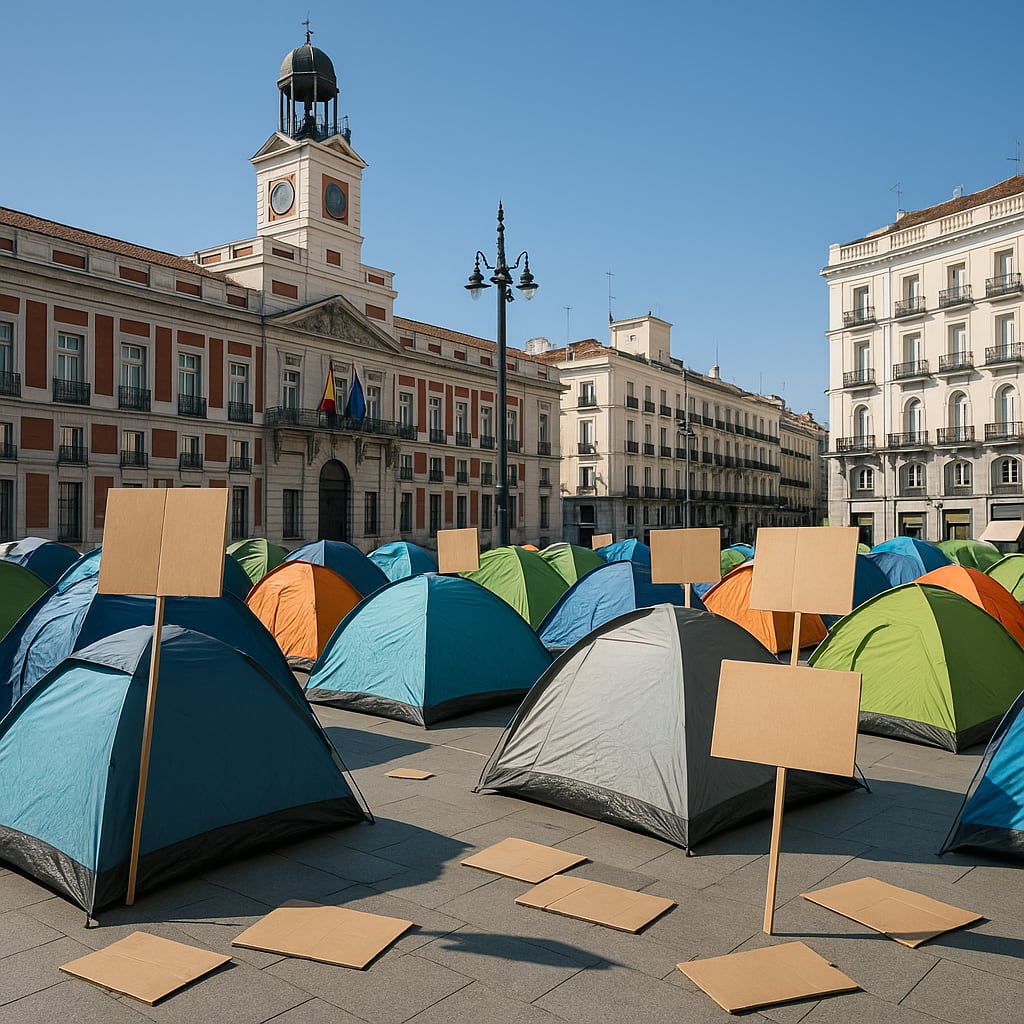
Spain’s housing protests swell after decree defeat, with clashes in some cities and calls for a general strike
Narrative Snapshot
Across outlets, there is broad agreement on the scope and coordination of the mobilization. Reports describe simultaneous marches in more than 50 cities, a flagship demonstration in Madrid anchored by an encampment at Puerta del Sol, and prominent calls for a general strike led by the Tenants’ Union. Attendance figures diverge: organizers in Madrid cited 500,000, while the Government Delegation put the figure at 70,000; UK and Russian outlets referenced “tens of thousands,” reflecting the range across sources. The general thrust is that a sustained campaign preceded and then accelerated after parliament rejected government housing decrees, with the eviction of 87-year-old Maricarmen Abascal serving as a galvanizing symbol.
What outlets emphasize differs. Al Jazeera focused on street battles in Barcelona, citing fires, barricades, and projectiles, while RT detailed clashes in Valencia involving rubber bullets and tear gas. In contrast, Italian and UK coverage dwelled on social and generational grievances, with Corriere della Sera reporting from among under‑30 “acampados” in Madrid and La Repubblica profiling the “keys” protest figure Javier Gil, who argues for an Austrian‑style public housing model. Argentina’s Clarín highlighted sharp criticism of Prime Minister Pedro Sánchez and the general‑strike framing, and ANSA layered in Eurostat data on EU‑wide price and rent rises.
Several outlets locate the stakes in electoral and structural terrain. ANSA noted polls suggesting PP and Vox edging toward a majority while cautioning the crisis could reopen the contest, and La Repubblica cited survey results indicating support among PP, Vox, and Junts voters for anti‑eviction measures and restrictions on “vulture funds.” Telesur reported Sánchez’s announcement of a snap general election for November 29 to seek a larger progressive bloc on housing. Folha de S.Paulo contextualized Spain’s crisis against a history of overbuilding, underscoring the mismatch between past supply patterns and current access, while Telesur earlier documented a mediated resolution in Abascal’s case via a municipal lease program.
What Happened
After Spain’s parliament rejected two emergency housing decrees proposed by the Sánchez government, demonstrations organized by the Tenants’ Union surged across more than 50 cities. In Madrid, an encampment at Puerta del Sol anchored a march converging on Plaza de Cibeles, with organizers claiming 500,000 participants and authorities estimating 70,000. Protest slogans targeted rentiers, “vulture funds,” and evictions, and aired demands including a 50% rent cut, open‑ended rental contracts, and expropriation of investor‑held homes. Violence flared at the margins: Al Jazeera reported clashes in Barcelona, and RT described police use of rubber bullets and tear gas in Valencia. The protests followed public outrage over the eviction of 87‑year‑old Maricarmen Abascal, whose case, Telesur reported days earlier, resulted in a mediated agreement for her return under a municipal lease cap. Telesur later reported that Sánchez announced a snap election for November 29.
Why It Matters
The confrontation over housing policy sits at the intersection of EU‑level affordability pressures and national political realignment. ANSA cited Eurostat data showing EU house prices up 4.7% and rents up 3%, situating Spain’s actions inside a wider continental trend. The coalition of grievances—youth precarity, tenant protections, and investor ownership—has moved from social to institutional arenas: La Repubblica highlighted cross‑party voter support for anti‑eviction measures and limits on “vulture funds,” implying bargaining space across Spain’s fragmented parliament. The rejection of decrees spotlights legislative capacity constraints, while Telesur’s report of a snap election raises the prospect of resetting that capacity to legislate on housing. Internationally, the salience of Spain’s turmoil is already informing neighboring debates; ANSA reported Italy’s government is weighing budget measures for young people amid rising housing costs. For decision‑makers, the episode tests how quickly democratic institutions can absorb street‑level demands into coherent, enforceable policy under contested majorities.
Diverging Narratives
Coverage differs on scale and character. Attendance was variously described as tens of thousands or hundreds of thousands, with Madrid’s count contested between organizers and authorities. Some outlets, including Al Jazeera and RT, emphasized disorder in Barcelona and Valencia, while others foregrounded peaceful mass mobilization and the social base of the movement, with Corriere della Sera centering under‑30 protesters and La Repubblica profiling the “keys” protests and their leadership.
Responsibility and remedies are framed through distinct lenses. Clarín underscored criticism of Sánchez following the decrees’ defeat, while The Guardian highlighted that opposition parties struck down measures intended to address anger over the high‑profile eviction. Movement demands reported by Telesur and RT—rent halving, indefinite contracts, and expropriation—contrast with La Repubblica’s interview with Javier Gil, who calls for a public housing model akin to Austria’s, pointing to different policy horizons within the protest camp itself. Timelines also diverge in emphasis: La Repubblica noted the demonstrations were scheduled before the parliamentary vote, suggesting a pre‑existing mobilization rather than a purely reactive surge.
Electoral implications are read through different prisms. ANSA referenced polling that favors PP and Vox but allowed that the housing crisis could reshape the race. La Repubblica cited data indicating support among right‑leaning electorates for stronger tenant protections, complicating party‑line assumptions. Telesur’s report of a snap election adds another variable, positioning the ballot as a route to a larger legislative bloc for housing action.
What Happens Next
Two decision tracks are explicit in the reporting. First is the protest strategy: banners reading “Towards the general strike” and the Tenants’ Union’s central role signal an escalation pathway; analysts should watch for formal strike calls, sectoral participation commitments, and coordination with labor confederations, which would indicate whether mobilization shifts from demonstrations to economic disruption (Telesur). Second is the institutional route: after the defeat of emergency decrees, parties face choices about re‑tabling protections, negotiating narrower bills, or deferring to an electoral reset. La Repubblica’s finding that right‑leaning voters back anti‑eviction measures is a concrete indicator to monitor for cross‑bench bargaining.
If, as Telesur reports, a snap general election was announced for November 29, key signals will be the publication of the Royal Decree in the BOE and how party platforms crystallize around rent caps, eviction limits, and investor regulation. Public‑order choices will also matter: responses to the Barcelona and Valencia clashes (Al Jazeera, RT) could affect protest dynamics and public support. Finally, ANSA’s note on Italian budget deliberations is an external indicator of policy diffusion to watch beyond Spain.