
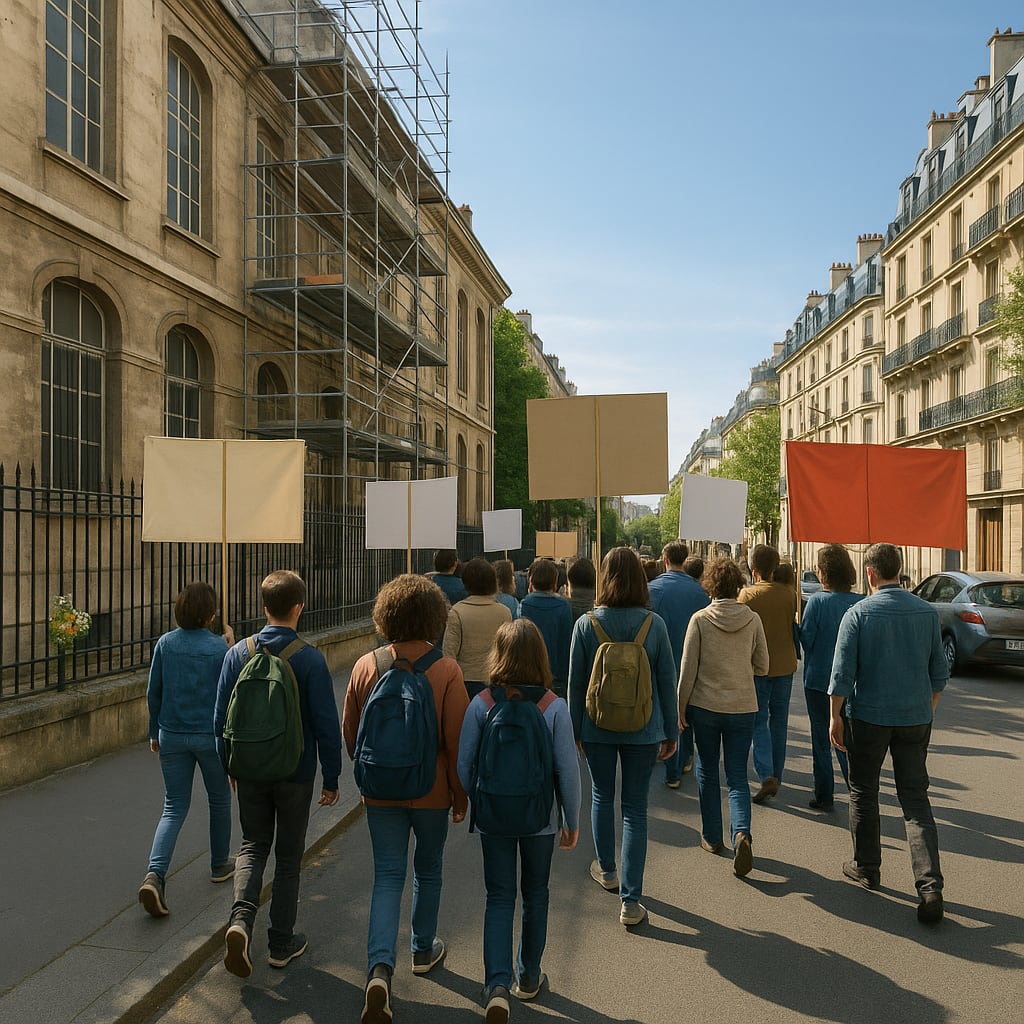
France’s student-led protests surge nationwide as unions join, while clashes spur injury probes and a political defense of policing
Narrative Snapshot
Across outlets, there is broad alignment that Tuesday marked the largest mobilization yet, with students joined by teachers, parents, and trade unions in street actions and school blockades nationwide. French, U.S., German and Asian media stress the breadth of social backing and the focus on understaffing and dilapidated facilities, with the Interior Ministry counting roughly a quarter-million demonstrators nationwide and 56,000 in Paris, while organizers claim higher totals (reports from Folha de S.Paulo, Japan Times, France 24, New York Times, Deutsche Welle, NBC News).
Where coverage diverges most is on policing. Multiple outlets document tear gas in major cities and serious injuries to minors, including a 15-year-old who lost a hand and a separate case in which an officer has been charged after firing a tear-gas grenade at close range at a 14-year-old (BBC, Corriere della Sera, Al Jazeera English, France 24, Bangkok Post, Clarín, Telesur English). Rights advocates call France’s “less-lethal” arsenal disproportionate; the prime minister rejects accusations of “police brutality,” framing incidents as “accidents” amid urban violence (France 24, The Guardian, Fox News, Le Monde). Italian and U.S. outlets also highlight injured officers and significant arrests (ANSA, Fox News).
On demands, French and international reporting centers on public education investment; some coverage links pressures on the school budget to defense allocations and broader fiscal debates under President Emmanuel Macron and Prime Minister Sébastien Lecornu (South China Morning Post, Deutsche Welle, New York Times, TASS, Telesur English). The role of social media in mobilization—and calls by some mayors to temporarily block platforms for minors—introduces a governance dimension largely noted within French media (France 24). Russian state outlets emphasize disorder and, in one account, spillover to Belgium; most other reporting foregrounds the aims of the movement and the scale of peaceful participation earlier in the day (RT, South China Morning Post).
What Happened
After nearly three weeks of high school blockades, France saw its biggest day of student-led action on October 6, with marches and school closures from Marseille to Nantes and Lyon, and a large afternoon rally in Paris. The Interior Ministry reported about 256,000 demonstrators nationwide, including 56,000 in Paris, while student and university groups cited higher figures (Folha de S.Paulo; Japan Times). Riot police used tear gas in Paris and Marseille as clashes flared around some blockades; hundreds of schools were shuttered or barricaded (BBC; NBC News; South China Morning Post). Authorities detained hundreds on the day and more than 6,100 over two weeks, many minors (ANSA; Corriere della Sera). Incidents left teenagers seriously injured, including a 15-year-old who lost a hand; a police officer was charged for firing a tear-gas grenade at close range at a 14-year-old (Telesur English; France 24). Prime Minister Sébastien Lecornu defended policing in parliament; President Emmanuel Macron convened senior ministers at the Élysée (Le Monde; Fox News; ANSA).
Why It Matters
The confrontation exposes pressure points in France’s capacity to deliver core public services and manage protest. Student, teacher, and union alignment expands the constituency for increased school funding and puts education appropriations in direct conversation with defense and broader fiscal choices flagged in several accounts (New York Times; Deutsche Welle; TASS; Telesur English). Police tactics are now a policy issue in their own right: serious youth injuries, a criminal charge against an officer, and Amnesty International’s call to ban certain “less-lethal” weapons raise questions about proportionality standards and compliance with rights norms (France 24). High arrest totals involving minors draw in juvenile justice and oversight bodies (Corriere della Sera; Telesur English). Domestically, cabinet cohesion is tested as the prime minister defends law enforcement while mayors and magistrates call for restraint (Le Monde; Telesur English; France 24). Internationally, sustained disturbances and rights critiques could weigh on France’s human rights posture and internal security credibility.
Diverging Narratives
Two frames dominate. Rights groups, several European and Latin American outlets, and on-the-ground reporting emphasize disproportionate force against minors, citing severe injuries and an officer’s indictment as evidence of systemic problems with France’s crowd-control arsenal (France 24; The Guardian; BBC; Clarín; Bangkok Post; Telesur English). The government, echoed in some international coverage, argues police act in response to “urban violence,” arson, and vandalism, cautions against labeling actions “brutality,” and stresses injured officers and large arrest totals (Le Monde; Fox News; ANSA; Corriere della Sera).
Counts and characterization vary. The Interior Ministry’s nationwide turnout of roughly 256,000 contrasts with organizers’ 450,000; Paris figures range from 56,000 (Interior; Japan Times) to 100,000 (organizers, per Folha de S.Paulo). Injury accounting is unsettled: the education minister acknowledged 190 injured students, while other reports cite at least 215 injured teenagers and more than 700 injured police officers across the period, reflecting differing sources and time frames (Telesur English; Fox News citing Reuters). On causation, most outlets center underfunding and deteriorating conditions; some also highlight tensions over defense spending priorities and fiscal policy (South China Morning Post; Deutsche Welle; TASS; Telesur English). A separate strand in international media reframes unrest through security or identity politics lenses, including a high-profile U.S. political figure’s claim unrelated to the movement’s stated aims (Fox News). Russian state media accentuate violent episodes and report protest “spillover” to Belgium—an angle not echoed elsewhere in this set (RT).
What Happens Next
Key decisions now sit with the executive and policing authorities. First, on education policy: watch for concrete budgetary signals from the Élysée and government following Macron’s meeting with senior ministers, and whether ministries propose staffing, infrastructure, or timetable reforms that networked student and union groups could treat as credible concessions (ANSA; Fox News; New York Times; Deutsche Welle). Second, on public-order doctrine: legal proceedings against at least one officer and Amnesty’s call for curbs on “less-lethal” weapons put interior and justice officials under pressure; additional indictments, equipment guidance, or bans would indicate movement on accountability (France 24). Third, on information governance: calls by some mayors to temporarily restrict minors’ access to social media set up a test of national appetite for platform controls; legislative initiatives or platform agreements would be clear signals (France 24). Movement endurance will be visible in the persistence of school blockades and turnout levels reported by Interior and organizers. Analysts should also track whether reports of cross-border protests gain corroboration from national authorities beyond the single Russian state-media account (RT).