
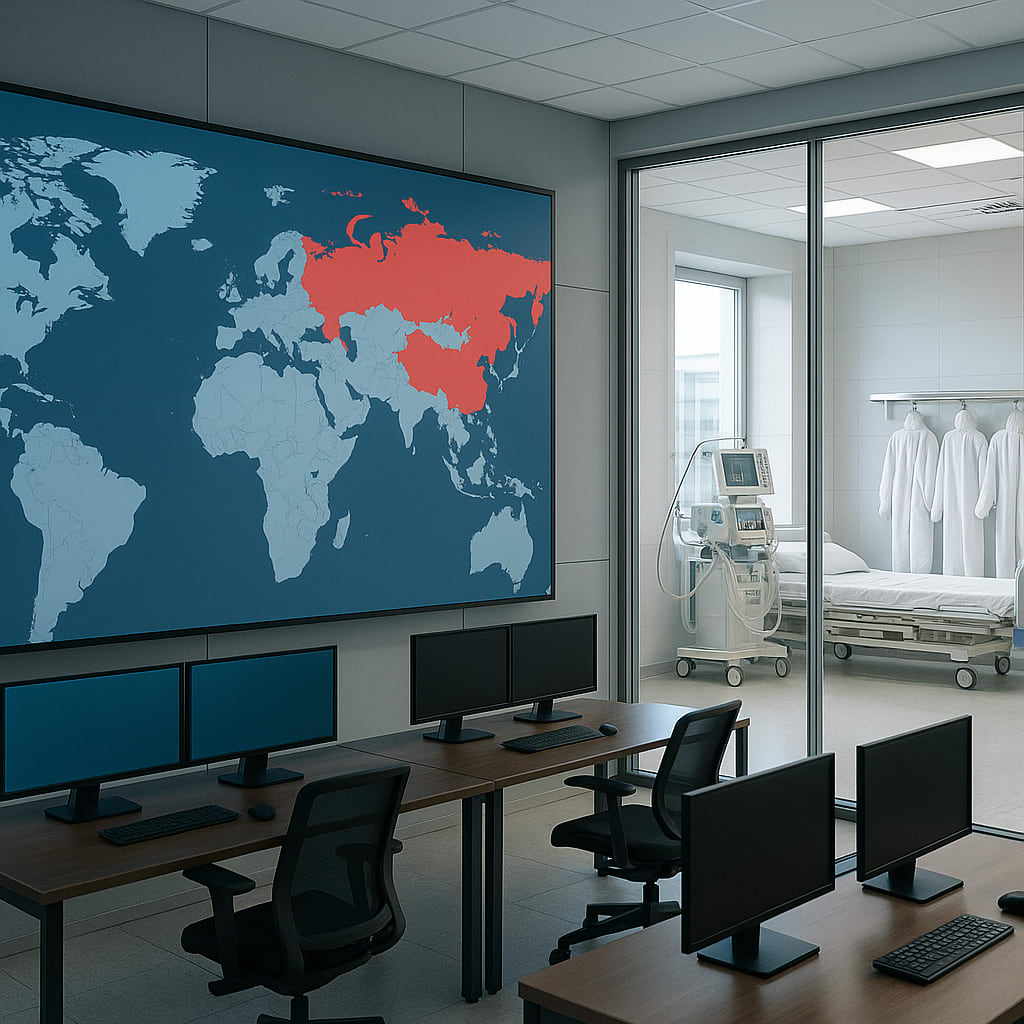
Suspected plague death at Siberian research lab prompts monitoring, transparency calls, and low-risk assessments
Narrative Snapshot
Across outlets, there is broad convergence on the immediate public‑health posture: authorities identified close contacts, imposed precautionary measures locally, and international agencies assessed the external risk as very low. What differs is how these moves are framed. Russian official statements focus on ruling out a lab link and containing speculation, while North American and European coverage emphasizes verification, transparency, and coordination with the World Health Organization.
A second split runs through the question of containment steps. Several reports describe hospital quarantine and monitoring of roughly 200 contacts around Irkutsk, while Russian officials deny any anti-plague measures were imposed. That gap anchors much of the follow-on reporting: some outlets treat the response as precautionary and proportionate, others as evidence of unresolved uncertainty that warrants outside scrutiny.
Finally, political overlays shape the narrative differently. U.S. and allied outlets highlight Washington’s offer of assistance, a pending Trump–Putin call, and WHO engagement; Russian and sympathetic media foreground calls to rely on Rospotrebnadzor’s statements and downplay alarm. Some commentary in U.S. outlets invokes historical concerns about Russian biodefense research; others counter with expert explainers underscoring treatability and low cross-border risk.
What Happened
Reports from Siberia say a 28-year-old employee of the Irkutsk Anti-Plague Research Institute died after developing pneumonia, with nearly 200 contacts placed under medical observation; some accounts add that a hospital in Shelekhov was quarantined. Russia’s public health agency, Rospotrebnadzor, stated the death was due to “pneumonia of unknown etiology,” said testing found “no microorganisms associated with the patient’s professional activities,” and reported no incidents at the facility. The Kremlin urged the public to follow Rospotrebnadzor’s guidance. The World Health Organization assessed the risk outside Russia as “very low,” and the UK Health Security Agency said the risk to the UK is very low. U.S. authorities, including the CDC, said they are aware and monitoring; the U.S. Embassy in Moscow issued a health alert noting reports of suspected pneumonic plague. President Donald Trump offered assistance and said he had a call scheduled with President Vladimir Putin.
Why It Matters
This episode tests core functions of the International Health Regulations: rapid risk assessment, transparent sharing of epidemiological data, and alignment of national risk communication with global guidance. WHO’s low-risk assessment coexists with calls from Washington and others for more detail from Moscow, putting a spotlight on information flows and verification practices when a potential lab-associated infection is alleged. It also probes cross-border coordination norms at a fraught geopolitical moment, with the United States signaling readiness to assist while some political figures at home urge precautionary travel measures. For decision-makers, the case sits at the intersection of biosafety governance and public trust: how Russia documents its investigation, how quickly it communicates results to WHO counterparts, and how health agencies calibrate advisories will shape precedent for handling future laboratory‑adjacent incidents involving high‑consequence pathogens.
Diverging Narratives
Russian authorities emphasize the absence of evidence linking the death to the institute’s work and caution against speculation, urging reliance on Rospotrebnadzor’s official statements. Multiple international outlets, however, continue to describe the case as suspected pneumonic plague given the worker’s affiliation and the scale of contact tracing. Coverage also diverges on whether anti-plague measures were applied: some reports cite a hospital quarantine and extensive monitoring, while others relay official denials that such measures were imposed.
Risk framing differs too. WHO and the UKHSA state the external risk is very low, and explanatory pieces stress that pneumonic plague is treatable if detected early. Parallel reporting in U.S. outlets spotlights political and security angles: State Department and CDC monitoring, a U.S. Embassy health alert, and calls by some U.S. figures for travel restrictions. One former senior U.S. arms official, citing past defector accounts, warns publicly about possible antibiotic-resistant strains; other coverage counters with expert interviews and measured assessments of Russia’s response steps. In Latin American and Russian-aligned reporting, the Kremlin’s message to avoid rumors features prominently, alongside mention of alternative hypotheses under investigation, including foreign travel versus workplace exposure.
What Happens Next
Three decision points will shape the arc of this story. First, the etiological determination: Russian authorities say tests have not tied the death to lab pathogens, while WHO and U.S. agencies seek clarity. Confirmation of the pathogen and a formal WHO notification would resolve key uncertainties; prolonged ambiguity would keep pressure on information-sharing channels. Second, the public‑health posture around Irkutsk: reports of hospital quarantine and roughly 200 contacts under observation mean secondary case detection—or the lack thereof—will drive whether local measures are maintained or wound down. Third, the diplomatic track: the announced Trump–Putin call and ongoing U.S.–WHO requests for transparency could translate into data exchange or joint technical engagement; absent that, expect continued external monitoring, including embassy alerts and national advisories, and potential renewed calls for travel restrictions from some U.S. political figures if clarity does not improve.