
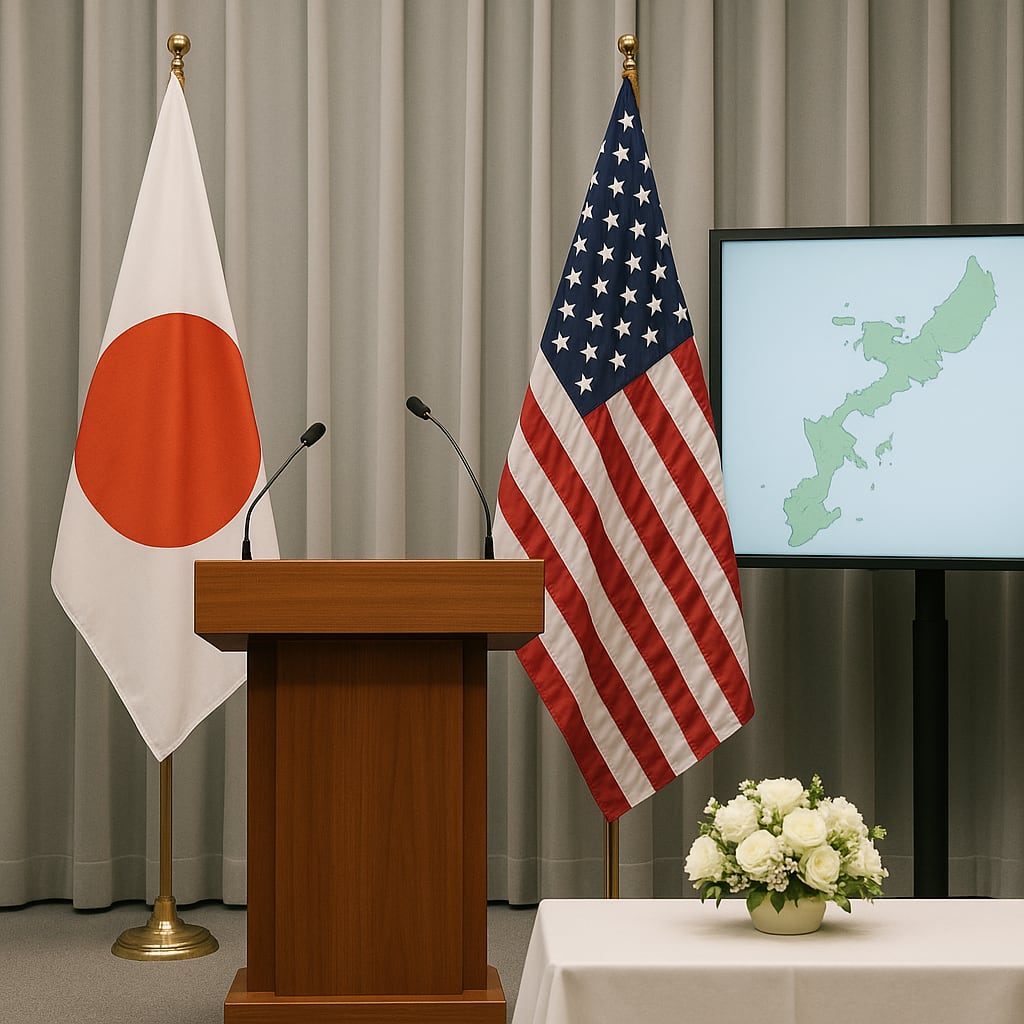
Alleged Okinawa murder by U.S. Marine prompts Tokyo protest, base curfew, and pressure on Okinawa’s new governor
Narrative Snapshot
Across outlets, there is clear alignment that Tokyo treated the case as a politically sensitive security issue, not only a criminal matter. State media in China and Russia highlight government-level protests and public anger, repeatedly calling the incident “heinous” and stressing the long-standing friction over U.S. bases (CGTN; RT). Japanese and regional reporting foregrounds the policy response: summoning U.S. officials, urgent pledges of stricter discipline, and immediate movement restrictions on troops (Japan Times; South China Morning Post; The Hindu).
Coverage diverges in emphasis. Western outlets lean into command accountability and alliance stewardship, centering Lt. Gen. Benjamin Watson’s framing that trust with local communities underpins deterrence and must be actively rebuilt through a “period of reflection” and tightened standards (Fox News; Japan Times; SCMP). By contrast, CBC and Bangkok Post situate the incident in a broader grievance set—noise, pollution, and violence against women—underscoring why public reactions in Okinawa routinely scale beyond a single case (CBC; Bangkok Post).
The strategic angle is most pronounced in Japan- and Asia-focused analysis: Okinawa’s newly elected governor, Genta Koja, had just rejected an unconditional defense buildup, and the arrest now complicates Tokyo’s plans for closer cooperation on a southwestern posture as regional salience grows (Japan Times; The Diplomat; SCMP). Latin American reporting registers calls to review military agreements and reinforce discipline on bases, pointing to potential agenda creep from criminal justice into alliance management (Clarín).
What Happened
Okinawa police arrested 20-year-old U.S. Marine Lance Cpl. Devin Jacob (Devin) Ballard on suspicion of robbing and murdering 39-year-old Anna Yagi at a hotel in Naha in the early hours of Saturday, October 3. Surveillance footage reportedly showed Ballard and Yagi entering together and Ballard leaving alone with what appeared to be her belongings; he denies the allegations (RT; CGTN). An autopsy found death by suffocation due to strangulation, and investigators noted a detached landline receiver in the room, suggesting a telephone cord may have been used (CGTN).
Prime Minister Sanae Takaichi condemned the killing as a “heinous crime,” lodged a protest with the United States, and demanded full cooperation, stricter discipline, and preventative measures (RT; CGTN). Foreign and defense ministers summoned the U.S. ambassador and the U.S. Forces Japan commander (CGTN). In response, U.S. forces instituted a 48-hour operational pause with no off-base liberty and a complete alcohol ban, followed by a 30-day midnight-to-5 a.m. curfew dubbed a “Period of Reflection” (SCMP; Japan Times; Fox News; Bangkok Post).
Why It Matters
The incident intersects with a longstanding, politically salient basing debate in Okinawa at a moment when Tokyo seeks to expand and harden its southwestern defense posture. Governor Genta Koja, who took office days earlier and has rejected an unconditional defense buildup, now faces intensified public pressure that could constrain central–prefectural coordination on force posture and facilities (Japan Times; The Diplomat; SCMP).
At the alliance-management level, Tokyo’s rapid diplomatic protest and ministerial summons signal that discipline and local trust are treated as enabling conditions for deterrence and access. U.S. commanders have explicitly tied troop conduct to alliance credibility and regional security, framing the curfew and alcohol ban as measures to repair community relations (Fox News; Japan Times). Calls reported to review military agreements and bolster base discipline suggest that criminal incidents can spill over into bilateral agenda-setting, with implications for how authorities calibrate restrictions, oversight, and communication protocols after high-profile cases (Clarín; The Hindu; CBC).
Diverging Narratives
State-linked Chinese and Russian outlets concentrate on the political sensitivity of the U.S. presence and public anger, spotlighting Tokyo’s characterization of a “heinous crime,” the formal protest to Washington, and renewed demonstrations (CGTN; RT). Their accounts also relay granular investigative details—autopsy findings and the possible use of a telephone cord—conveying severity and stoking accountability expectations while noting the suspect’s denial (CGTN).
U.S. and some regional reporting emphasizes command responsibility and alliance stewardship. Lt. Gen. Watson’s message connects everyday conduct to “the strength of our alliance and the security of this region,” framing the 48-hour pause and 30-day curfew as reflection and retraining rather than purely punitive constraints (Fox News; SCMP; Japan Times). Canadian and Thai outlets contextualize the episode within recurring Okinawan grievances—noise, pollution, and crimes against women—linking public reaction to structural burdens borne by the host community (CBC; Bangkok Post).
Within Japanese coverage, the policy center of gravity is on swift, visible measures and engagement with Okinawa leadership. Defense Minister Shinjiro Koizumi pledged new response measures “as soon as possible” but offered no timeline, while Koja’s prior stance against unconditional buildup—and his immediate call for stricter discipline—raises questions about whether central–prefectural cooperation on basing can proceed as planned (Japan Times; Toronto Star/AP; The Diplomat).
What Happens Next
Key decisions will hinge on central–prefectural coordination. Koizumi’s intention to meet Governor Koja and implement response measures “as soon as possible” creates a near-term test of whether Tokyo can pair discipline assurances with sustained defense posture plans; watch for any joint statements, timelines, or new oversight mechanisms emerging from these meetings (Japan Times).
On the U.S. side, the 48-hour operational pause and 30-day curfew are immediate controls; indicators include whether commanders extend restrictions, formalize additional training, or announce longer-term policy adjustments tied to community engagement and discipline (SCMP; Japan Times; Fox News).
At the political level, monitor whether calls to review military agreements migrate into official channels, and whether protests remain localized or expand to national venues, as seen outside the U.S. Embassy in Tokyo (Clarín; Al Jazeera English). The criminal investigation’s evidentiary disclosures and prosecutorial steps will also shape public sentiment and the scope of bilateral mitigation measures (CGTN; RT).