
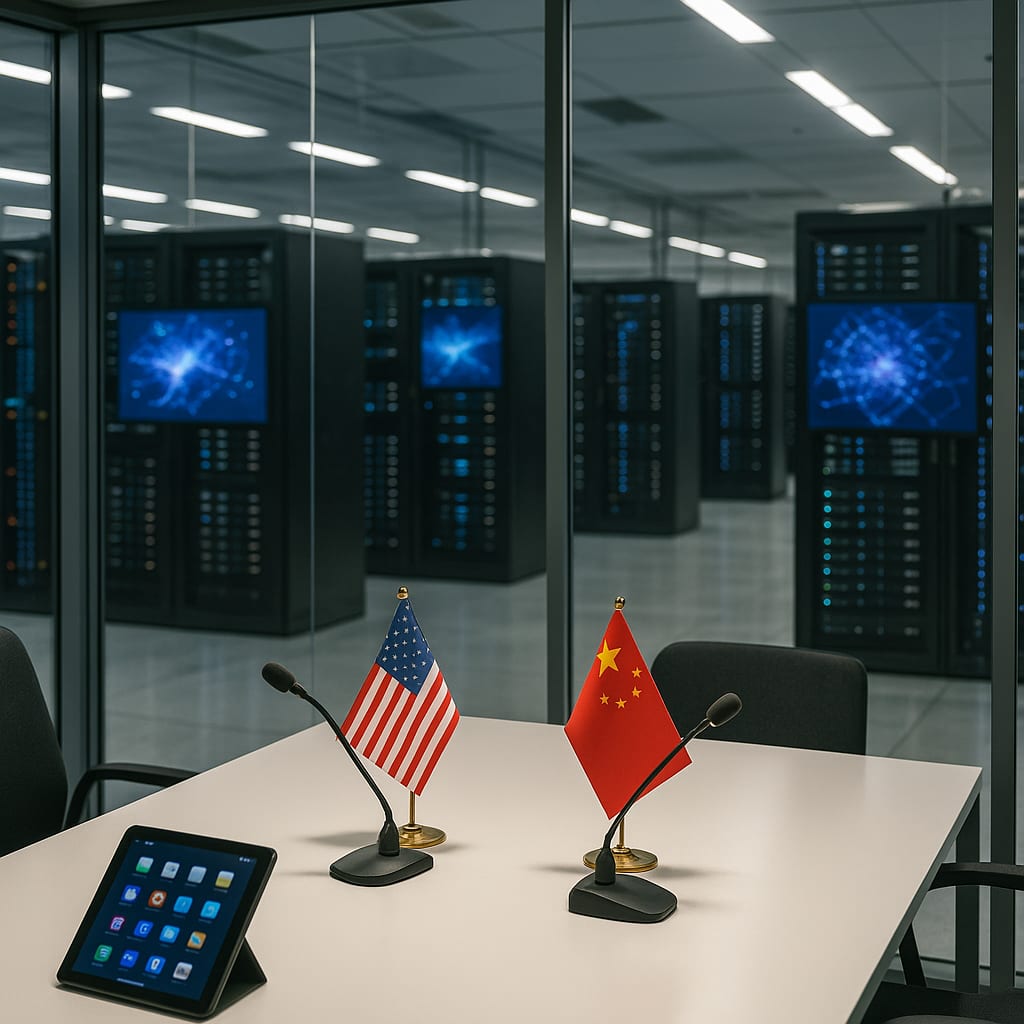
U.S.–China AI rivalry accelerates even as leaders open dialogue on safeguards
Narrative Snapshot
Across outlets, the picture is of simultaneous acceleration and contested governance. The South China Morning Post highlights a rapid-fire cadence of model releases—Xiaomi livestreaming a training run in Beijing on the same day Anthropic and OpenAI rolled out frontier systems in San Francisco—capturing the pace and the “model fatigue” now confronting executives and developers. Folha de S.Paulo emphasizes a U.S. push to compete specifically in the open, customizable segment that Chinese groups have come to dominate, reporting a Trump administration- and Nvidia-backed startup’s release of an open-system model whose parameters are downloadable.
Where risk management enters, the framing splits. A Fox News op-ed by Rep. Ro Khanna centers on binding, verifiable U.S.–China guardrails, asserting that congressional pressure preceded an announcement by Donald Trump and Xi Jinping to establish a bilateral AI dialogue. TeleSUR situates the leaders’ meeting within a broader effort to create mechanisms that prevent a slide back into confrontation across flashpoints from Taiwan to the Middle East. By contrast, Japan Times reports Beijing’s dismissal of warnings about Chinese AI as “fearmongering,” treating calls to slow development as an effort to hold China back. A second SCMP piece underscores how domestic AI agendas also carry political objectives, with the DeepZang Tibetan-language model explicitly tied to “promoting ethnic integration.”
What Happened
On September 22, the South China Morning Post reports a concentrated burst of AI releases: Xiaomi publicly streamed training of its MiMo‑V2.6 model in Beijing while Anthropic unveiled Opus 5.5 and, an hour later, OpenAI released GPT‑6 Sol and Luna in San Francisco. In early October, Folha de S.Paulo notes an American startup, backed by Nvidia and the Trump administration, launched an open-system model with downloadable parameters, positioned against Chinese groups strong in customizable, publicly available AI. Governance moves unfolded in parallel. According to a Fox News op-ed by Rep. Ro Khanna, a congressional hearing advocating a binding, verifiable U.S.–China AI treaty was followed by an announcement from Donald Trump and Xi Jinping to establish a bilateral AI dialogue. TeleSUR frames their Washington meeting as creating mechanisms to manage rivalry amid wider geopolitical tensions. Japan Times adds that Beijing has labeled some AI risk warnings “fearmongering.” Separately, SCMP reports a Hohhot seminar to upgrade China’s Tibetan-language DeepZang model to promote ethnic integration.
Why It Matters
The sources place AI competition within evolving U.S.–China risk management efforts that could set precedents for verification and crisis prevention. Khanna’s call for joint technical working groups and mutually trusted verification technologies points to a concrete, institution-building pathway if the announced bilateral dialogue matures. TeleSUR’s emphasis on rivalry “management” links AI talks to broader stability concerns alongside trade, Taiwan, and Middle East crises. At the industrial layer, SCMP’s “model fatigue” signals potential coordination challenges for firms and regulators trying to track fast‑cycling releases across jurisdictions. Folha’s reporting on a Trump- and Nvidia-supported open model suggests U.S. policy and corporate capital are converging to contest China’s lead in customizable, publicly available systems—implicating export controls, open‑source norms, and standards processes. SCMP’s DeepZang coverage shows how language models can be harnessed for domestic integration goals, indicating that AI policy is not only about frontier risk but also about state-directed social and linguistic priorities.
Diverging Narratives
Governance intent is described in markedly different registers. The Fox News op-ed foregrounds urgency for a binding, enforceable, and verifiable U.S.–China AI treaty, advocating joint technical working groups to develop verification tools. TeleSUR characterizes the Xi–Trump meeting as a move to install mechanisms that keep rivalry from escalating, without suggesting de-escalation of competition itself. Japan Times, by contrast, reports Beijing’s rejection of risk‑slowing proposals as “fearmongering,” implying official resistance to externally framed slowdowns. On the competitive plane, SCMP emphasizes the operational strain of incessant releases, while Folha underscores Washington’s ambition—via a government- and Nvidia-backed startup—to directly challenge Chinese dominance in open, customizable AI. A second SCMP piece ties AI development to political integration through the Tibetan-language DeepZang model, highlighting domestic social objectives alongside technical milestones. Together, the accounts align on rapid capability growth but diverge on the desirability and design of constraints, the salience of verification, and the role of AI in state integration agendas.
What Happens Next
Key decisions cluster around three tracks. First is whether the announced bilateral AI dialogue advances toward the joint technical working groups and verification technologies urged in Khanna’s op-ed; indicators include formalized agendas, named technical leads, and pilot verification exercises. Second is how Beijing operationalizes its stance that slowdown calls are “fearmongering,” which would be reflected in continued high‑visibility training runs like Xiaomi’s livestream and in state‑linked initiatives such as DeepZang’s upgrades aimed at ethnic integration, as reported by SCMP. Third is whether U.S. policymakers deepen support for open, customizable models to counter Chinese groups’ lead, signaled by further government‑backed releases of downloadable‑parameter systems and alignment with major chip vendors, as described by Folha. Across industry, SCMP’s “model fatigue” frame suggests watching for consolidation, cadence adjustments, or new coordination mechanisms that could shape both competition and oversight capacity.