
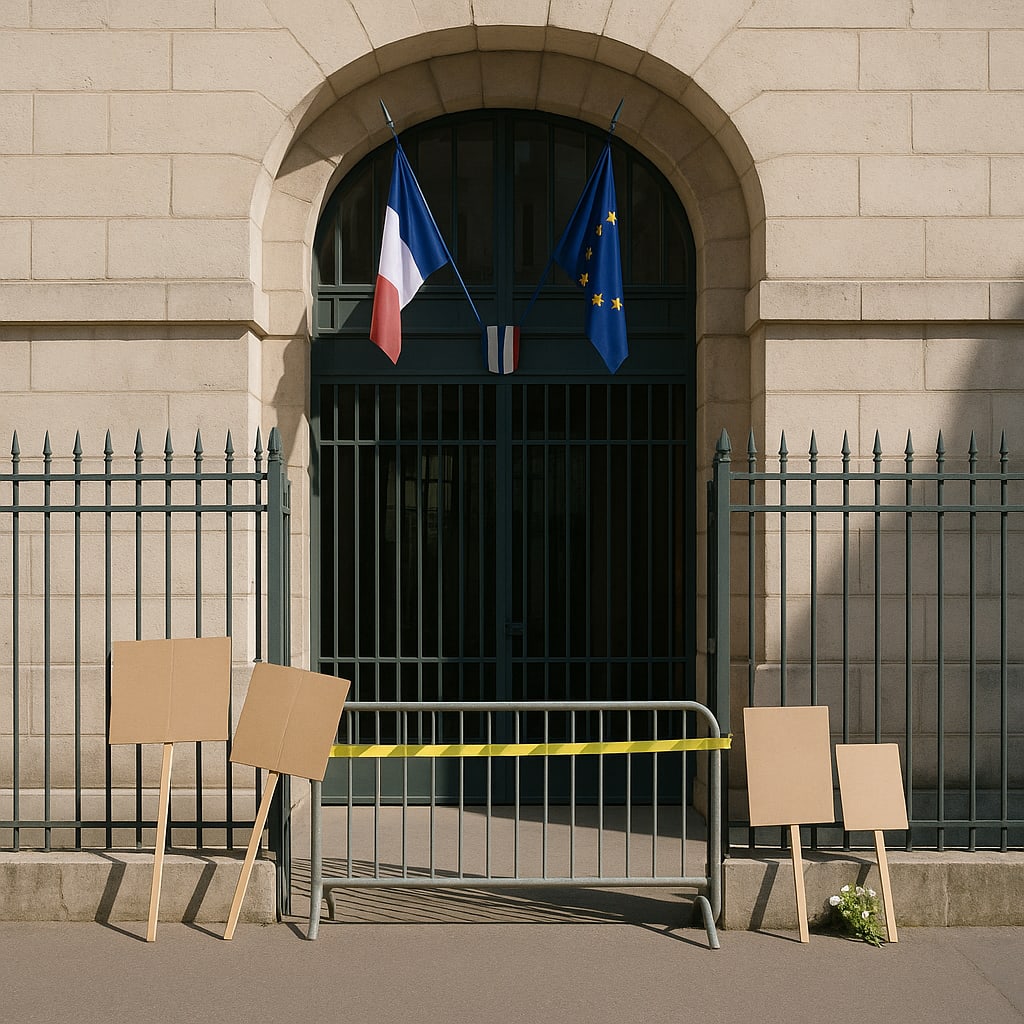
France temporarily suspends police stun grenades at high‑school protests after Lens injury
Narrative Snapshot
Across outlets, there is broad agreement that Interior Minister Laurent Nuñez has ordered a temporary halt to police use of stun grenades at high-school demonstrations, in direct response to a 15-year-old losing a hand during a protest in Lens. French reporting adds institutional texture and specificity: Le Monde highlights 18 internal investigations now open by the police and gendarmerie inspectorate and notes the minister’s refusal to apologize, while a separate Le Monde explainer identifies the EF-SON device involved as produced by Alsetex, a longstanding supplier to the Interior Ministry. Anglo-European outlets center the pause within mounting allegations of police brutality and note a forthcoming address by Prime Minister Sébastien Lecornu.
International coverage largely aligns on the measure’s limited scope—“in the context of the high-school students’ movement”—and its provisional nature pending clarification of events, but framing varies. Some headlines describe a “suspension” or “halt,” while Clarin characterizes it as a “prohibition,” and Tehran Times situates the episode within a narrative of “brutal repression.” RT and The Guardian foreground the severity of the Lens injury with graphic or detailed accounts; BBC, DW, and Folha emphasize rising complaints of disproportionate force.
What is most at stake differs by outlet. French and regional European reporting pairs the policing decision with the political calendar—Lecornu’s speech and the education funding demands drawing large crowds—while SCMP quantifies immediate operational impact with hundreds of school closures and new marches planned. Telesur injects movement scale (a reported 256,000 in a nationwide mobilization) and additional injury claims involving minors, underscoring the human cost theme that underpins much of the international focus.
What Happened
Interior Minister Laurent Nuñez announced a temporary suspension of police use of stun grenades “in the context of the high-school students’ movement,” after a 15-year-old protester in Lens lost a hand during clashes on Monday, October 5. He said the measure would remain in place while authorities establish what happened, a formulation echoed in multiple outlets. Le Monde reported that 18 investigations by the General Inspection of the National Gendarmerie and Police have been opened and that the minister declined to apologize; it also noted more than 200 injured high-school students since the start of the movement. Le Monde identified the implicated device as the EF-SON, manufactured by Alsetex. BBC, DW, France 24, and others situate the decision amid growing accusations of police brutality. Al Jazeera and DW note that Prime Minister Sébastien Lecornu is set to address the nation following large rallies demanding more education funding.
Why It Matters
The suspension touches three policy arenas at once: public-order policing doctrine, youth safety in protest settings, and the government’s response to education-sector mobilization. A device-specific, context-limited pause—rather than a blanket ban—signals an attempt to calibrate force options under scrutiny while internal oversight proceeds, as evidenced by the 18 inspectorate probes reported by Le Monde. Identification of the EF-SON and its manufacturer, Alsetex, places procurement and equipment standards within the frame, potentially influencing future crowd-control toolkits and national guidance on “less-lethal” munitions. International reporting that foregrounds allegations of excessive force underscores reputational and rights-risk considerations for French authorities at a time of sustained demonstrations. With Lecornu’s address following rallies over education funding, the policing decision intersects directly with policy concessions or reforms the government may contemplate to address the protests’ root demands.
Diverging Narratives
Outlets uniformly report a halt, but diverge on its characterization and scope. French and UK sources specify a temporary suspension limited to high-school protests, “until we know what happened.” By contrast, Clarin’s headline describes a prohibition without detailing the limitation to student-led events. Attribution of the Lens injury varies in certainty and detail: The Hindu cites a “strong possibility” a stun grenade caused the teenager’s injury; Telesur, citing a police union source, reports the boy picked up a dispersal grenade; RT relays an official saying the hand was “apparently” severed by a police grenade. On accountability, Le Monde notes Nuñez’s refusal to apologize even as inspectorate cases mount, while Telesur reports the government has rejected claims of repression amid large turnouts. Injury counts are presented at different levels of aggregation: The Guardian references “hundreds” of injuries during the protests, whereas Le Monde specifies more than 200 injured high-school students. The breadth of the movement is likewise framed differently—SCMP stresses operational disruption with over 500 schools closed and fresh marches scheduled, while Telesur cites a 256,000-strong mobilization—shaping distinct readings of protest momentum and state response.
What Happens Next
Key decision points are clustered around investigations, policy signaling, and protest dynamics. First, the 18 inspectorate inquiries will determine whether the EF-SON’s deployment complied with existing rules and will inform whether the suspension remains confined to student protests or is extended or formalized; watch for findings that clarify causality in the Lens case and any subsequent guidance from the Interior Ministry. Second, Prime Minister Lecornu’s address, prompted by mass rallies over education funding, is a hinge for de-escalation or further mobilization; analysts should track whether he outlines funding commitments or maintains the current stance noted by outlets that reported government rejection of repression claims. Third, with SCMP reporting over 500 school closures and unions preparing new marches, the scale and tactics of upcoming demonstrations will test the suspension’s operational impact; monitor whether authorities broaden restrictions or adjust crowd-control posture in response to any renewed clashes or injuries.