
French high school protests persist despite government pledges, with policing tactics under scrutiny
Narrative Snapshot
Across French and international outlets, coverage converges on the scope and persistence of a youth-led movement centered on school conditions, while diverging on causes, characterization of unrest, and political stakes. French and European reporting emphasizes the breadth and mostly peaceful nature of mobilization interspersed with clashes. Le Monde describes a nationwide “Act IV” that remained largely calm before late-day incidents, noting sustained participation from Paris to Marseille and Lyon. France24 repeatedly documents large turnouts, school closures, and continuing blockades, while The Guardian highlights students’ insistence on “concrete measures” and reports of hundreds injured over 10 days.
Anglophone and international outlets frame the political and institutional context differently. The New York Times depicts a resurgent far left seeing both opportunity and risk in the movement, while noting a government narrative that blames far-left actors for fanning unrest. The South China Morning Post stresses a structural tension between demands for investment in public services and a government facing bond-market pressure to rein in debt and deficits, a constraint largely absent from street-level accounts.
Treatment of policing varies markedly. Multiple European outlets report tear gas and baton use at Paris’s Bastille and in cities like Lyon, Nantes, and Strasbourg. CGTN centers on the government’s suspension of stun grenades after a teenager’s severe injury and on Prime Minister Sébastien Lecornu’s promise to deliver a funded plan by the end of October. ANSA adds that UNICEF is monitoring police conduct. By contrast, Fox News foregrounds violence, alleged far-left and radical Islamist involvement, and links the unrest to immigration politics; RT amplifies large arrest tallies tied to specific protest peaks; and Telesur emphasizes repression and higher cumulative detention figures while framing emergency education hires as insufficient.
With elections approaching, French outlets probe partisan positioning. France24 asks how parties are calibrating their responses; Folha de S.Paulo questions whether the familiar claim that protest disaffection automatically redounds to the far right’s electoral benefit actually fits this moment. The most immediate stakes, however, are administrative capacity and fiscal prioritization: whether the government can credibly finance near-term fixes and policing norms acceptable to students and rights monitors while stabilizing schools that protesters describe as deteriorating.
What Happened
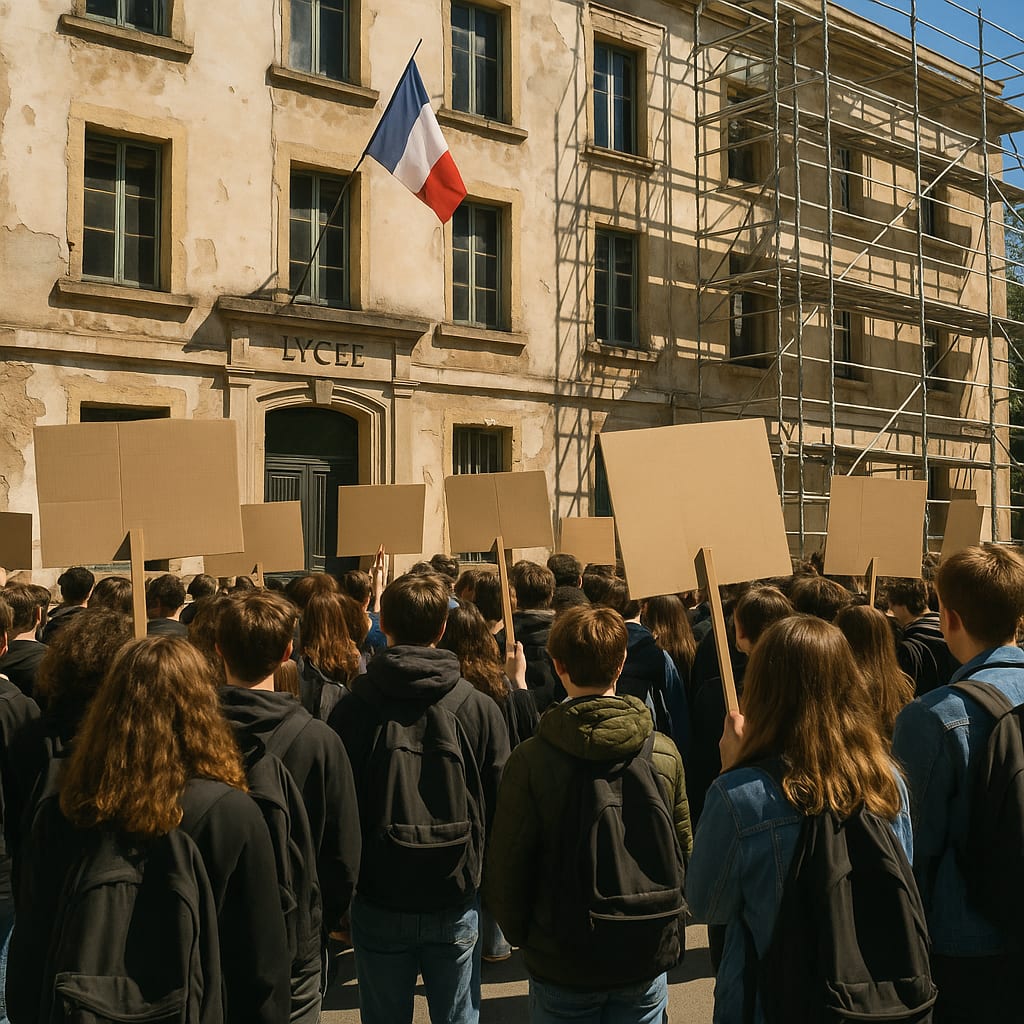
High school students in France have staged three weeks of protests over dilapidated facilities, teacher shortages, and police tactics, blockading campuses and marching in cities including Paris, Lille, Rennes, Nantes, Lyon, Toulon, Marseille, and Strasbourg. France24 reported at least 375 schools fully or partially closed during one day of action and 71,500 participants nationwide on another, with police detaining more than 500 people. The Guardian and Deutsche Welle documented tear gas and baton use in Paris; Italian outlets shared footage of clashes at Bastille and police charges in Lyon. After a teenager lost a hand, the government suspended stun grenades and Prime Minister Sébastien Lecornu pledged a funded plan by end-October. Education Minister Édouard Geffray announced 3,000 substitute hires within days, which student groups called inadequate. The New York Times reported government accusations that far-left leaders are stoking unrest, as those leaders openly back the students.
Why It Matters
The protests place France’s education system and public-order doctrine under simultaneous strain while exposing fiscal trade-offs. The South China Morning Post underscores that protesters’ demands for investment collide with a “cash-strapped” government under bond-market pressure to reduce deficits, raising questions about the pace and funding of rehabilitation and staffing. CGTN reports Lecornu’s pledge of “concrete, quick and fully funded answers,” but specifics were deferred, making budget credibility central. Street-level policing is an immediate governance test: multiple outlets report forceful crowd control; CGTN notes the stun-grenade pause after a catastrophic injury; ANSA says UNICEF is monitoring police conduct, elevating scrutiny beyond domestic forums. Politically, France24 highlights parties maneuvering as elections near, and the New York Times details how far-left engagement presents both mobilization potential and co-option risks. For decision-makers, the durability of the movement will hinge on whether near-term measures demonstrate institutional capacity to deliver without undermining fiscal targets or civil liberties.
Diverging Narratives
Interpretations split along at least three axes. First, the nature of the protests: Le Monde and The Guardian depict broad, largely peaceful mobilization punctuated by end-of-day incidents; Deutsche Welle and Italian outlets focus on repeated clashes and tear gas; Fox News frames “riots” driven by an “unholy alliance” of far left and radical Islamist groups, while the New York Times reports the government’s accusation that far-left actors are seeking political gain even as it notes those leaders’ overt support. Second, policing and rights: CGTN highlights policy restraint with the stun-grenade suspension and pledges of funded solutions, while several European outlets document aggressive tactics; ANSA’s reference to UNICEF monitoring adds an external check that other outlets omit. Third, scale and severity: France24 cites 71,500 participants and over 500 detentions on a single day; RT reports 1,949 arrests during a peak day; Fox News relays roughly 2,000 arrests by early October; Telesur cites 5,000 detentions through October 5 and 6,600 by October 9, attributing the bulk to minors, and stresses repression. Finally, structural framing: SCMP centers fiscal constraints and bond markets; Folha de S.Paulo questions assumptions that unrest mechanically advantages the far right, a note that contrasts with Fox News’ linkage to immigration politics.
What Happens Next
Three decision points will shape trajectories. First, the government’s policy package: Lecornu promised end-October proposals on facility rehabilitation and staffing, while Geffray’s immediate 3,000 substitute hires drew student rejection as insufficient. Analysts should watch whether measures specify timelines, funding sources, and deployment, and whether they address both infrastructure and substitute pipelines as reported by CGTN and Telesur. Second, policing doctrine: the stun-grenade suspension and reports of tear gas and baton use create a test of de-escalation. Signals include whether the suspension becomes a sustained policy shift, incident trends at focal sites like Bastille, and any findings or statements from UNICEF noted by ANSA. Third, political positioning ahead of elections: France24 flags party reactions; the New York Times and Fox News capture competing frames about far-left roles. Track whether parties convert street demands into legislative proposals or intensify blame narratives, and whether participation levels reported by France24 rise or fall in response.