
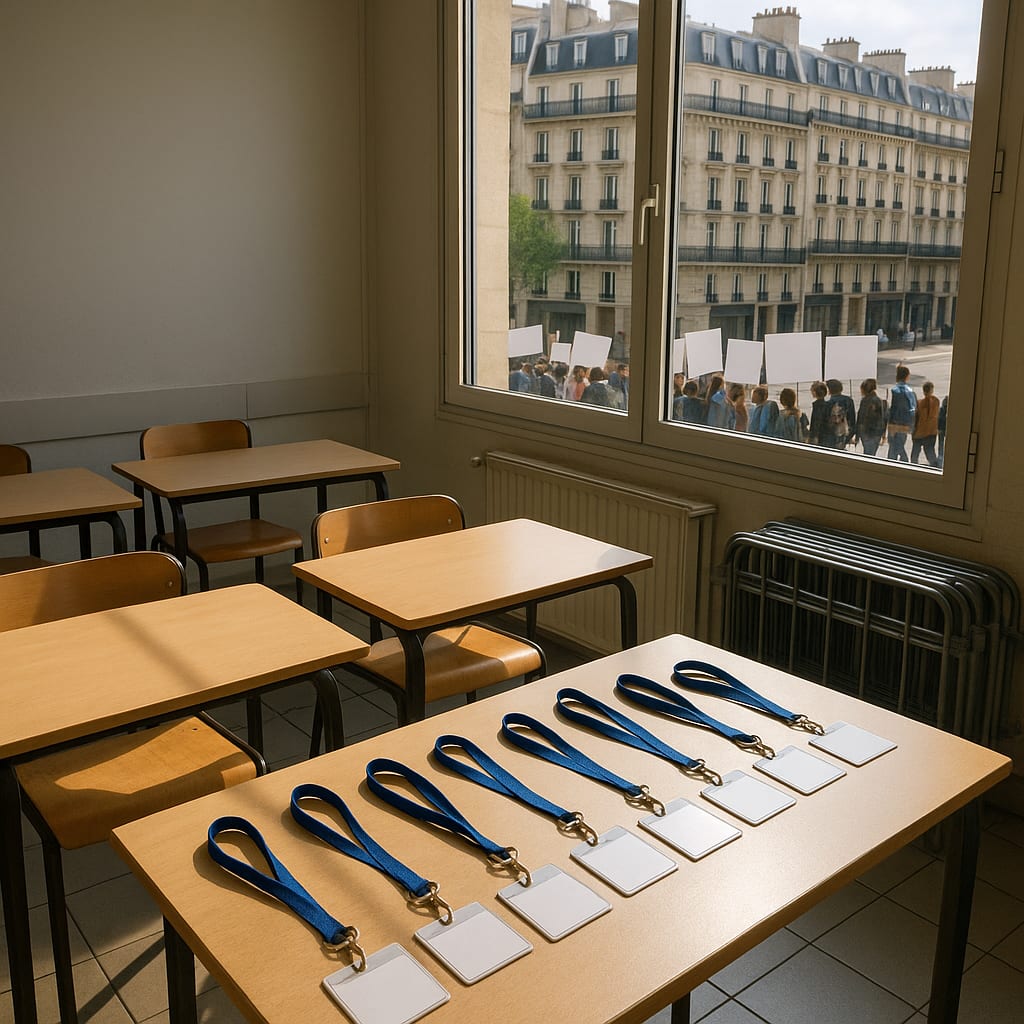
French student protests harden as government pledges 3,000 substitute teachers and curbs crowd-control weapons
Narrative Snapshot
Across outlets, there is broad agreement that the mobilization is nationwide, student-led, and disruptive to secondary education, with repeated reports of blocked school entrances, campus shutdowns, and large marches in major cities. French sources anchor the coverage with official tallies and policy steps: Le Monde cites 71,500 demonstrators nationwide on Thursday with 504 arrests and 48 injured officers, while France24 reports 141 high schools still closed on Friday and student-teacher unions calling new strikes next Tuesday. Multiple international outlets converge on the same street-level scenes in Paris and other cities—tear gas, water cannons, baton charges—linking them to demands for more teachers and funding.
Where coverage diverges most is on scale, causality, and policing. Arrest and closure counts vary by source and time: Fox News reported about 2,000 arrests by October 2 and roughly 400 schools shuttered; Telesur later cited at least 6,600 arrests and more than 500 high schools affected; ANSA and France24 relayed lower, more current closure figures tied to specific days. On drivers, French and Anglo-American outlets foreground underfunding, teacher shortages, and decrepit facilities; the New York Times also highlights the far left’s bid to channel the unrest and the government’s accusation of opportunism. Al Jazeera and Middle East Eye frame a generational crisis with echoes of 1968, while the South China Morning Post emphasizes the fiscal constraint facing a government under bond-market pressure.
Policing is treated as both an immediate operational challenge and a legitimacy test. European and U.S. outlets document the repeated use of tear gas and charges at Place de la Bastille and elsewhere. CGTN focuses on the suspension of stun grenades after a 15-year-old’s severe injury and on the government’s pledge to table proposals at month’s end, while ANSA adds that UNICEF is monitoring police conduct. France24 notes that elite universities are increasingly backing the students, and Folha de S.Paulo spotlights the political visibility of local left officials intervening at protests, underscoring how the street dynamic is bleeding into institutional and electoral arenas.
What Happened
High school students orchestrated blockades and marches nationwide into a third week, with riot police deployments and recurrent clashes. On Thursday, the Interior Ministry counted 71,500 demonstrators, including 24,500 in Paris, alongside 504 arrests and 48 injured officers, according to Le Monde. Police used tear gas, water cannons, and batons in Paris and other cities, including at Place de la Bastille, as reported by Al Jazeera English, Deutsche Welle, NBC News, and Italian outlets. The Education Ministry said teaching was fully or partly suspended in 375 schools on Thursday (ANSA), while 141 high schools remained closed Friday (France24). In response, Education Minister Édouard Geffray pledged 3,000 substitute teachers to be deployed between Friday and Tuesday (Le Monde; Japan Times), and the government paused stun grenades after a 15-year-old was gravely injured (CGTN). Student and teacher unions announced further strikes next Tuesday (France24).
Why It Matters
The confrontation tests France’s state capacity in a core public service amid administrative and fiscal constraints. The government’s plan to dispatch 3,000 substitutes—some identified as idle due to inefficient past assignment processes—points to systemic matching failures beyond headline shortages (Japan Times). Simultaneously, the South China Morning Post situates demands for investment against a cash-strapped government under bond-market pressure to cut debt and deficits, highlighting a classic allocative trade-off likely to shape any end-of-October proposals promised by the prime minister (CGTN). Crowd-control choices carry human-rights and reputational stakes: the stun-grenade pause after a teenager’s severe injury (CGTN) and UNICEF’s monitoring of police conduct (ANSA) place policing under international scrutiny. Historically resonant frames from Al Jazeera English and the New York Times underscore the potential for student mobilizations to catalyze broader coalitions, especially as elite universities align with protesters (France24), elevating the policy urgency for decision-makers.
Diverging Narratives
Scale and severity are contested across time and outlets. French authorities’ day-specific counts—71,500 demonstrators, 504 arrests Thursday (Le Monde)—sit alongside earlier and higher movement-wide arrest totals from Fox News (about 2,000 by Oct. 2) and later, much higher figures from Telesur, which cites at least 6,600 arrests and over 500 schools affected across weeks of unrest. School closure snapshots likewise differ: ANSA reports 375 schools where teaching was suspended on Thursday; France24 lists 141 high schools closed on Friday; CGTN notes more than 500 closed a day after earlier demonstrations. These discrepancies reflect differing reference periods and definitions rather than a single reconciled measure.
Causal framing also splits. The Guardian, the New York Times, and The Hindu emphasize material grievances—teacher shortages, dilapidated buildings, and absent staff—while the New York Times adds a political lens, with far-left leaders encouraging the movement and officials accusing them of stoking it for gain. Al Jazeera English and Middle East Eye stress generational precarity and 1968 analogies; the South China Morning Post highlights macro-fiscal limits. On policing, European and U.S. outlets document forceful tactics; CGTN centers the policy shift suspending stun grenades after a serious injury; ANSA flags UNICEF’s oversight. France24’s “first win” framing of the substitute-teacher pledge coexists with messages that protest leaders deem concessions insufficient and will escalate with new strikes.
What Happens Next
Two implementation tracks will shape momentum. First is delivery on the education side: Geffray’s promise to deploy 3,000 substitutes between Friday and Tuesday (Le Monde; France24; Japan Times). If placements materialize at scale, closures reported by France24 and ANSA are a key indicator to watch; if gaps persist, student and teacher unions’ announced strikes next Tuesday (France24) are positioned to expand. Second is policing posture after the stun-grenade pause (CGTN). Further restrictions or new incidents—such as the severe injury already reported—will influence legitimacy debates, including UNICEF’s monitoring (ANSA). Analysts should also track the prime minister’s end-of-October package (CGTN) for specificity, funding, and timelines against the South China Morning Post’s fiscal constraint frame. Political signals matter as well: backing from elite universities (France24), far-left engagement and government pushback (New York Times), and the prominence of local officials at protests (Folha de S.Paulo) will indicate whether the movement remains sectoral or broadens.