
French high school protests over dilapidated classrooms draw UN concern and police investigations
Narrative Snapshot
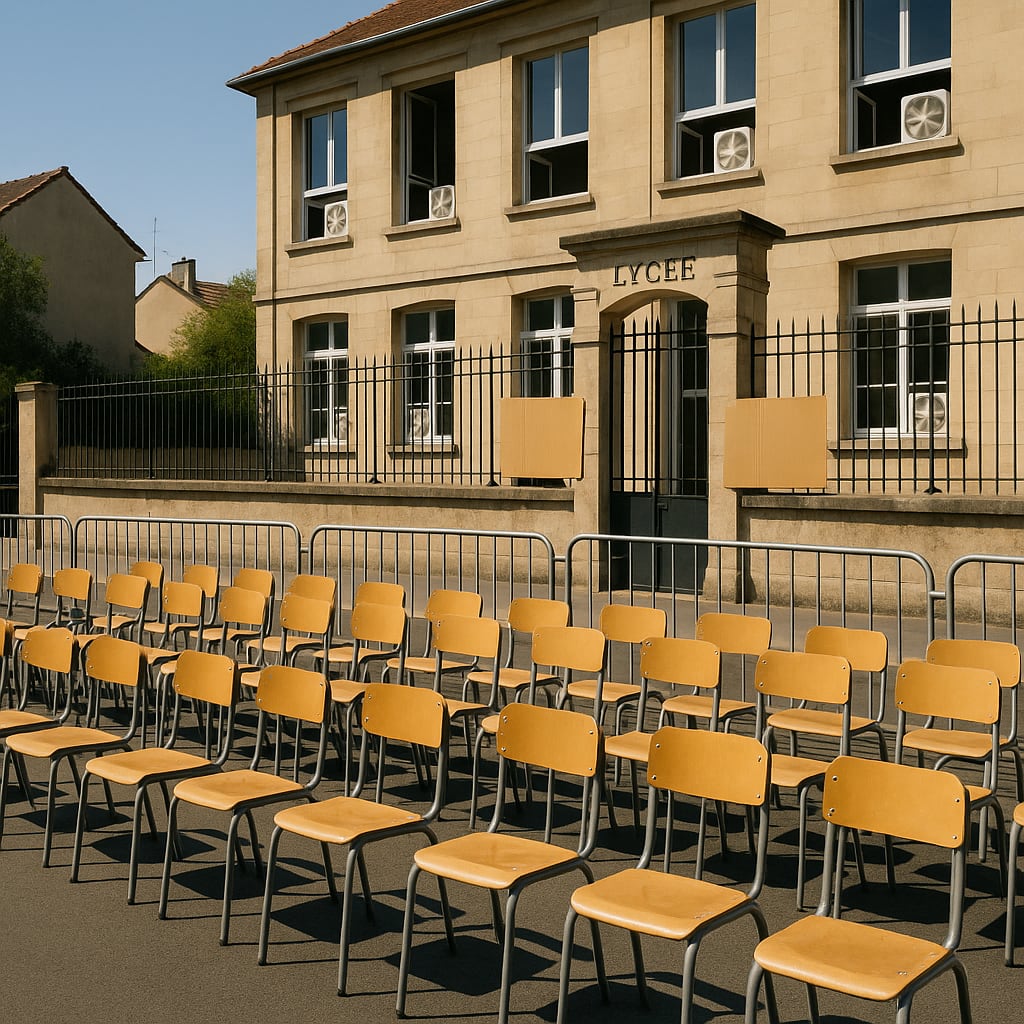
Across outlets, there is broad agreement on the proximate drivers: students cite missing teachers, overcrowded timetables and classrooms, decaying buildings, and heat that existing facilities cannot handle. Reporting from India’s The Hindu details absent staff, overloaded schedules, and infrastructure unsuited to rising temperatures, while the Guardian’s on-the-ground account from a Paris banlieue describes packed rooms, a shortage of desks and chairs, and heatwaves that made learning impossible. German public broadcaster DW and Fox News align on a distributional critique: France’s education system spends heavily overall, but relatively little reaches infrastructure. DW frames this as a fairness problem, while Fox highlights ministry figures showing a large share to salaries and a small share to investment.
Where coverage diverges is on violence and policing. France 24 reports 24 internal investigations into protest-linked incidents and renewed calls to end rubber-bullet launchers criticized by UN experts and rights groups. The Hindu notes UN concern over violence. Russian and US outlets emphasize disorder and escalation: RT foregrounds riot police using tear gas, water cannon, and batons amid clashes, while Fox amplifies claims that political actors are exploiting genuine anger. French and Russian wires register countervailing signals: Le Monde stresses that most blockades are non-violent even as some schools face unprecedented vandalism and threats to principals, and TASS cites AFP on a recent decline in protest intensity alongside an estimated €30 million in damage.
Narrative texture also varies. BBC interprets the student mobilization as a focal point of polarized politics and attitudes toward police. Al Jazeera’s note of NBA player Victor Wembanyama expressing solidarity injects a cultural endorsement, while Italy’s ANSA highlights a viral clip of a police officer performing a haka, an unusual moment of de-escalation within a fraught environment. Le Monde situates the movement within a wider national strain marked by debt, inflation pressure, housing and employment concerns, and climate impacts on agriculture.
What Happened
A high-school protest movement that began in mid-September at a Créteil lycée over unfilled teaching posts spread nationwide, with students demanding smaller classes, improved facilities, and more funding, RT reports. Complaints center on absent teachers, overloaded timetables, and dilapidated classrooms unable to cope with heatwaves, according to The Hindu and the Guardian. Police responses in Paris and elsewhere have included tear gas, water cannon, and baton charges, RT notes, with severe injuries prompting 24 investigations by the IGPN police watchdog and renewed calls to scrap launcher-fired rubber bullets, France 24 reports. The Hindu says the UN has voiced concern about violence. TASS, citing AFP, puts property damage at €30 million and notes officials have seen a decline in protest intensity. DW underscores that although France spends heavily on education, critics say funds are distributed unfairly; Fox News cites ministry data showing just 8.5% goes to investment.
Why It Matters
The disputes crystallize longer-running structural pressures on France’s social model: a high-spending system confronting distributional trade-offs, rising debt service costs, and infrastructure needs raised by climate stress. DW’s and Fox’s accounts converge on a core policy dilemma—operating costs dominate education budgets while capital investment lags—mirroring students’ demands for physical upgrades documented by the Guardian and The Hindu. Police tactics are now subject to formal scrutiny, with 24 IGPN probes and rights-based objections to rubber bullets reported by France 24, situating France within a wider European debate over crowd-control norms and accountability. UN concern flagged by The Hindu elevates human-rights and policing standards to the multilateral arena. Le Monde’s framing of parallel crises—debt, purchasing power, housing, and employment—underscores how education unrest intersects with fiscal consolidation and social cohesion, while BBC’s emphasis on polarization highlights risks to political legitimacy as authorities balance deficit targets, union opposition to cuts reported by RT, and student safety.
Diverging Narratives
Outlets differ on causality, proportionality, and momentum. The Hindu and the Guardian foreground concrete deficiencies—missing teachers, overcrowding, and heat—while RT ties the movement to broader anger over underfunding and proposed budget cuts, and Fox amplifies a view that political actors are organizing violence atop legitimate grievances. Assessments of protest character vary: Le Monde reports most blockades remain incident-free even as some schools see unprecedented vandalism and threats to principals; RT centers on street clashes and heavy police tactics; TASS relays AFP’s estimate of €30 million in damage but also a recent decline in intensity. On policing, France 24 and The Hindu highlight severe injuries, formal investigations, and calls to scrap rubber-bullet launchers criticized by UN experts, whereas RT’s footage-driven narrative emphasizes forceful crowd control without engaging oversight debates. Investment narratives also diverge: DW argues France’s high education spend masks unfair distribution, while Fox cites ministry data showing the bulk devoted to salaries and only a fraction to infrastructure—distinct emphases that converge on the capital shortfall students describe.
What Happens Next
Several decision points emerge. First, policing policy: outcomes of the 24 IGPN investigations reported by France 24, and any interior ministry response to renewed calls to end rubber-bullet launchers, will signal whether crowd-control norms shift or current equipment remains in service. Second, protest dynamics: The Hindu reports students planning fresh actions even as TASS cites officials noting declining intensity; turnout patterns and the spread beyond initial hotspots will indicate whether mobilization persists or ebbs. Third, budget allocation: DW’s fairness critique and Fox’s investment share figures frame a test for the education ministry—whether to reweight spending toward infrastructure and address teacher absences. Signals to watch include draft budget lines, union responses to proposed cuts flagged by RT, and targeted facility upgrades in heat-exposed schools described by the Guardian. Finally, school-level continuity: Le Monde’s accounts of exhausted principals facing threats elevate the question of reopening protocols and protection measures needed to sustain in-person learning without renewed vandalism.