
India detains thousands and restricts Delhi amid youth-led protests over voter roll changes
Narrative Snapshot
Across outlets, there is broad agreement on the scale of India’s security response and the centrality of the voter list revision to the unrest. International wires and broadcasters consistently report mass detentions, preemptive arrests of protest leaders, and heavy deployments across the capital, with measures ranging from sealing off protest sites to suspending mobile internet and closing metro stations and markets in central Delhi (New York Times, BBC, CGTN citing Reuters, Japan Times, The Guardian). Several European outlets characterize the mobilization as a generational challenge to Prime Minister Narendra Modi, with the authorities seeking to head off a large youth turnout (Le Monde, New York Times).
Where coverage diverges is in emphasis. Some reports foreground the administrative and legal framing—an unauthorized demonstration, reinforced perimeters, and preemptive policing—while still noting the breadth of detentions (Folha de S.Paulo; La Repubblica; BBC). Others concentrate on rights implications, citing allegations of heavy-handed tactics by police and claims that the voter roll changes disproportionately affect Muslims and other minorities (France24; Bangkok Post). Chinese and Hong Kong-based outlets carry granular operational details, including anonymous official tallies and shutdowns, while also amplifying a UN human rights call for “meaningful dialogue” (CGTN citing Reuters; South China Morning Post).
Technology is a through-line. One strand documents state surveillance—facial recognition, social media analysis, and tracking of previously identified protesters—deployed to anticipate and disrupt mobilization (Telesur English). Another highlights civic-tech countermeasures, such as an AI-powered app designed to help detained protesters navigate release and return home (Al Jazeera English). Together, they frame a contest over assembly and accountability shaped by digital tools, logistics control, and rapid legal interventions.
What Happened
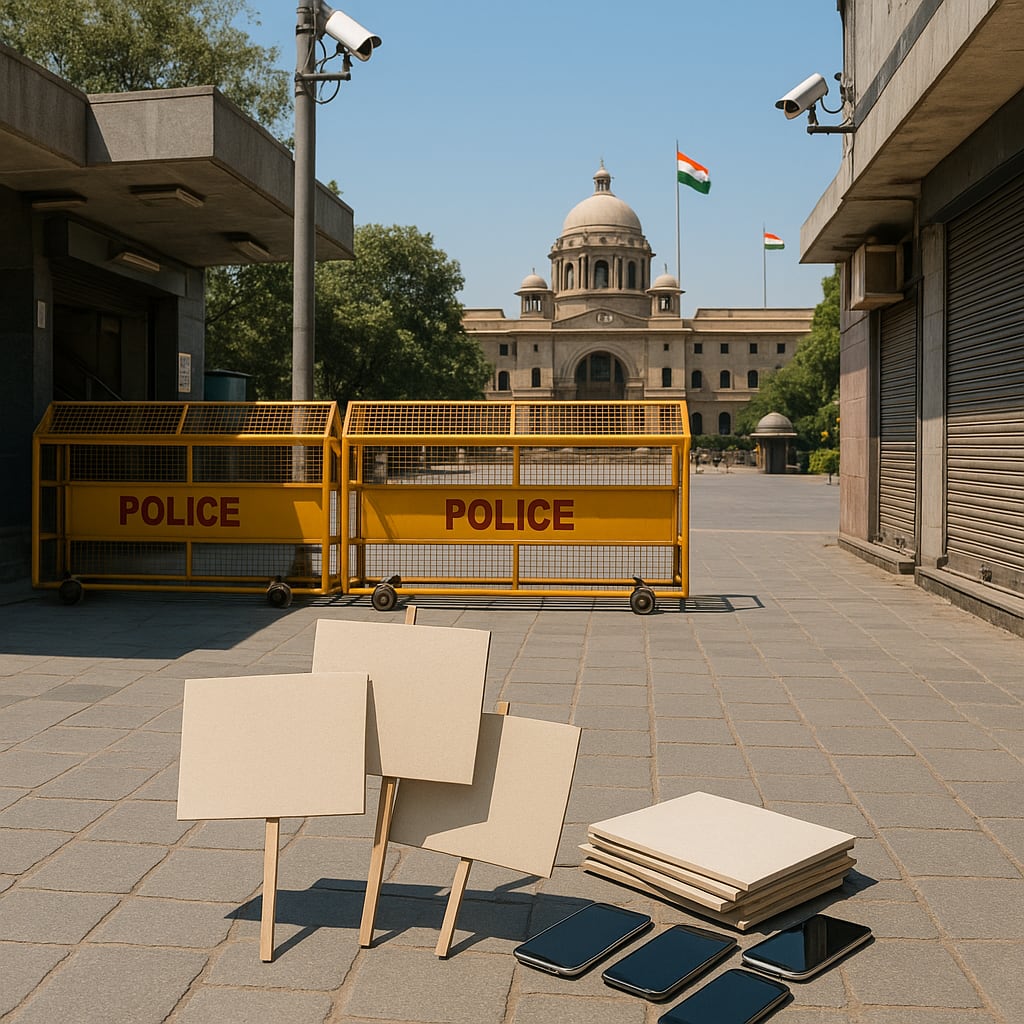
Following near-daily demonstrations since early October demanding the resignation of Chief Election Commissioner Gyanesh Kumar over a contentious voter list revision, Indian authorities moved to prevent a mass rally planned by the youth-led Cockroach Janta Party in New Delhi (France24, Oct. 6; CGTN citing Reuters). On October 10, police and paramilitary forces locked down parts of the capital, sealing Jantar Mantar, deploying thousands, barricading roads, closing metro stations, and suspending mobile internet in the central district; markets were also shut (BBC; The Guardian; Japan Times; CGTN citing Reuters). Authorities detained more than 2,000 people in Delhi and about 400 in Mumbai, including CJP founder Abhijeet Dipke, before a court ordered the release of Dipke and two other leaders on October 11 (CGTN citing Reuters; South China Morning Post; New York Times; BBC). Opposition figures, including Rahul Gandhi, urged continued protest and announced a march to the Supreme Court (ANSA; La Repubblica; The Guardian; Al Jazeera English).
Why It Matters
The confrontation places India’s election administration and the integrity of the franchise under scrutiny at a moment of sustained youth mobilization. Multiple outlets report that critics view the voter list revision as benefiting the ruling Bharatiya Janata Party, with concerns that changes disproportionately impact Muslim and other minority voters, elevating questions about equitable access to electoral participation and the perceived impartiality of the Election Commission (CGTN citing Reuters; France24, Oct. 12). The state’s response—preemptive detentions, movement restrictions, and targeted digital surveillance—highlights evolving protest-control practices that combine physical lockdowns with data-driven monitoring (BBC; The Guardian; CGTN citing Reuters; Telesur English). For decision-makers in governments and multilateral bodies, the UN human rights appeal for “meaningful dialogue” underscores the salience of international norms on peaceful assembly and due process (CGTN citing Reuters). The episode also signals the organizational capacity of a digitally native cohort to sustain contention even amid arrests and shutdowns (Le Monde; Japan Times; Al Jazeera English).
Diverging Narratives
Accounts differ on framing and implications rather than the basic facts of the crackdown. Several outlets underscore the state’s law-and-order rationale, noting the demonstration was called without authorization and describing the extensive security perimeter and transport closures as preventive measures to avert disorder (Folha de S.Paulo; BBC; Japan Times). Others center claims of excessive force and civil liberties concerns, citing accusations by opposition leaders and journalists of police abuses during the operation and emphasizing the scale and preemptive nature of the detentions (Bangkok Post; France24, Oct. 12; New York Times).
On the electoral issue, reporting is aligned that the voter roll revision is the core grievance, but differs in emphasis. Some focus on partisan advantage—critics saying the changes benefit the BJP—while others highlight the potential disenfranchisement of minorities (CGTN citing Reuters; France24, Oct. 12). Technology is portrayed both as a tool of state control—via facial recognition, social media analysis, and monitoring of 2,800 previously identified protesters—and as an enabler of protest resilience through civic-tech applications and preplanned leadership succession communicated by video (Telesur English; Al Jazeera English; France24, Oct. 10). International reaction appears limited but notable, with a UN spokesperson urging dialogue, a point more visible in some Asian state media than in Western coverage (CGTN citing Reuters).
What Happens Next
Two immediate decision points shape the trajectory. First is whether authorities permit or impede the opposition’s plan to march to the Supreme Court seeking the election chief’s removal, and how courts respond to any petitions or custody cases that emerge. The weekend’s detentions followed by judicial releases indicate legal contestation will continue; further rulings on protest-related arrests or access restrictions would signal the institutional balance at play (South China Morning Post; The Guardian; Al Jazeera English, Oct. 12; New York Times, Oct. 11). Second is the state’s operational posture. Renewed transport closures, additional internet suspensions, or expanded surveillance of identified networks would point to continued disruption strategies, while any engagement aligned with the UN’s call for dialogue would indicate a shift (CGTN citing Reuters; Telesur English). Analysts should track Election Commission communications, opposition mobilization capacity after leader releases, and protest spillovers beyond Delhi, including detentions reported in Mumbai (CGTN citing Reuters).