
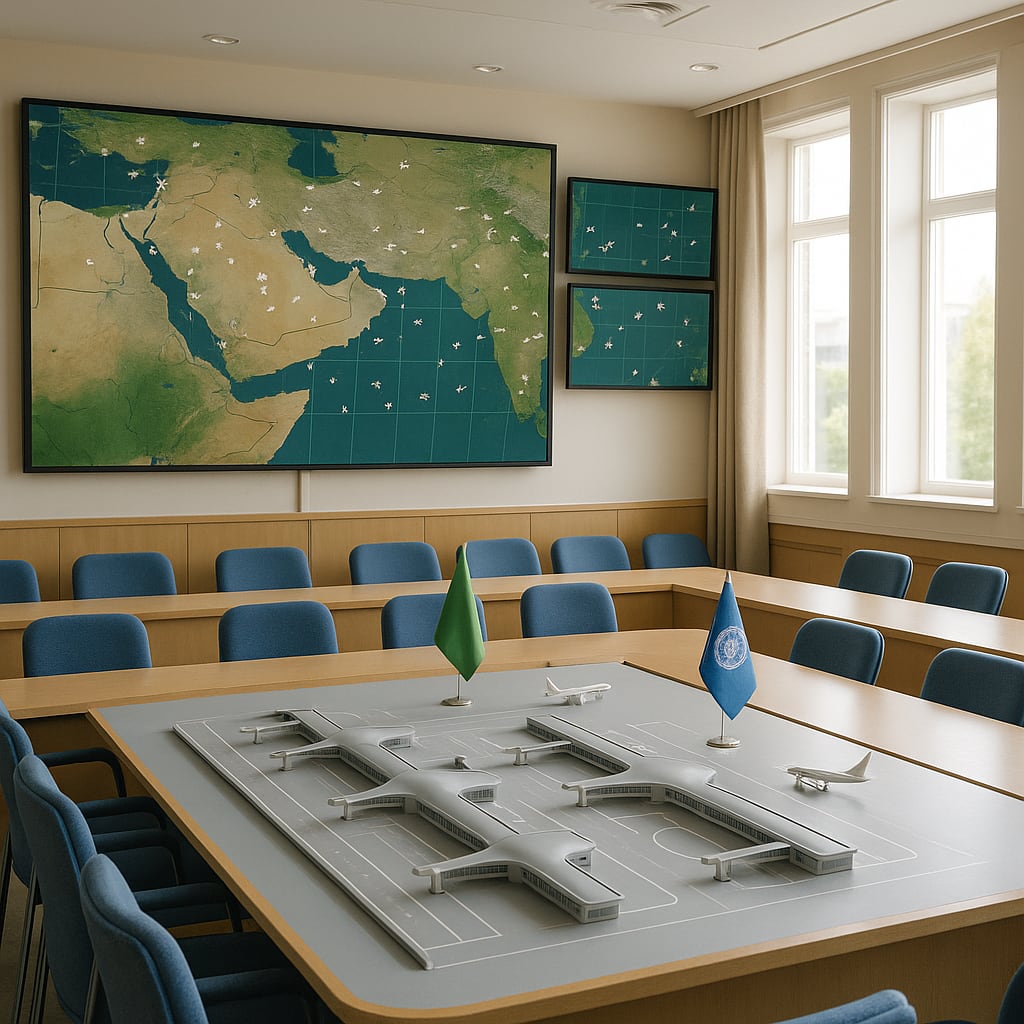
Deadly Riyadh airport strikes prompt Saudi retaliation, Houthi airspace threats, and global warnings
Narrative Snapshot
Across outlets there is broad agreement that Riyadh’s King Khalid International Airport suffered a lethal strike on Saturday followed by another attack on Sunday, with Saudi authorities reporting 12 dead and more than 300 injured from the first incident and one death and 11 injuries from the second (France24; Le Monde; Al Jazeera English; TASS; Bangkok Post). Coverage also aligns that Dammam’s King Fahd International Airport was hit the same day as the second Riyadh incident (CGTN; Deutsche Welle).
Where reports diverge is in attribution and framing. The Saudi-led coalition initially described Sunday’s incident as an “unidentified projectile,” while the Houthis claimed responsibility for multiple operations and warned that Saudi airspace is a theater of operations, exempting only Mecca and Medina (Middle East Eye; The Guardian live; Times of Israel; CGTN). Iranian and Russian outlets leaned into the disruption—Tehran Times highlighted flights halted and evacuation, while RT specified foreign national casualties, including an American, and combined weekend totals (Tehran Times; RT). Western and regional outlets emphasized policy ramifications: the Guardian and Haaretz reported President Donald Trump is weighing joining Saudi strikes; Al Jazeera English and The Hindu focused on travel advisories and consular guidance; Clarin underscored UN/EU condemnation to protect civilian infrastructure; Middle East Eye documented a joint Pakistan–Saudi–Egypt–Turkey statement demanding an end to Houthi attacks and later noted an Iranian–Saudi call in which Tehran urged dialogue (The Guardian; Haaretz; Al Jazeera English; Clarin; Middle East Eye).
The stakes identified across coverage center on aviation safety, escalation dynamics between Saudi Arabia and the Houthis amid a wider regional confrontation involving Iran referenced by several outlets, and potential spillovers into energy security and international commercial activity in the kingdom (France24; South China Morning Post; RT; The Guardian).
What Happened
Saudi Arabia’s General Authority of Civil Aviation said a Saturday strike on Riyadh’s King Khalid International Airport killed 12 and injured more than 300, the deadliest such incident in a decade; operations were suspended and flights diverted (France24; Le Monde; New York Times). On Sunday, a second strike at the airport killed one and injured 11, and authorities also reported an attack on King Fahd International Airport near Dammam, with damage assessments under way (Al Jazeera English; TASS; Bangkok Post; CGTN). The Houthis claimed multiple missile and drone operations and warned airlines and travelers to avoid Saudi airports, exempting Mecca and Medina (The Guardian live; Times of Israel; CGTN). The Saudi-led coalition vowed a firm and “decisive” response and said it had recently struck dozens of Houthi targets in Yemen; Houthi-run and independent outlets also reported Saudi airstrikes in Sanaa, Taiz, and Saada (France24; CGTN; Middle East Eye). Travel advisories and airline suspensions followed, including EgyptAir and Kuwait Airways, with several governments urging citizens to avoid travel (CGTN; The Hindu; Al Jazeera English).
Why It Matters
The attacks push the Yemen conflict into direct confrontation with international civil aviation, intensifying legal and normative pressure to protect civilian infrastructure—an emphasis of UN/EU statements and the R4 group’s condemnation (Clarin; Middle East Eye). They also test crisis management capacity around major hubs ahead of high-profile gatherings in Riyadh flagged by regional media, with knock-on effects for investment sentiment (Haaretz). The Houthis’ “airport for airport, siege for siege” framing signals a doctrine of reciprocal targeting, while Riyadh’s pledge of a decisive response reinforces a cycle of retaliation (The Guardian live; France24). International positions are fluid: Washington is considering joining Saudi strikes, while Tehran’s foreign minister urged dialogue with Saudi Arabia (The Guardian; Haaretz; Middle East Eye). For decision-makers, the episode intersects with maritime and energy security—given Houthi claims against Aramco and prior targets—and with alliance coordination among Saudi partners issuing joint statements and travel advisories (Middle East Eye; RT; Al Jazeera English).
Diverging Narratives
Casualty accounting is largely consistent but not uniform: Saudi authorities and multiple outlets reported 12 dead and over 300 injured on Saturday and one dead and 11 injured on Sunday; others summarized at least 13 dead across the weekend or combined totals of 13 dead and about 320 injured (France24; Le Monde; Al Jazeera English; TASS; BBC News; RT). Attribution language differs: Saudi and allied reporting initially used “unidentified projectile” for Sunday’s strike and highlighted an interception, while Houthi spokesmen claimed precise missile and drone operations, casting them as retaliation to Saudi airstrikes and blockade (Middle East Eye; CGTN; RT; Middle East Eye, 6–7 Oct). Strategic framing splits as well. Western and Israeli outlets tied the escalation to potential US military involvement and to economic risk in Riyadh; Iranian and Russian outlets emphasized repeated “hits” and airport shutdowns; Chinese state media foregrounded official statements from both sides and operational impacts without policy prescriptions (The Guardian; Haaretz; Tehran Times; RT; CGTN). On regional widening, Italy’s La Repubblica flagged the risk of Pakistan and Turkey entering the conflict, while contemporaneous reporting showed those governments, alongside Saudi Arabia and Egypt, issuing a coordinated condemnation rather than signaling troop deployments; separately, RT relayed an Axios report that Syria could consider deploying forces—an unconfirmed but notable data point (La Repubblica; Middle East Eye; RT).
What Happens Next
Three decision points dominate. First, the scope and tempo of Saudi retaliation: Riyadh has signaled a “decisive” response and touted recent strikes on Houthi targets; further coalition briefings and reported strike volumes in Sanaa, Taiz, and Saada will indicate whether a sustained air campaign follows (France24; CGTN; Middle East Eye). Second, external alignment: President Trump said Washington could join Saudi strikes, while an Iranian–Saudi call featured Tehran urging dialogue; watch for US announcements on military coordination and any follow-on diplomatic contacts between Riyadh and Tehran (The Guardian; Haaretz; Middle East Eye). Third, civil aviation and commercial continuity: GACA assessments will determine when Riyadh and Dammam airports fully reopen; airlines’ scheduling decisions and additional government travel advisories will reflect perceived risk (CGTN; Al Jazeera English; The Hindu). Analysts should also track Houthi communiqués for further “airport for airport” threats and any claims against energy infrastructure, as well as whether the R4 condemnation evolves into operational coordination or remains political (The Guardian live; Middle East Eye).