
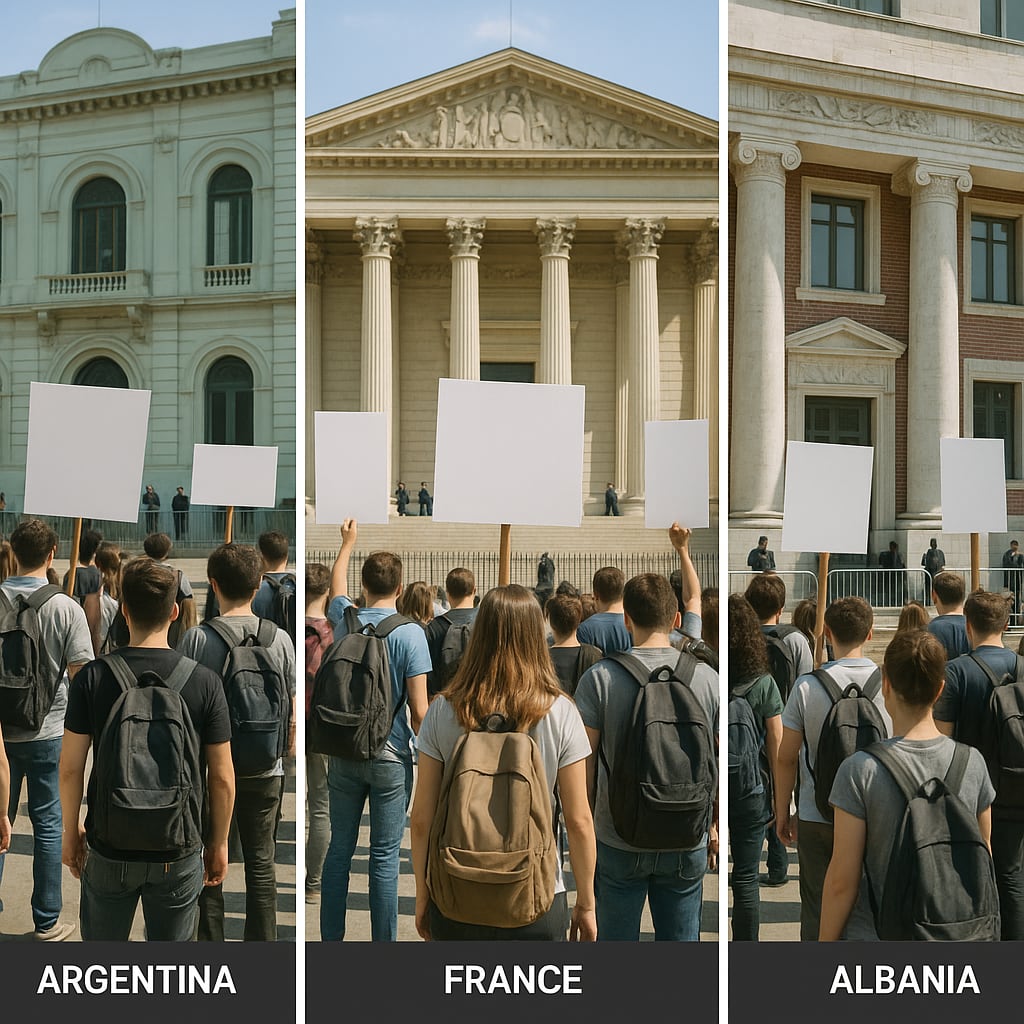
Student protests over education funding in Argentina, France and Albania trigger police crackdowns, legal battles and political backlash
Narrative Snapshot
Across outlets, there is broad agreement that education-centered mobilizations have been large, sustained, and met by force, with reporting of tear gas and water cannons in Buenos Aires, Paris and Tirana. Where they diverge is in framing agency and legitimacy. Argentine coverage splits between accounts emphasizing police repression of a “peaceful” university march demanding implementation of a legislated funding regime and salary indexation, and accounts foregrounding later “serious incidents” and officials alleging destabilization motives. The legal dimension in Argentina—injunctions, fines, and repeated government appeals—features prominently in some coverage while others center street clashes.
French reporting oscillates between public-order frames and institutional accountability. Interior Ministry turnout numbers and images of clashes sit alongside scrutiny of police tactics and formal investigations. The electoral overlay is explicit in national and international outlets, which link the protests to the presidential campaign and debate over political manipulation, while student groups’ assessment that emergency staffing measures are insufficient signals a bargaining gap.
On Albania, sources converge on the intensity of violence, arson against public buildings and banks, and calls for Prime Minister Edi Rama’s resignation. A contested point is who is being detained: police assertions that few arrestees are students contrast with on-the-ground observations that many demonstrators are teenagers. Rama’s refusal to resign anchors the government’s stance, while reporting underscores protesters’ combined grievances over deteriorating study conditions, costs, and corruption.
What Happened
In Argentina, the fifth Federal University March drew students, staff, unions and organizations to Congress to demand implementation of Law 27.795, inflation-indexed operating budgets, salaries and scholarships, and rejection of Emergency Decree (DNU) 70/23. Federal forces used tear gas and water cannons; at least 34 people were detained, amid a funding dispute marked by court orders, fines against the national government for noncompliance, and successive government appeals. Argentine outlets reported the day began peacefully before serious incidents; a senior lawmaker accused violent protesters of seeking to “destabilize.” In France, high school and university protests since mid-September prompted plans to hire 3,000 substitute teachers, while authorities reported 141 high schools closed, mass arrests exceeding 6,600–6,800, and multiple clashes under police watchdog investigation. In Albania, a third day of nationwide student-led protests saw fires at state buildings and banks, dozens injured, and Rama rejecting calls to resign.
Why It Matters
The confrontations are testing institutional guardrails that govern budget authority, policing, and accountability. In Argentina, a statutory mandate to index university financing collides with executive austerity tools and litigation tactics; repeated injunctions and fines establish a paper trail that could reshape inter-branch leverage over higher-education funding. In France, the scale and persistence of youth mobilization have forced stopgap administrative measures while reviving scrutiny of public-order doctrine and weapons, with formal oversight probes signaling potential constraints on crowd-control practices. The protests’ entanglement with the presidential campaign introduces incentives to frame unrest as either legitimate grievance or political manipulation. In Albania, sustained demonstrations and the prime minister’s refusal to step down highlight state capacity and legitimacy under pressure, with authorities’ characterization of detainees affecting perceived protest credibility. Regionally, reports that France’s movement is echoing beyond its borders point to cross-national diffusion risks policymakers will weigh.
Diverging Narratives
Accounts of Argentina’s march split on causality and conduct. Telesur English portrays “thousands of peaceful demonstrators” facing water cannons and tear gas and centers legal noncompliance—injunctions, fines, and a string of government appeals—alongside real wage erosion for university workers. Clarin depicts a mobilization that “started peacefully” before “serious incidents,” and carries the Chamber of Deputies president’s claim that some aimed to “desestabilizar,” while the Bangkok Post condenses the confrontation into clashes at a protest over the “budget-slashing” president’s education spending. In France, turnout and violence are narrated through competing lenses: unions’ 480,000 versus the Interior Ministry’s 161,500; images of tear gas, baton charges, and severe injuries under watchdog review versus a government staffing response that student groups deem inadequate. The BBC raises whether student anger is being “weaponised” ahead of elections, as AP reporting notes arrests, injuries, and campaign effects, while France24 examines police accountability and public support for the movement. In Albania, unanimity on arson and force coexists with dispute over protester profiles: police say few detainees are students, yet contemporaneous reporting observes crowds largely of teenagers. International outlets emphasize resignation demands and spreading protests; Rama’s vow not to resign anchors the counter-narrative.
What Happens Next
In Argentina, the immediate hinge is enforcement of Law 27.795 versus continued executive resistance. Courts have fined the government and ordered transfers; the administration has filed repeated appeals. Analysts should watch for new rulings, collection of penalties, any budget disbursements to universities, and whether academic unions and the CIN/FUA escalate actions. In France, authorities’ deployment of 3,000 substitutes is a minimal concession; student organizations judge it insufficient. Key signals include the outcome of police watchdog investigations, any policy shifts on riot-control weapons, arrest and school-closure trends, and whether presidential campaign actors amplify narratives of manipulation or propose substantive education remedies. In Albania, police posture has hardened and protests have spread as Rama refuses to resign. Indicators include protester composition and detention data, geographic diffusion, injury counts, and whether authorities open dialogue on university conditions or maintain a solely coercive response.