
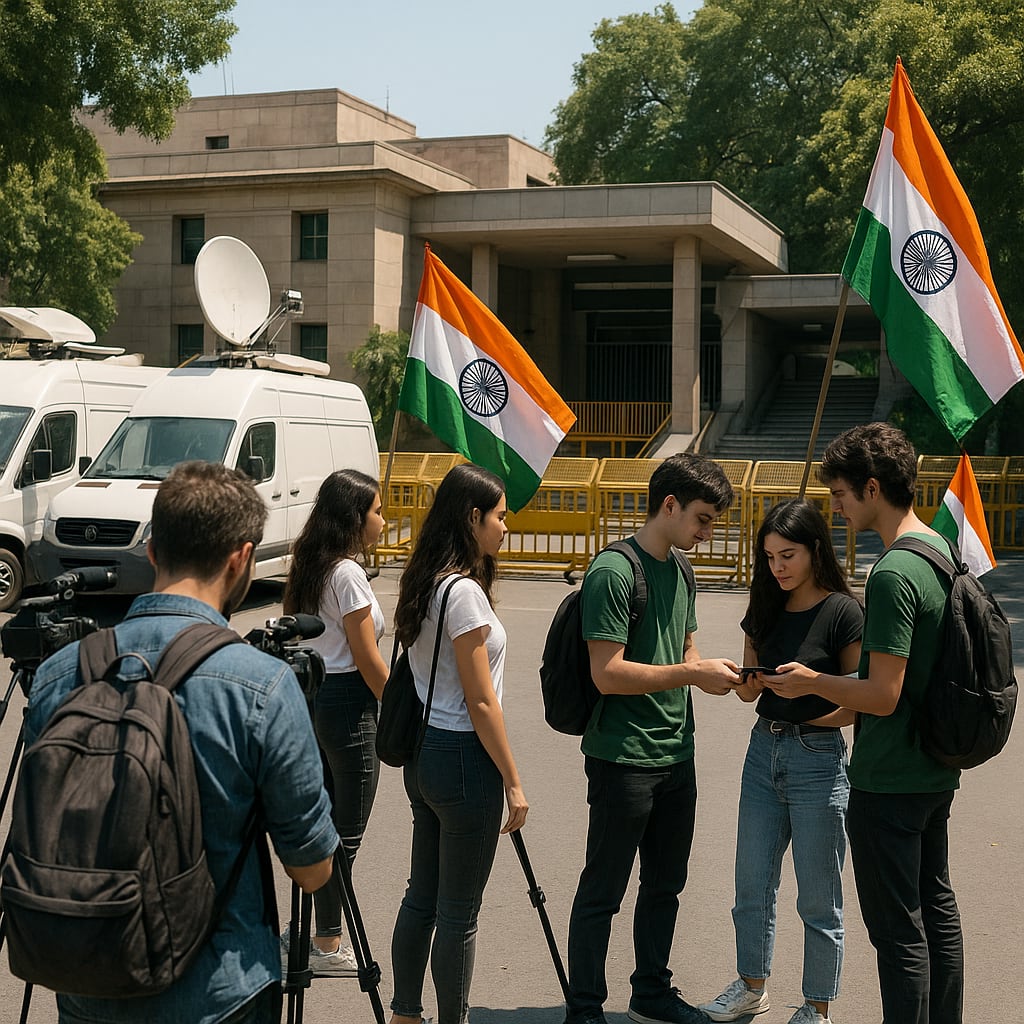
India jails ‘Cockroach’ movement leaders and detains reporters amid protests over election oversight
Narrative Snapshot
International coverage converges on the state’s dual-track response: targeted arrests of movement leaders and broad constraints on information flows. Al Jazeera and the Toronto Star, citing reporters and press freedom groups, highlight the detentions and alleged assaults of journalists covering the protests in Delhi, while France 24 documents a sweeping operational lockdown—tens of thousands of security personnel, shuttered metro stations, and a 24-hour internet blackout—aimed at containing a youth-led mobilization that nevertheless adapted by using Bluetooth-based workarounds.
A second through line is the institutional target of the protests. Bangkok Post and the South China Morning Post situate the arrests within demonstrations against India’s Election Commission, with the SCMP emphasizing accusations of voter roll manipulation and demands for the chief election commissioner’s resignation. Coverage thus links street-level policing decisions to questions about electoral integrity that have now reached the courts, as Deutsche Welle reports on a petition by Rahul Gandhi and others seeking an independent audit of voter deletions.
Where outlets diverge is in framing. The Guardian and Al Jazeera emphasize that the jailed Cockroach Janata Party leaders were punished for entering a formally banned protest site at Jantar Mantar, detailing alleged actions like jumping barricades and waving the national flag. France 24’s analysis foregrounds the political stakes, arguing that the state’s increasingly repressive posture risks puncturing the perception of Prime Minister Narendra Modi’s invincibility. Le Monde adds movement sociology, noting the “Cafard” formation’s origins as a joke that evolved into a cross-campus, broader constituency. BBC’s report on the Bollywood actor Imran Khan being ordered to leave India after attending a protest underscores the breadth of enforcement beyond movement organizers.
What Happened
Two leaders of the youth-led Cockroach Janata Party, Ashutosh Ranka and Saurav Das, were sentenced to five days in Delhi’s Tihar jail after entering Jantar Mantar, a historic protest site closed by authorities; The Guardian reports the court cited actions including jumping police barricades, raising slogans, and waving the Indian flag, with Al Jazeera and Bangkok Post also noting the five-day remand. France 24 reports that on October 10 New Delhi faced a near-lockdown during Gen Z–led protests, with more than 30,000 security personnel deployed, over 50 metro stations closed, and a 24-hour internet blackout that protesters partially circumvented via Bluetooth-based tools; a France 24 field report corroborates on-the-ground evasion of police cordons. Al Jazeera and the Toronto Star report at least 35 journalists detained over 48 hours, with allegations of assaults by police. BBC reports Bollywood actor Imran Khan was ordered to leave India after participating in a protest in Mumbai on October 10. The South China Morning Post ties the protests to accusations of voter roll manipulation and calls for the election chief’s resignation, while Deutsche Welle reports a petition by Rahul Gandhi and others seeking an independent audit of sweeping voter deletions is before the Supreme Court, with coverage noting both that a hearing was likely and that it was being heard.
Why It Matters
The coverage links crowd control and information restrictions to a test of India’s electoral institutions. Reports from Bangkok Post and the South China Morning Post indicate protests are directed at the Election Commission over alleged voter roll manipulation, while Deutsche Welle highlights a petition pushing for independent judicial scrutiny of voter deletions. Together, these accounts point to an institutional stress test in which policing of protest, adjudication by the Supreme Court, and the Election Commission’s response are interdependent. France 24’s analysis suggests the state’s coercive toolkit—from protest-site bans to internet blackouts—may have diminishing returns as protesters adapt technologically, raising questions about the efficacy and legitimacy costs of such measures. Al Jazeera and the Toronto Star’s reporting on detentions and alleged assaults of journalists indicates constraints on independent verification, a factor that bears on transparency for domestic stakeholders and international observers assessing the credibility of electoral processes and civil liberties.
Diverging Narratives
Outlets differ in emphasis between legal process and political contention. The Guardian and Al Jazeera present the jailing of Cockroach Janata Party leaders primarily as enforcement of a ban at Jantar Mantar, focusing on specific infractions like breaching barricades and slogan-chanting. By contrast, the South China Morning Post situates arrests within a broader dispute over alleged voter roll manipulation and calls for the election chief’s resignation, framing the crackdown as part of a contest over electoral fairness.
Assessments of state authority also vary. France 24’s interview with Dr. Subir Sinha argues that the government’s increasingly repressive posture may reveal institutional fragility and erode the perception of Narendra Modi’s invincibility, a lens not explicitly adopted by other outlets. Le Monde contributes a sociological angle, describing how a movement that began as a joke coalesced around charismatic figures and expanded beyond student circles, implying organizational resilience behind the street mobilizations documented elsewhere.
There is also timing ambiguity around judicial proceedings. Deutsche Welle carried items the same day stating the Supreme Court was likely to hear, and that it was hearing, a petition led by Rahul Gandhi for an independent audit of voter deletions, underscoring uncertainty over the procedural stage but agreement on the petition’s substance. Finally, BBC’s report that Bollywood actor Imran Khan was ordered to leave India after a protest in Mumbai adds a cultural and enforcement dimension less present in political coverage focused on Delhi.
What Happens Next
Three decision points emerge from the reporting. First, judicial oversight: Deutsche Welle’s coverage of Rahul Gandhi’s petition means analysts should watch for whether the Supreme Court orders an independent audit of voter deletions or declines intervention; either move will signal the Court’s posture toward electoral administration and shape the protesters’ claims reported by the South China Morning Post. Second, administrative response: given SCMP and Bangkok Post accounts of demands for the election chief’s resignation, any formal response from the Election Commission—public justification of roll maintenance, openness to review, or disciplinary stasis—will affect the protests’ trajectory. Third, security and information controls: France 24’s documentation of mass deployments, metro closures, and an internet blackout, alongside protesters’ Bluetooth workarounds, sets up a dynamic to watch between escalating restrictions and adaptation. Al Jazeera and the Toronto Star’s reporting on detained journalists suggests that changes in policing of the press will be a key indicator for how authorities intend to manage scrutiny of future demonstrations.