
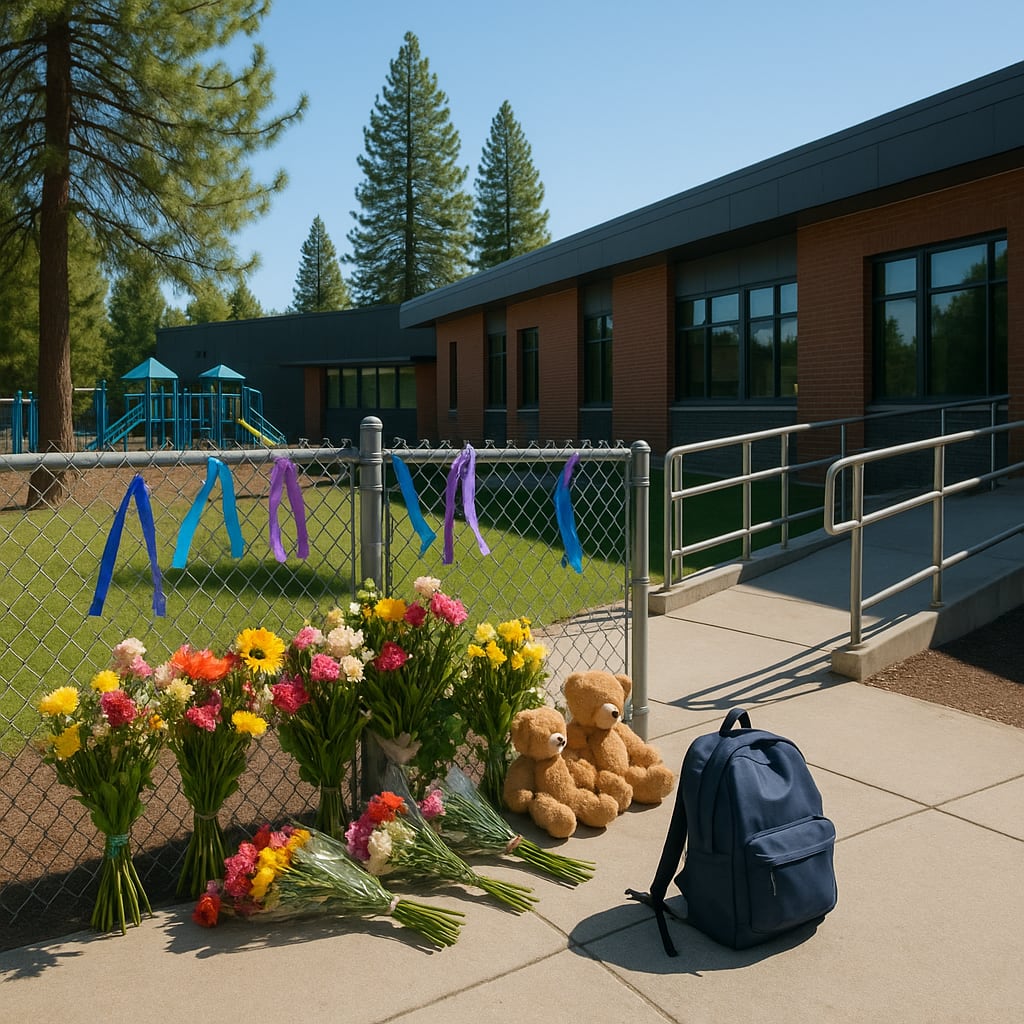
Four killed, two wounded in Oregon elementary school shooting; 16-year-old former student shot dead by bystander
Narrative Snapshot
Across outlets, the core contours converge: a 16-year-old former student entered Silver Rail Elementary in Bend, Oregon, on Thursday and killed three children and a teacher before being shot dead by a community member inside the school. Later reports align on the casualty toll and the bystander intervention, with The Guardian, Deutsche Welle, France24 and multiple U.S. outlets describing the four fatalities and crediting a civilian for stopping the attacker. Early dispatches, particularly those filed shortly after the first police statements, emphasized uncertainty—hospitalizations and lockdowns rather than a definitive death toll (La Repubblica; The Hindu, 15 Oct; Toronto Star, 15 Oct; South China Morning Post). CGTN quickly relayed U.S. broadcast reports of multiple child fatalities the same day, anticipating the later-confirmed count, while one early Argentine report attributed the shooter’s neutralization to police before subsequent accounts clarified the role of the armed bystander (Clarin, 15 Oct; The Guardian, 16 Oct; CBC News).
Several outlets center the school’s special education setting. The Hindu and the BBC report the suspect had been a special needs student at Silver Rail and that the attack targeted a special educational needs classroom; The Guardian adds that all the victims were shot in the same classroom. Coverage consistently foregrounds acts of civilian and staff intervention: BBC says a teacher fought the attacker before an armed father shot the suspect multiple times; Deutsche Welle notes police praise for three people whose actions curtailed the rampage; Fox News and CBC identify the bystander as a parent of two students. This focus on on-site interventions sits alongside official accounts of a swift police response within minutes of the first calls (The Hindu, 15 Oct; South China Morning Post).
Policy framing diverges most in U.S. coverage. Fox News highlights Democratic calls for tighter gun laws—emphasizing reports that the shotgun belonged to the suspect’s mother—while giving equal prominence to gun-rights advocates arguing the event vindicates armed-citizen responses and undercuts proposals focused on “assault weapons” or gun-free zones. International outlets, including Folha de S.Paulo and Clarin, emphasize the provenance of the weapon and the ongoing inquiry into how the minor accessed it, while largely avoiding the domestic partisan frame.
What Happened
Authorities received a call at 12:59 p.m. about a shot fired into a car outside Silver Rail Elementary in Bend, Oregon, followed minutes later by emergency calls from inside the school (South China Morning Post). Police arrived rapidly and the building went into lockdown (The Hindu, 15 Oct; La Repubblica). A 16-year-old former student entered and opened fire in a special needs classroom, killing three children—ages five, eight and 11—and 25-year-old teacher Megan Lambert, according to later reporting (The Guardian; New York Times; The Guardian, “what we know”). Two people were hospitalized, described as a special-needs teacher and student (Toronto Star, 17 Oct), with ages reported as seven and 54 in earlier accounts (The Guardian). The attacker, identified by police as Griffin J. John II (The Hindu, 16 Oct), was shot dead by a bystander, identified in U.S. outlets as a father of two students, named by Fox News as Kaylub Gianmarco (CBC News; Fox News). Federal agencies joined the response (CGTN).
Why It Matters
The incident concentrates multiple strands of U.S. gun-policy contention into a single case: a minor allegedly accessing a parent’s firearm (Folha de S.Paulo; Clarin, 16–17 Oct), an attack in a “gun-free” school setting, and a fatality toll ended by an armed civilian (Fox News). Democratic officials immediately renewed calls for “common-sense” gun laws, including measures that would reduce risks in schools (Fox News, “Democrats call for gun control”), while gun-rights advocates pointed to the absence of an “assault weapon,” the presence of a gun-free zone, and the decisive role of an armed bystander as arguments against additional restrictions (Fox News, “inconvenient fact”). For decision-makers, the case sharpens pressure points around safe-storage requirements, parental liability when minors obtain firearms, and the design of school security protocols that must account for special education settings. It also underscores the operational interplay between rapid police response, federal support, and civilian intervention documented across outlets.
Diverging Narratives
Early reporting diverged on both the toll and who stopped the shooter. Initial accounts emphasized hospitalizations and lockdown status (Toronto Star, 15 Oct; La Repubblica; The Hindu, 15 Oct; South China Morning Post), while CGTN quickly cited U.S. broadcasts reporting four deaths. By the next day, The Guardian, France24, and Deutsche Welle described three child victims and one teacher, consistent with subsequent AP-based coverage (Toronto Star, 17 Oct). On the shooter’s death, later stories widely credit an armed bystander—identified as a parent of two students (CBC News; The Guardian; Fox News)—while an initial Argentine dispatch attributed neutralization to police (Clarin, 15 Oct), reflecting the typical evolution from provisional to consolidated accounts.
Causal interpretations also part ways. Multiple outlets report the suspect was a former special needs student who targeted a special needs classroom (The Hindu, 16 Oct; BBC News; France24), a framing that focuses attention on vulnerabilities in specialized learning environments and staff protection. U.S. political coverage splits between calls for stricter laws, keyed to the reported use of a shotgun owned by the mother (Folha de S.Paulo; Fox News, “Democrats call”), and arguments that civilian armed response is the key policy lesson (Fox News, “inconvenient fact”). Investigative questions remain open across reporting: authorities were still determining motive and the precise means of firearm access even as the suspect’s mother publicly expressed remorse and stated she had purchased the shotgun two months earlier (Clarin, 17 Oct).
What Happens Next
Two decision tracks will shape outcomes. First, the law-enforcement investigation into motive and firearm access—already flagged by Folha de S.Paulo and Clarin—will determine whether and how safe-storage practices factored into the event. Analysts should watch for official findings on access pathways, any referrals to prosecutors, and whether federal partners (FBI/ATF involvement noted by CGTN) surface regulatory or trafficking dimensions.
Second, policy responses in Oregon and Washington will test competing frames reported by Fox News: Democratic calls for tighter gun laws, potentially including strengthened storage or access controls, versus gun-rights groups’ push to validate armed-citizen models and contest restrictions tied to weapon type or gun-free zones. Signals to monitor include whether Oregon’s delegation introduces or backs new federal or state measures, how school districts communicate about safety reviews after the district’s public praise for staff courage (Fox News, 18 Oct), and whether advocacy groups leverage the case in litigation or legislative campaigns.