
Brazil’s Lula and Flávio Bolsonaro trade attacks in first televised runoff debate
Narrative Snapshot
Foreign and domestic outlets describe a combative exchange, but they privilege different facets of the confrontation. France24, Deutsche Welle and Al Jazeera converge on the texture of the encounter—personal accusations, charges of lying and corruption, and sharp exchanges on core portfolios such as the economy, security and healthcare—framing the night as part of a closely fought final stretch before the October 25 vote. Argentina’s Clarín centers the strategic attempt by each candidate to internationalize the opponent’s image: Lula tying Flávio Bolsonaro to Javier Milei and Donald Trump, and Bolsonaro associating Lula with Daniel Ortega and Nicolás Maduro, an emphasis that situates the contest within regional and extra‑regional alignments.
Brazil’s Folha de S.Paulo underscores the salience of corruption allegations and references to family members, while Italy’s Corriere della Sera spotlights terse on‑stage exchanges—refusals to stand near one another and disclaimers of violence—illustrating how format and stagecraft shape the narrative. Telesur focuses on logistics and scale, detailing a broad broadcast pool and multi‑platform distribution, emphasizing reach rather than substance. In parallel, Fox News reporting on several U.S. debates highlights similarly adversarial dynamics—accusations involving white supremacy, Epstein ties, debate disruptions, and prop‑like notecards—indicating that outlets in different systems are documenting an escalation of performative confrontation as elections near.
What Happened
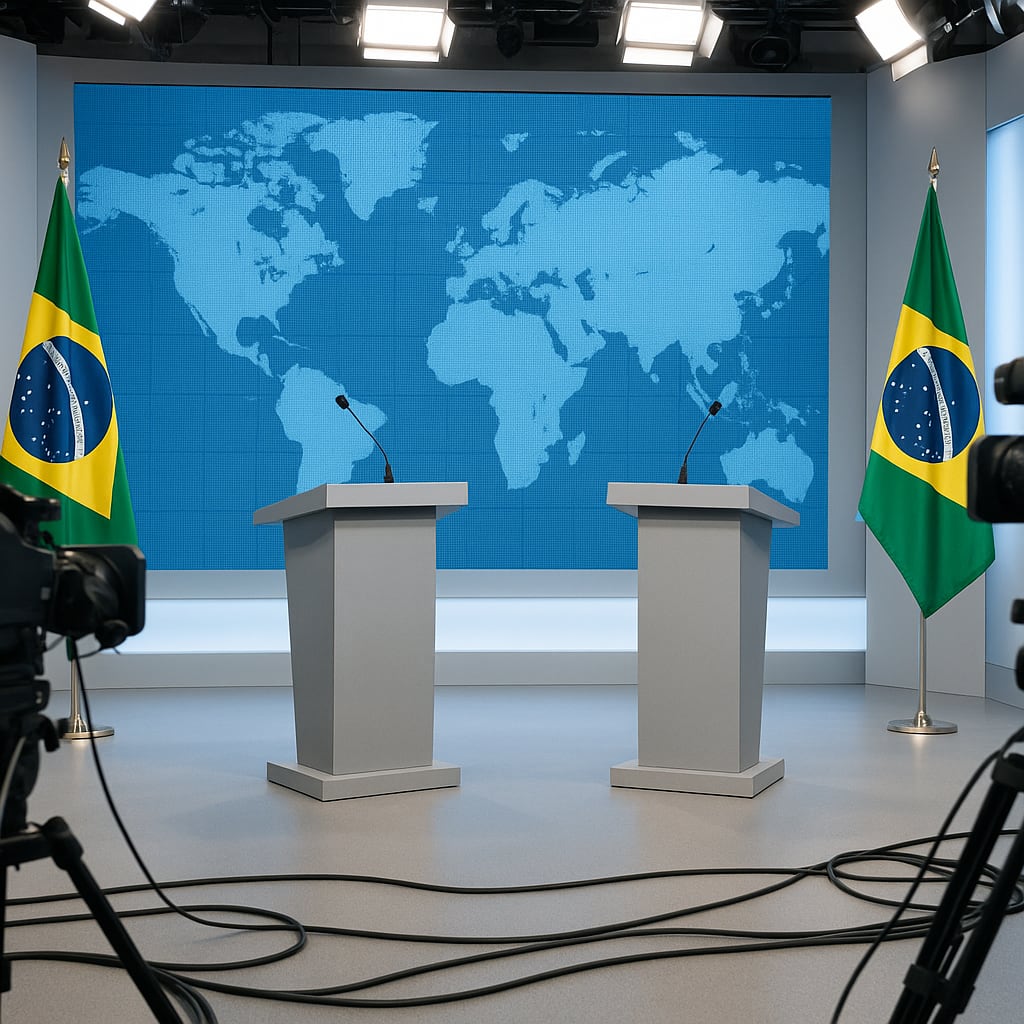
President Luiz Inácio Lula da Silva and Senator Flávio Bolsonaro met on October 18 in São Paulo for their first joint debate of the runoff, hosted by Band and carried by a media pool that included Band, TV Gazeta, TV Cultura, Jovem Pan and O Estado de S. Paulo, with live distribution across BandNews TV/FM, Bandeirantes radio, Band’s YouTube, website and BandPlay (Telesur). The two‑hour program featured sustained personal attacks and mutual accusations of lying and corruption (France24), with Folha de S.Paulo noting exchanges that invoked relatives alongside corruption claims. Substantive clashes surfaced on the economy, security and healthcare (France24). Lines that crystallized the acrimony included sharp barbs quoted domestically by Folha and, in translation, by Corriere della Sera, which highlighted a refusal to stand in proximity and a rejoinder about not being violent. Clarín reported that Lula linked Flávio Bolsonaro to Javier Milei and Donald Trump, while Bolsonaro associated Lula with Daniel Ortega and Nicolás Maduro. Deutsche Welle also noted barbs over Bolsonaro’s ties to Trump.
Why It Matters
The debate’s proximity to the October 25 runoff (Telesur; France24) makes it a critical mass‑audience moment for framing governing mandates on economic management, public security and health service delivery—the issue domains explicitly contested on stage (France24). The reciprocal attempts to tag opponents with foreign leaders—Milei and Trump on one side; Ortega and Maduro on the other (Clarín; DW)—signal that Brazil’s domestic contest is being narrated through competing international reference points, with implications for how each camp would be perceived in hemispheric and transatlantic forums.
The broadcast consortium and multi‑platform carriage (Telesur) maximized exposure, shaping the informational environment in which late deciders calibrate risk and competence. Comparative reporting from the U.S. (Fox News) on similarly heated debate styles—featuring personal allegations, disruptions and performative cues—underscores a cross‑context pattern of campaign communication where spectacle can crowd policy detail, a dynamic relevant to electoral authorities, media regulators and civil society organizations concerned with debate norms and voter information quality.
Diverging Narratives
Outlets diverge in emphasis rather than basic facts. International wire‑style reporting from France24 and Al Jazeera foregrounds the tenor of the exchange—“heated,” “barrage of attacks”—while still enumerating issue areas contested (economy, security, healthcare in France24). Clarín spotlights the use of transnational associations as a deliberate campaign tactic, detailing Lula’s linkage of Flávio Bolsonaro to Javier Milei and Donald Trump and Bolsonaro’s counter‑linkage of Lula to Daniel Ortega and Nicolás Maduro. Deutsche Welle isolates the Trump angle among the barbs, reflecting European audience interest in U.S. linkages.
Brazil’s Folha de S.Paulo documents the rhetorical escalation through specific lines and notes the inclusion of relatives in the accusations, adding domestic texture to the stakes around corruption narratives. Corriere della Sera draws attention to stagecraft and physical distancing on set, quoting pointed exchanges about proximity and violence. Telesur, by contrast, concentrates on the debate’s timing, distribution network and first‑encounter status, situating the event within campaign logistics rather than policy content. Collectively, these frames leave unresolved how far the campaigns will develop concrete programmatic contrasts in the final week, even as multiple outlets confirm that core policy areas were in contention.
What Happens Next
With one week to the October 25 runoff (Telesur; France24), campaign communications will likely crystallize around the narrative choices surfaced in the debate. One path is continued mobilization via international analogies—Milei/Trump versus Ortega/Maduro—as reported by Clarín and DW; analysts should watch closing ads and surrogate messaging for repetition or expansion of these linkages. Another is an intensified focus on policy portfolios already contested—economy, security, healthcare (France24)—which would be evident in targeted proposals, budget frames, or crime/health metrics emphasized in stump speeches and interviews.
Given Folha’s reporting on corruption‑focused exchanges and references to family members, a further decision point is whether either camp escalates personal allegations; monitoring press conferences and social media for new charges or document dumps will indicate that trajectory. Finally, Telesur’s account of the debate’s broad carriage highlights the role of media amplification; tracking which networks in the pool prioritize policy clips versus personal attacks in their post‑debate coverage will signal the information cues most voters receive before ballots are cast.