
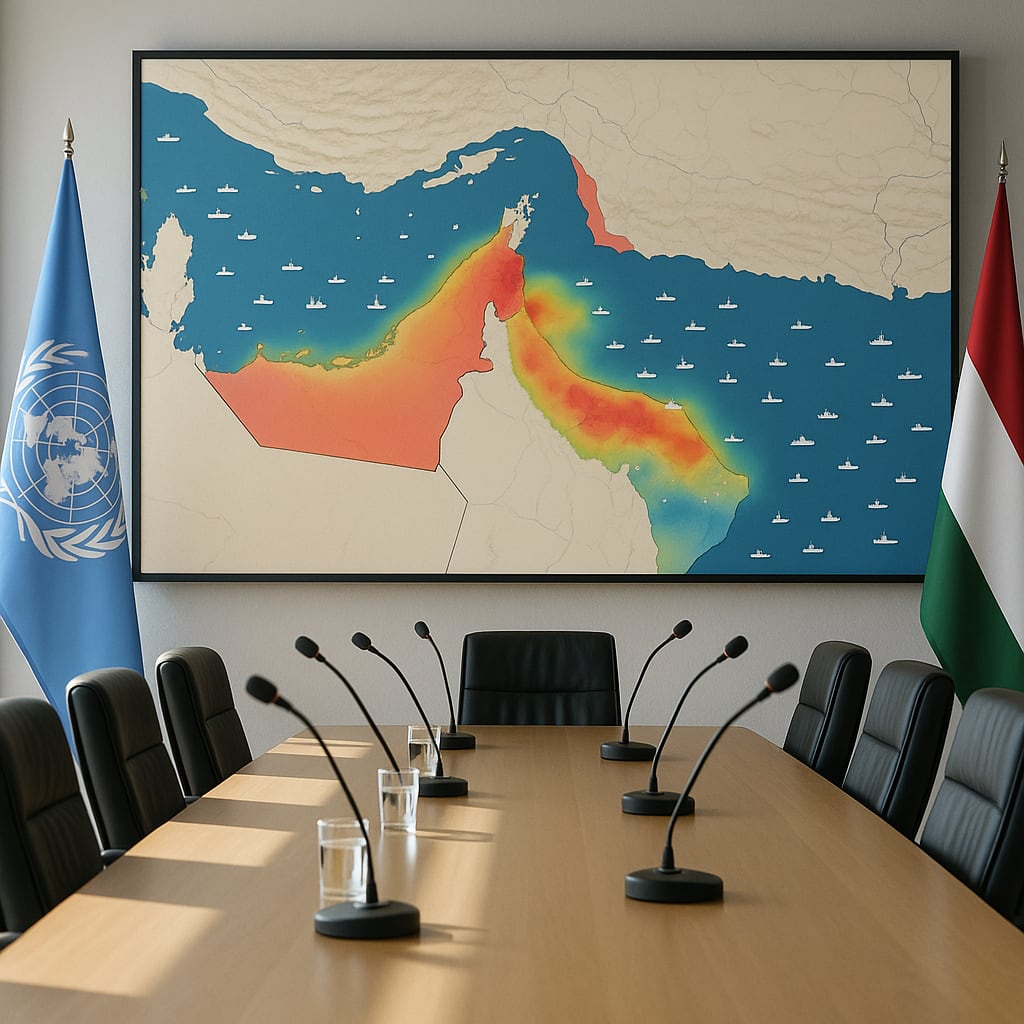
IRGC reports tanker mine blast and fire in the Strait of Hormuz as maritime threat levels spike
Narrative Snapshot
Across Iranian and several international outlets there is broad alignment on the core claim that an oil tanker transiting the southern Strait of Hormuz suffered an explosion and fire after striking a naval mine, as reported by Iran’s Islamic Revolutionary Guard Corps (IRGC) Navy. Iranian state-aligned reporting characterizes the vessel as “violating” regulations by switching off identification systems and using unauthorized routes, framing enforcement as a response to illicit behavior. Some coverage extends this to a second “violating” supertanker incident and an IRGC warning that the strait is closed.
Maritime risk monitors and trade data point to a severe operational environment but stress persistent uncertainty. UK Maritime Trade Operations (UKMTO) describes the threat to shipping as severe, with further attacks deemed highly likely, yet also notes that most attacked ships are declining to report incidents and that some third-party data cannot be independently verified. Independent tracking indicates dramatically reduced traffic, while separate reporting cites a wartime peak in attacks and the loss of two cargo vessels.
Policy framing diverges. Tehran links maritime security directly to the scale of U.S. military pressure and has floated a seven-day reopening proposal via Qatar, while rejecting U.S. claims that traffic has normalized. Western and multilateral voices emphasize seafarer safety and operational risk, with the UN maritime chief urging against transiting the strait without guarantees and a U.S. military spokesman claiming most Iranian attempted attacks are unsuccessful.
Regional and global outlets emphasize different facets: some pair the incidents with broader regional hostilities, others highlight the strait’s criticality for oil flows or foreground Iran’s conditional offer to restore passage. Russian and Argentine outlets largely echo the IRGC’s account of a mine-triggered fire and the strategic stakes.
What Happened
Iran’s IRGC Navy said an oil tanker exploded and caught fire in its engine room after hitting a naval mine in the southern Strait of Hormuz; Iranian media added the ship had switched off navigation and identification systems while transiting. Russian and Iranian state outlets, and UK-based coverage, carried the IRGC account, with Chinese state media also reporting a second similar incident and an IRGC warning that the strait is closed. Earlier, Tehran had said non‑compliant vessels would face sanctions, without explicitly threatening military action. UKMTO reported eight attacks involving unknown projectiles on 11 and 13 October, noting IRGC harassment activity. Data cited by media show two cargo vessels sank in separate projectile incidents, including the Singapore-flagged GFS Pride on 14 October. The UN maritime agency’s chief warned of around 6,000 seafarers trapped near the waterway amid a reported surge to roughly two dozen attacks over two weeks. Iran’s foreign minister said Tehran conveyed a seven-day reopening proposal via Qatar.
Why It Matters
The Strait of Hormuz is a system-critical chokepoint for global energy flows, and current reporting depicts a sharp, prolonged degradation in maritime security and throughput. UKMTO indicates combined transits remain about 70 percent below pre‑war levels, while market data cited in media point to a steep dip in oil movements. This challenges existing maritime risk management arrangements—UKMTO/JMIC advisories, IMO safety advocacy, and U.S.-facilitated transits—by combining contested enforcement claims, underreporting by shipowners, and persistently high attack rates. Iran’s linkage of navigation security to relief from U.S. military and economic pressure situates the crisis within broader contests over freedom of navigation versus coastal-state control and sanctions enforcement. Engagement channels referenced by Tehran—including an OIC forum, Qatari facilitation, and technical talks with Oman—suggest potential venues for deconfliction, but they hinge on U.S.-Iran dynamics. For policymakers, maritime insurance, flag registries, naval risk postures, and energy market stability are immediately exposed to prolonged disruption.
Diverging Narratives
Iran-centered accounts emphasize regulatory noncompliance—AIS shutdowns, unauthorized routing—and describe targeted enforcement against “illicit” tankers, with explicit warnings that violators will be dealt with severely. Chinese state media relays an IRGC statement that the strait is closed, reinforcing an enforcement posture. Iranian political coverage pairs this with assertions of sovereignty, deterrence, and opposition to a U.S.-dominated security order, while dismissing U.S. claims of normalized traffic.
Maritime security reporting foregrounds contested facts and opacity. UKMTO cites a severe threat environment, ongoing IRGC harassment, and difficulty verifying both incident counts and U.S.-reported transit figures, due to non-reporting by affected vessels. Media cite FT assessments of wartime-high attack tempos and multiple ship losses, but also note that in several cases damage remains unconfirmed. The U.S. military’s claim that the vast majority of Iranian attempted attacks fail, reported alongside the IMO chief’s advice to avoid transiting absent guarantees, illustrates competing risk assessments: one stressing degraded but mitigated threat, the other urging precautionary withdrawal.
Finally, Iran’s proposal to restore normal passage within seven days if conditions are met is presented by Iranian and Russian outlets as a concrete diplomatic offramp, while Western coverage ties Tehran’s offer to its broader accusation that U.S. and Israeli actions precipitated the crisis. This leaves core issues—rules of transit, verification, and the scope of enforcement—unresolved in public reporting.
What Happens Next
Three decision points emerge. First, whether Washington engages Tehran’s seven‑day reopening proposal conveyed via Qatar. Acceptance on terms described by Iran would aim to restore normal passage; absence of engagement keeps the current risk posture and depressed traffic in place, with Iran linking any reopening to changes in U.S. pressure. Second, operational compliance and reporting behaviors by shipowners: IRGC warnings target AIS-off and “unauthorized” routing, while UKMTO highlights widespread underreporting. A shift toward consistent AIS use and incident reporting would be a measurable indicator of either confidence recovery or coerced compliance. Third, multilateral risk governance: the IMO chief’s call to avoid transit until guarantees contrasts with U.S. assertions of mitigated risk and UKMTO’s severe-threat advisories. Analysts should watch for verifiable traffic rebounds, formalized safe‑route arrangements via Oman, changes in advisory language from UKMTO/JMIC and IMO, and any reduction in projectile or mine incidents documented by multiple independent sources.