
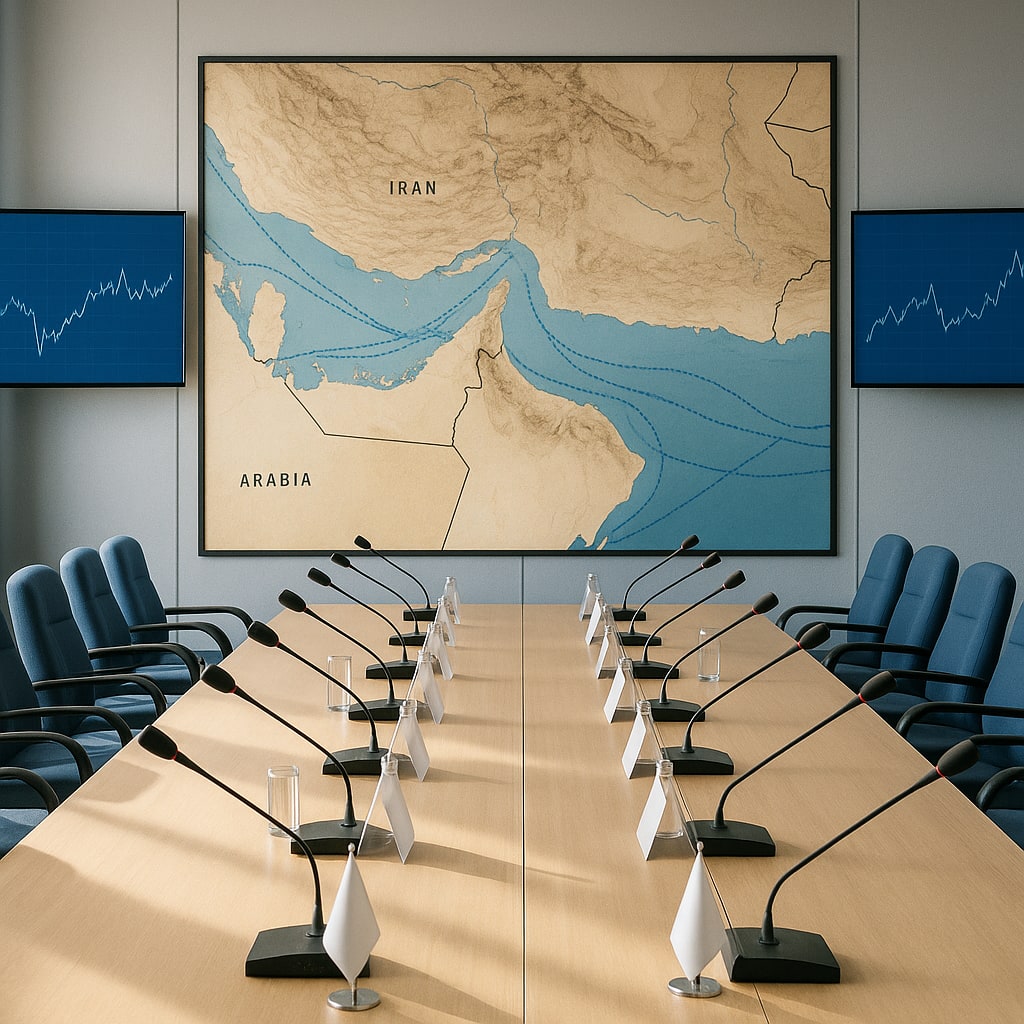
Hormuz disruptions and hardening rhetoric around Iran push energy and security risks higher
Narrative Snapshot
Across sources there is broad agreement that the security environment around Iran has tightened and that energy markets are already absorbing consequences. Reporting ranges from Iranian claims that the Strait of Hormuz is closed and tankers have been hit to Gulf and international warnings that further price and supply shocks are likely. Multiple outlets tie Houthi attacks inside Saudi Arabia and threats to maritime traffic to this backdrop, while commodity coverage tracks a firmer crude market and unusual inventory moves.
What diverges is the framing of causality and next steps. Iranian officials and state media emphasize U.S. and Israeli responsibility for regional instability and signal readiness for further confrontation, including explicit warnings against striking energy infrastructure. Israeli coverage centers on expectations of renewed conflict absent a diplomatic settlement and highlights a doctrinal shift toward preemption ahead of elections. U.S. reporting spotlights force-protection tradeoffs and missile-defense consumption rates, while Qatar’s leadership underscores dialogue and rejects new tolls on Hormuz transits. A Chinese state outlet highlights both tanker incidents and Israel’s doctrine change, and separate analysis points to Chinese refiners reshaping near-term crude demand as they replace constrained Iranian barrels.
What is most at stake, according to the sources, is the intersection of security decisions and energy flows: whether maritime passage can be restored reliably, whether cross-border strikes escalate, and whether diplomacy—via Baghdad, Moscow, or quiet Gulf channels—can lower the temperature fast enough to avoid deeper market dislocation.
What Happened
Iran’s Islamic Revolutionary Guard Corps said two “violating” supertankers suffered explosions from naval mines in the Strait of Hormuz, reiterated the strait is closed, and warned ships against “unauthorized” routes, amid continued Saudi‑Houthi hostilities (CGTN). Yemen’s Houthis claimed strikes on Riyadh’s airport and a nearby air base as explosions were reported in the Saudi capital (Middle East Eye). Iran’s foreign minister warned Israel not to attack energy sites and spoke of “unfinished business,” while blaming the U.S. for regional insecurity (Haaretz; Tehran Times; TASS; Middle East Eye). The U.S. president said Washington is hitting Iran “economically and militarily” (Al Jazeera). Israel unveiled a national security doctrine that lowers the bar for preemption days before elections (CGTN), and Israeli analysts warned escalation is likely without diplomacy (The Times of Israel). Qatar cautioned that energy “shockwaves” have not peaked and called for dialogue (Al Jazeera). Russia’s foreign minister visited Tehran to mediate (Clarin). A UAE government‑linked jet twice landed in Tehran amid rising tensions (Middle East Eye). U.S. missions issued security alerts over possible Iran‑backed attacks (The Hindu). Oil prices rose on Middle East risks; the U.S. paused weekly Strategic Petroleum Reserve draws; Chinese refiners stepped up Middle East crude purchases as they replaced Iranian supply (AllAfrica; Clarin; Middle East Eye).
Why It Matters
The strait’s disruption tests the resilience of a global energy system still adjusting to sanctions regimes and conflict‑related logistics constraints. Multiple sources flag both immediate price responses and structural shifts, including rising Brent and WTI, depleted U.S. commercial stocks, and Chinese refiners’ pivot to Saudi barrels amid a continuing U.S. blockade of Iranian supply (Clarin; Middle East Eye). For regional security architectures, Saudi Arabia’s public accusation that Iran is encouraging Houthi strikes stresses a 2023 rapprochement framework (Middle East Eye), while Israel’s newly articulated doctrine to preempt threats lowers thresholds for cross‑border action (CGTN). U.S. force‑posture choices are also implicated: redeployment and expenditure of Patriot and THAAD interceptors to the Middle East occur alongside Indo‑Pacific risk management (Fox News). Diplomatically, Qatar’s call for dialogue, Russia’s mediation bid, Iran’s formal complaints to the UN, and reported Baghdad channel proposals to reopen Hormuz indicate competing mechanisms to de‑escalate or institutionalize new norms of maritime control (Al Jazeera; Clarin; IRNA; Middle East Eye). This all lands amid critiques that energy‑driven policy often undercuts broader strategy, as noted in analysis tracing U.S. choices from 1953 to today (Japan Times).
Diverging Narratives
Iranian officials, echoed by state media, frame the U.S. as the main source of insecurity, assert that prior fighting strengthened Iran, and threaten severe retaliation if Israel targets energy infrastructure (TASS; Tehran Times; Haaretz). Tehran also sent formal warnings to the UN about “unlawful threats” and highlighted domestic claims of adversaries’ political weakness (IRNA). Israeli outlets emphasize the likelihood of renewed conflict without a settlement and, via Chinese coverage, the institutionalization of an Israeli doctrine that normalizes preemptive action ahead of elections (The Times of Israel; CGTN). U.S. framing in one report downplays Indo‑Pacific risks from missile‑defense diversions, casting the Iran conflict as an opportunity to modernize, while acknowledging large interceptor expenditures (Fox News).
On the maritime front, Iranian and Chinese state reporting present the Strait of Hormuz as closed with tankers damaged by mines (CGTN), whereas separate coverage portrays an active diplomatic offer from Tehran to reopen the strait within six days under specified conditions, with talks to resume thereafter if Washington agrees (Middle East Eye). Gulf‑focused reporting adds quiet signaling, such as a UAE government‑linked jet’s repeated landings in Tehran, alongside public warnings that energy shockwaves are not yet at their peak and that new transit fees are off the table (Middle East Eye; Al Jazeera). Saudi officials publicly accuse Iran of encouraging Houthi violations of the détente framework, while battlefield reports describe continued Houthi strikes inside the kingdom and IRGC actions against shipping (Middle East Eye).
What Happens Next
Key decisions center on whether parties escalate or accept mediated de‑escalation. Israeli choices under a preemptive doctrine, in a tight electoral window, will shape confrontation risks noted by Israeli analysts and signaled in Iranian warnings (CGTN; The Times of Israel; Haaretz). Washington’s response to Tehran’s Baghdad‑linked proposal to reopen Hormuz within six days sets a clear marker; acceptance would trigger talks on day seven per Iran’s stated conditions, while refusal would prolong maritime disruption (Middle East Eye). Gulf signaling bears watching: additional UAE‑Tehran flights, Saudi statements on Houthi activity, and Qatar’s continued rejection of transit fees together indicate the room regional actors perceive for diplomacy versus coercion (Middle East Eye; Middle East Eye; Al Jazeera). On the security‑logistics side, U.S. missile‑defense redeployments and replenishment rates will constrain operational tempo (Fox News). For markets, analysts should monitor confirmed Hormuz transit status, Houthi strike tempo, Chinese prompt crude buying, U.S. inventory trends, and any fresh IEA or OPEC+ guidance tied to supply recovery risks (Clarin; Middle East Eye; AllAfrica).