
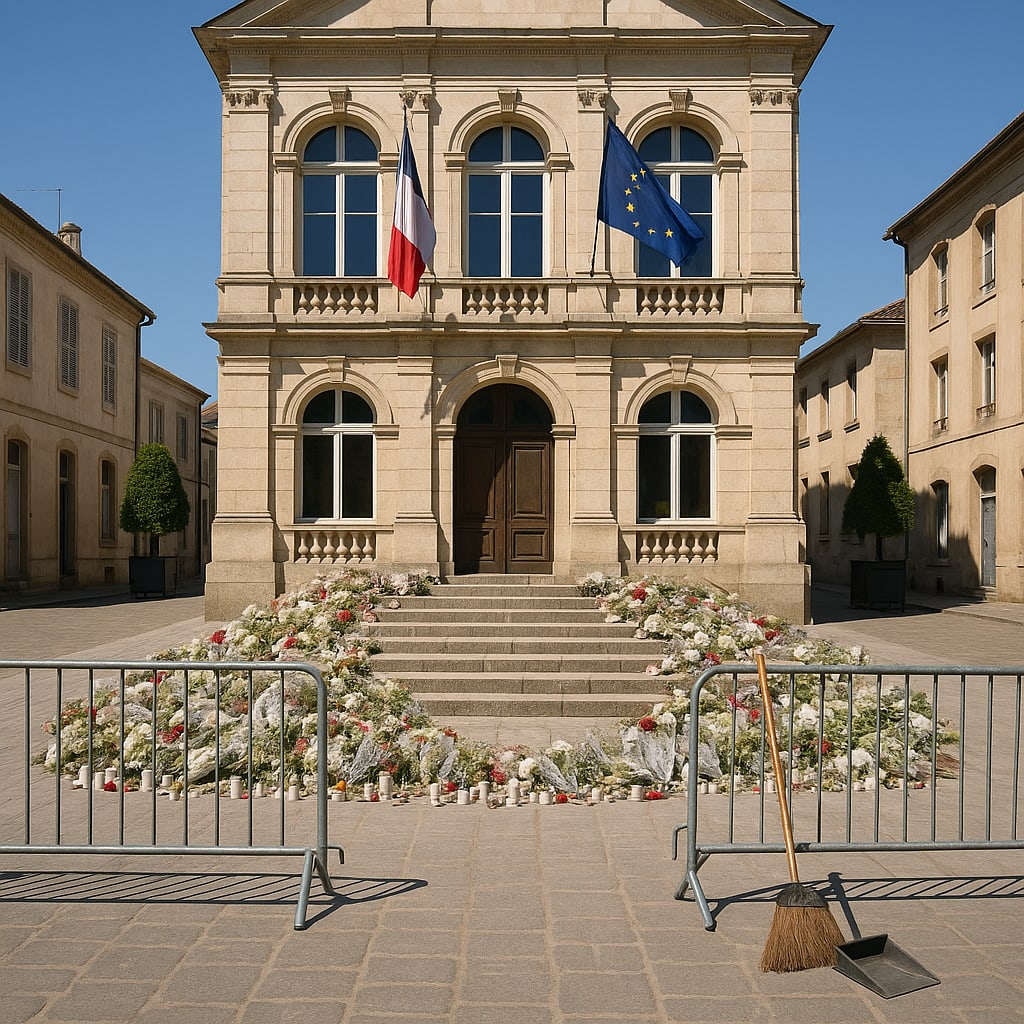
France tallies sweeping arrests and damage after cost-of-living protests turn violent, with Limoges city hall burned and retailers seeking relief
Narrative Snapshot
Across outlets, the point of convergence is the scale and breadth of disorder: reports place arrests in the thousands and document extensive destruction from Paris and Marseille to Lyon, Bordeaux and Limoges, with the burning of Limoges’ 140-year-old town hall becoming the emblematic image of the weekend’s unrest. Coverage differs on exact tallies and severity, but it consistently underscores a mix of mass demonstrations and opportunistic violence, including looting and arson, that overwhelmed local authorities in places.
Causal and compositional framing diverges. Several accounts root the unrest in cost-of-living grievances; Italian and Argentine outlets describe peaceful marches alongside black bloc and groups of mostly young looters. Indian and Iranian outlets place added emphasis on inflation pressures linked to the U.S.-Iran war, while a French outlet documents the circulation of AI-generated images that inflamed sectarian narratives without corroboration. Israeli reporting highlights a vandalized Paris synagogue and damaged Jewish-owned shops in Marseille, while noting the lack of evidence that Jewish businesses were deliberately targeted.
The response lens also varies. British and Argentine outlets foreground admissions that police “lost control” in some cities and President Emmanuel Macron’s call for unequivocal condemnation and a security review. French business coverage prioritizes the economic hit—retail losses, tourism fears, and a sell-off of French debt and the euro—while German reporting stresses regional spillovers via a travel caution. Italian wires add that a Paris media outlet’s headquarters was attacked, underscoring how protest flashpoints extended to institutions beyond state property.
What Happened
Mass protests over high prices and public services were held across France, with events in Paris, Marseille, Lyon, Bordeaux and other cities accompanied by riots, looting and arson. Reports on arrests range from about 1,800 to more than 2,500. A defining incident was in Limoges, where rioters set the historic town hall ablaze; a bell tower collapsed, and authorities said the national anti-terrorism prosecutor’s office would join the investigation. Shops were looted widely, with Marseille alone seeing more than 600 premises hit. An attack on a Paris synagogue was reported, with Torah scrolls unharmed, and Jewish-owned shops were set ablaze in Marseille. AI-generated images purporting to show an elderly couple assaulted circulated widely but were debunked. President Macron urged political and social actors to condemn violence and ordered a full security review. Retailers convened a crisis meeting with the government as clean-up operations began nationwide.
Why It Matters
The unrest tests France’s capacity to manage simultaneous public-order, judicial, and economic shocks. Admissions that police lost control in some cities, combined with thousands of arrests, elevate scrutiny of internal security posture and resourcing. The announced involvement of the national anti-terrorism prosecutor in the Limoges case signals potential escalation of prosecutorial tools, with implications for legal thresholds applied to urban violence. Cross-border reverberations are already visible: Germany condemned the violence and issued a caution to its citizens in France, while Japanese coverage frames the turmoil within a broader European wave of unrest.
The economic channel is immediate. French retailers report severe losses, the tourism sector fears a downturn in winter bookings, and financial markets registered stress via a sell-off in French debt and the euro. The information environment is another pressure point: AI-generated disinformation linked to the riots and amplified online complicated crisis communication and risked inflaming sectarian tensions, adding a digital integrity dimension to public-order strategy.
Diverging Narratives
Sources differ on the scale and severity of the crackdown and harm. Arrest estimates range from roughly 1,800 to more than 2,500, and injury counts for police and firefighters span from over 500 to around 1,000. One Argentine outlet reported a protester died in Paris; other accounts did not echo that claim. Descriptions of policing vary: some reporting emphasizes outnumbered forces and an admission of losing control in certain cities, while others describe looters facing little resistance in parts of Paris.
Causal frames are not uniform. Many outlets foreground inflation and declining public services as the drivers, with Italian coverage distinguishing between peaceful demonstrators, black bloc, and youths who targeted shops. Indian and Iranian reporting connects inflation to the U.S.-Iran war or a “war on Iran,” adding a geopolitical layer absent from most European accounts. There is also tension around the character of certain incidents: Israeli coverage details vandalism at a Paris synagogue and fires at Jewish-owned businesses, yet cites community monitors saying there is no evidence of deliberate targeting of Jewish businesses. Meanwhile, FRANCE 24 documents AI-generated imagery that stoked claims about Muslims and Jews, underscoring how unverified content fed competing interpretations of the riots.
What Happens Next
Three decision points will shape trajectories. First, the security review ordered by President Macron will determine adjustments to policing and public-order doctrine; continued heavy deployments flagged by British reporting indicate an interim posture, and changes in force allocation or tactics will be key signals. Second, on justice, thousands of arrests translate into prosecutorial choices; confirmation of the anti-terrorism prosecutor’s formal role in the Limoges arson will clarify the legal framing of the most severe cases and could set precedent for future unrest investigations. Third, on economic stabilization, the government–retailers crisis meeting will test whether authorities deploy compensatory measures or enhanced protection for commercial districts; follow-through will be evident in any announced aid, insurance facilitation, or security commitments, as well as in tourism booking trends and market pricing after the reported sell-off.
A parallel track concerns information integrity. Watch for platform moderation actions or official clarifications in response to the AI-generated images that circulated during the unrest, given their role in shaping perceptions of the crisis.