
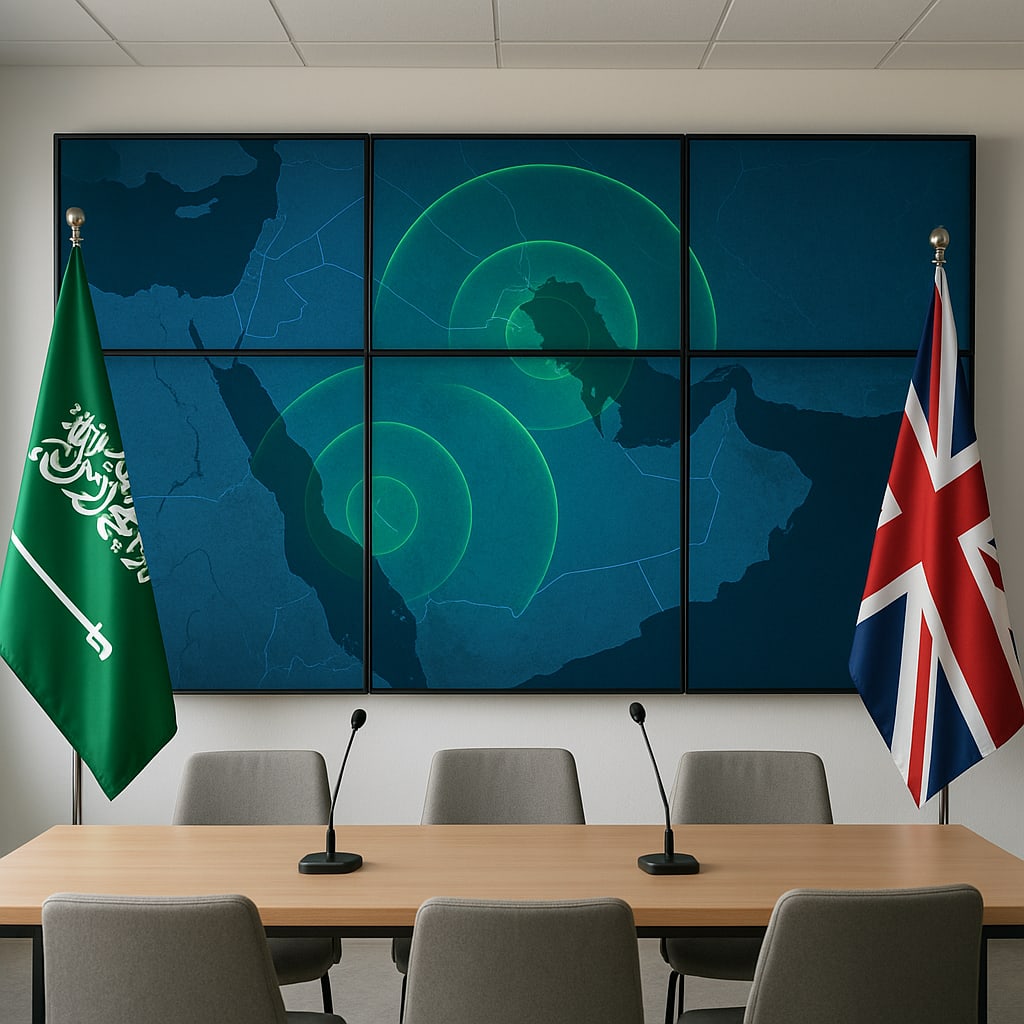
UK deploys RAF Typhoons to defend Saudi Arabia as Houthi attacks prompt Riyadh safeguards and investment summit delay
Narrative Snapshot
Across UK and international outlets there is broad agreement that Britain is sending RAF Typhoon fighters to fly defensive counter‑air missions over Saudi cities and critical infrastructure. Multiple reports stress the “defensive” parameters and explicitly note the aircraft will not conduct strikes on the Houthis, reflecting language from the UK Ministry of Defence carried by Middle East Eye, Al Jazeera English, and the South China Morning Post. The Guardian frames the move as the most significant military mission approved by Prime Minister Andy Burnham, highlighting the political weight of the decision.
Several sources foreground the domestic and commercial consequences inside Saudi Arabia. Clarin reports that Riyadh instituted remote work affecting offices in flagship properties such as the Kingdom Centre, with embassies urging caution. The South China Morning Post adds that Saudi Arabia postponed its flagship Future Investment Initiative—“Davos in the Desert”—to 2027 after recent deadly attacks, underscoring how security concerns are disrupting business plans.
Threat characterization diverges. The New York Times refers to the Houthis as Iran-backed, aligning with official shorthand. Fox News, citing former U.S. envoy Tim Lenderking and Saudi coalition spokesperson Turki al‑Maliki, emphasizes the group’s growing independence from Tehran and details recent lethal strikes on Riyadh’s main airport. Meanwhile, Middle East Eye reports on successful Saudi interception of a ballistic missile aimed at the capital, with brief civil defence alerts and blasts heard, highlighting both capability and persistence of the threat.
Regional alignments also appear in coverage. The Hindu quotes Pakistan’s military spokesperson pledging “whatever support is needed” to defend Saudi Arabia, situating the UK deployment within a wider pattern of external backing for Riyadh’s air defence posture.
What Happened
Multiple outlets report the UK will deploy RAF Typhoon jets to Saudi Arabia to fly defensive missions protecting cities and critical infrastructure from Houthi missiles and drones, with the Ministry of Defence specifying no offensive strikes will be undertaken (Middle East Eye; The Guardian; Al Jazeera English; South China Morning Post; New York Times; Folha de S.Paulo; ANSA). Clarin adds London will also send an Atlas A400M transport aircraft. Amid the ongoing threat, Saudi forces said they intercepted a Houthi ballistic missile targeting Riyadh, briefly triggering and then lifting a civil defence alert after blasts were heard in the capital (Middle East Eye). In parallel, Saudi authorities shifted Riyadh offices to remote work and embassies urged caution (Clarin). The South China Morning Post reports Saudi Arabia postponed its Future Investment Initiative to 2027 following recent deadly attacks. Pakistan’s army publicly offered “whatever support is needed” to defend Saudi Arabia (The Hindu). Fox News, citing Saudi officials, reported multiple October attacks on Riyadh’s airport causing fatalities and injuries.
Why It Matters
The UK deployment formalizes an explicit, operational air‑defence role for a NATO power in Saudi Arabia, reinforcing Riyadh’s external security guarantees and deepening Western involvement against Houthi projectiles that have targeted airports, oil facilities, and urban centres (The Guardian; New York Times). By defining a defensive mandate—no offensive strikes—the UK is drawing a line on rules of engagement reported by Middle East Eye and Al Jazeera English, a constraint that will shape escalation risks and coalition optics.
Economically, the postponement of the Future Investment Initiative to 2027 signals that security conditions are now constraining Saudi Arabia’s marquee investment agenda (South China Morning Post). Remote‑work shifts in Riyadh illustrate immediate urban‑security adjustments affecting corporate operations and diplomatic protocols (Clarin). Regionally, Pakistan’s pledge of open‑ended support (The Hindu) suggests potential broadening of Saudi Arabia’s security partnerships beyond Western allies. Fox News’ emphasis on Houthi operations threatening global infrastructure and shipping highlights the externalities for energy markets and trade corridors that multilateral bodies will need to monitor.
Diverging Narratives
Outlets converge on the UK mission’s defensive scope, but interpret its significance differently. Al Jazeera English and Middle East Eye foreground the Ministry of Defence’s constraint that RAF aircraft will not strike the Houthis, while The Guardian emphasizes the decision’s weight as Andy Burnham’s most significant approved military operation. Clarin characterizes the deployment as an escalation in Britain’s regional involvement, even as the UK communicates a limited mandate.
On the threat profile, the New York Times’ “Iran‑backed” shorthand contrasts with Fox News’ reporting that the Houthis are operating with increasing independence from Tehran; Fox also publishes detailed Saudi‑sourced casualty counts from attacks on Riyadh’s airport, which other outlets do not quantify. Coverage also differs on impact: Middle East Eye reports successful Saudi interception and transient alerts in the capital, while the South China Morning Post focuses on the strategic economic fallout via FII’s postponement. Clarin’s reporting on enforced telework and embassy cautions in Riyadh shifts attention to civilian and corporate risk management, a dimension less visible in the UK and U.S. pieces centered on air operations and attribution.
What Happens Next
Two immediate decision points are the durability of the UK’s defensive‑only parameters and whether mission tasks expand if intercept demand grows. Analysts should watch for MoD updates on rules of engagement and any reporting—like The Guardian’s—of RAF attempts to shoot down missiles and drones, which would test operational thresholds set out by Middle East Eye and Al Jazeera English.
Saudi domestic posture will hinge on the frequency and effectiveness of interceptions. Continuation or rollback of remote‑work directives and civil‑defence alerts, as reported by Clarin and Middle East Eye, will indicate perceived urban risk levels. On the economic front, the timing and conditions for rescheduling the Future Investment Initiative to 2027, highlighted by the South China Morning Post, will reflect investor confidence in security arrangements. Regionally, whether Pakistan’s “whatever support is needed” offer (The Hindu) translates into tangible deployments or training will signal the breadth of Riyadh’s coalition. Attack patterns on airports and energy infrastructure, cited by The Guardian, Fox News, and Folha de S.Paulo, remain the principal indicator set for policy recalibration.