
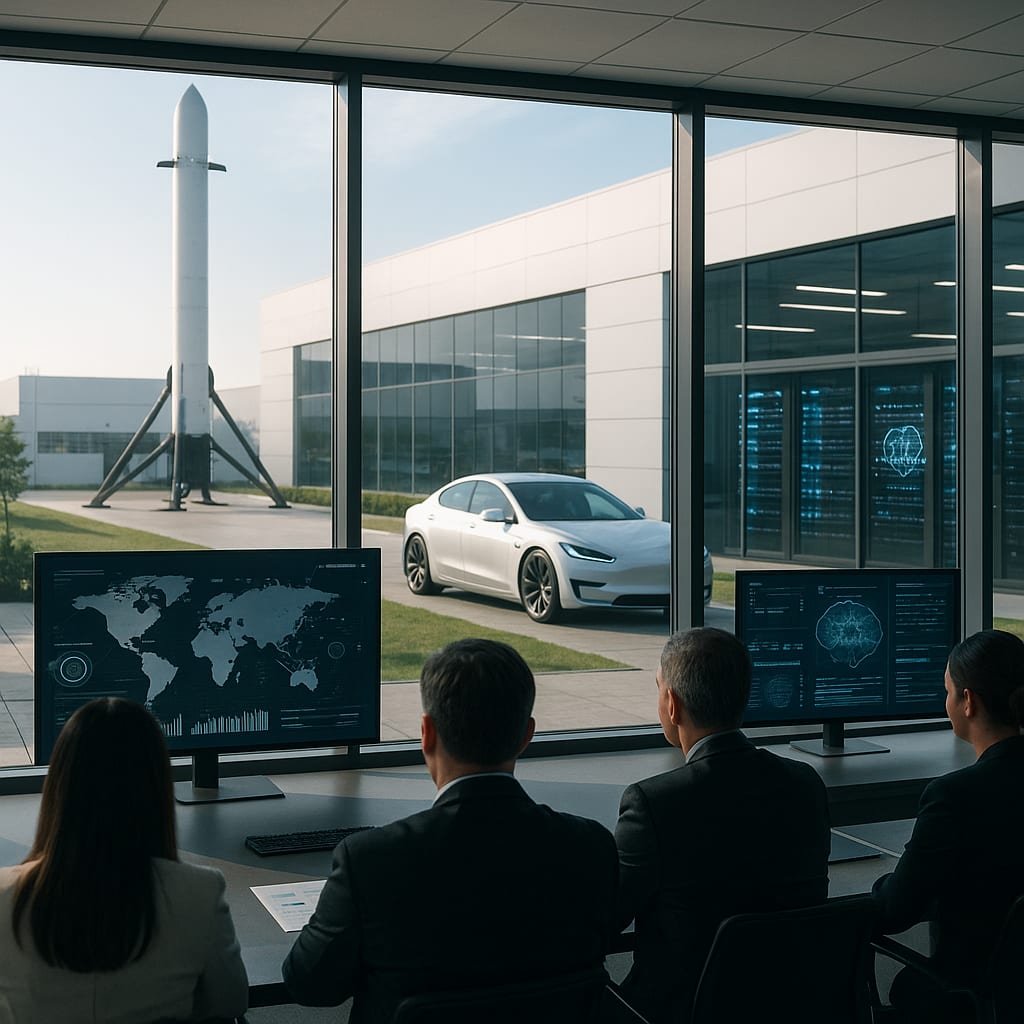
SpaceX and Tesla Explore Potential Merger as Musk Links Cars, Rockets and AI
Narrative Snapshot
The coverage broadly agrees that the proposed combination remains exploratory rather than completed. Reports consistently identify special committees at SpaceX and Tesla and present the transaction as potentially the largest corporate merger in history. Musk’s own formulation—there is “a lot of merit” in combining the companies—anchors most accounts, while Deutsche Welle emphasizes his warning that it would be premature to assume a deal is certain.
The principal difference lies in what the proposed merger is understood to represent. BBC News and Al Jazeera English foreground its unprecedented scale, with Al Jazeera describing a prospective $3.5 trillion company. The New York Times places the value at well over $3 trillion and frames the transaction as a consolidation of Musk’s interests in rockets, vehicles and artificial intelligence. Japan Times instead emphasizes the industrial breadth of the resulting conglomerate, spanning electric vehicles, batteries, rockets and satellites.
Coverage also separates the strategic rationale from Tesla’s immediate operating position. Reports focused on SpaceX highlight its new profitability and AI-computing revenue, while accounts focused on Tesla stress declining profit, weaker vehicle and energy-storage sales, or heavy spending on AI and robotics. The unresolved issue is therefore not only whether the companies can be combined, but whether the merger would be interpreted primarily as an AI and infrastructure strategy, a response to Tesla’s changing business outlook, or an expansion of Musk’s corporate and personal economic position.
What Happened
Musk said SpaceX and Tesla had formed special committees to examine a possible merger, describing cooperation on “superintelligence software” as a major potential benefit. He said he was not participating in the committee discussions and later declined to provide additional detail during Tesla’s earnings call, saying he was “tap dancing through a minefield.” SpaceX reported its first quarterly profit since becoming publicly traded, with Bangkok Post attributing the result to agreements to rent computing capacity to AI companies. Tesla’s results presented a more mixed picture: the Guardian said the company exceeded earnings expectations, while the New York Times and Folha de S.Paulo reported declining profit linked to weaker vehicle sales and, in Folha’s account, lower energy-storage sales.
Why It Matters
The proposed transaction would bring several strategically important activities under one corporate structure: electric vehicles, batteries, launch services, satellites, AI software and computing infrastructure. The reported valuations—above $3 trillion in the New York Times and $3.5 trillion in Al Jazeera English—indicate the scale of capital and technological concentration at issue, even though no transaction has been agreed. The proposal also illustrates how AI is becoming a connective rationale across sectors that have traditionally been managed separately. For decision-makers, the governance dimension is immediate. Musk leads both companies, yet the committees are presented as independent exploratory mechanisms, and the Guardian reports that approval would require the support of 50% of Tesla shareholders. The eventual process would therefore test how shareholder oversight operates when one executive controls both sides of a proposed combination.
Diverging Narratives
The sources do not report a direct disagreement over the existence of merger discussions, but they assign different weight to the reasons for considering a deal. Musk and the SpaceX-focused coverage present the combination as strategically complementary, particularly because both companies could cooperate on advanced AI software and computing. The Japan Times frames the proposal as a push that capitalizes on SpaceX’s momentum, while the Toronto Star notes that investors appear to believe Musk can execute an exceptionally large transaction and highlights its possible effect on his personal fortune.
Tesla-focused accounts place greater emphasis on pressure within the carmaker. The New York Times reports that profit declined as Tesla spent heavily on AI and other technologies, and Japan Times says AI and robotics spending trailed expectations while the company pursued futuristic business lines. Folha de S.Paulo links lower profit to weaker vehicle and energy-storage sales. These accounts do not establish that the merger is a response to Tesla’s performance, but they create a different interpretive context from reports centered on SpaceX’s profitability. There is also variation in the reported prospective valuation, from well over $3 trillion to $3.5 trillion, reflecting the preliminary status of the proposal rather than a settled transaction value.
What Happens Next
The first decision point is whether the special committees move beyond exploration. Their work, and any further statement from either company, will indicate whether the proposal has developed into a defined transaction or remains an idea endorsed by Musk. His stated nonparticipation in the committees and his refusal to elaborate on Tesla’s earnings call make the committees’ formal conclusions especially important.
A second point is shareholder approval. The Guardian reports that a merger would require approval from 50% of Tesla shareholders, making investor assessment of Tesla’s weaker sales and profit, its AI spending, and SpaceX’s reported computing-related profitability directly relevant. If the companies proceed, the terms, valuation and governance arrangements will determine how the two businesses and Musk’s interests are treated. If they do not, the reported operational trends will remain separate: SpaceX’s expansion into profitable AI computing and Tesla’s effort to justify substantial spending on AI and robotics.