
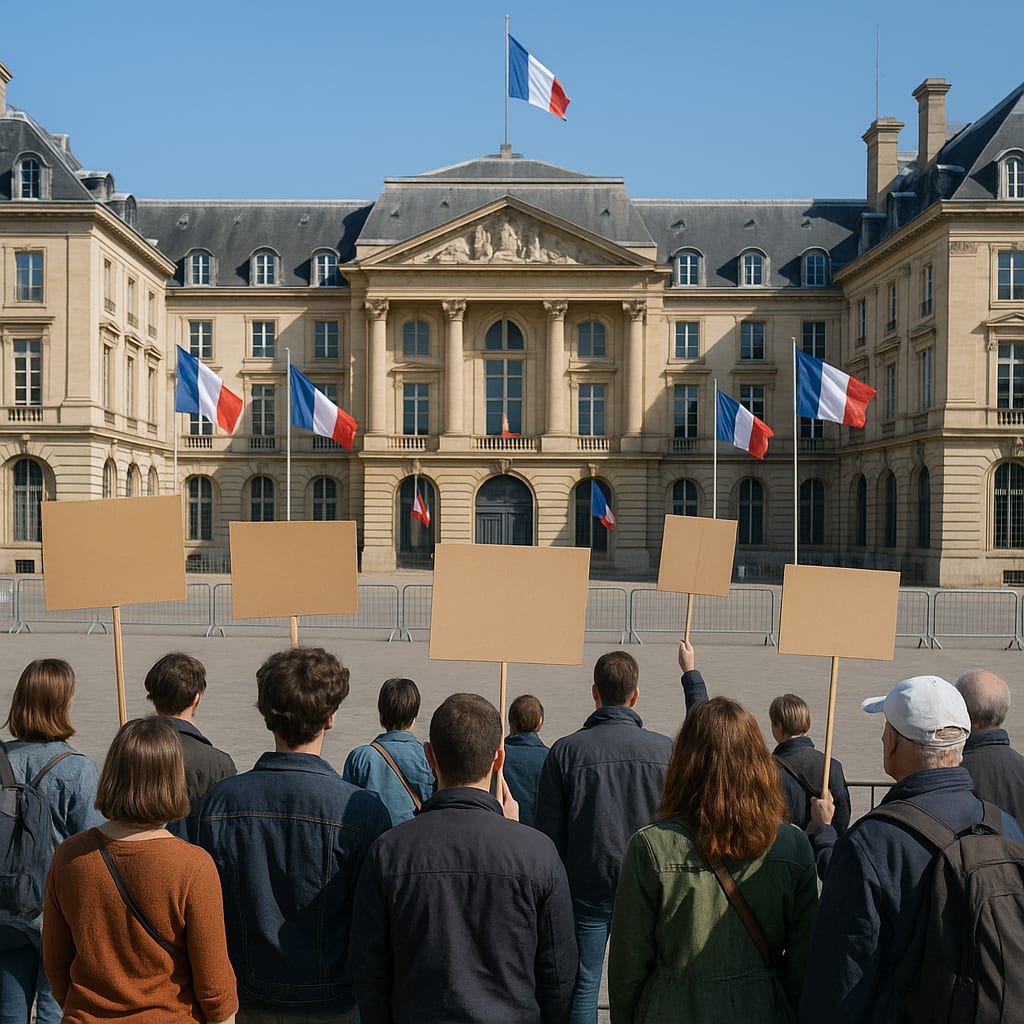
France faces renewed protests as government reviews security response and Macron rebukes foreign commentary
Narrative Snapshot
The coverage broadly agrees that the unrest combines two distinct developments: a sustained student movement centred on deteriorating educational conditions and a wider cost-of-living mobilisation that attracted hundreds of thousands of demonstrators, alongside looting, arson and clashes in several cities. French and international outlets differ mainly in emphasis. France24, The Guardian and sources from Telesur foreground the alleged failures of policing, intelligence and education policy, while the South China Morning Post and Al Jazeera place greater weight on the scale of the disorder and its political consequences for Macron’s government.
The security response is presented as both an operational failure and a test of the government’s political legitimacy. Interior Minister Laurent Nunez acknowledged that police had “lost control” in some cities and cited inadequate anticipation before offering his resignation, which Macron rejected. Reports describe curfews, mass arrests, injuries to police and protesters, and preparations for a “massive” police deployment. At the same time, unions and educators are presented as actors seeking to preserve the right to demonstrate rather than simply opponents of public order.
A second layer of coverage concerns information warfare and external political exploitation. Macron accused foreign leaders of spreading false or AI-generated material, apparently referring to Donald Trump and Benjamin Netanyahu, both of whom face elections in the coming weeks. France24 reported an Alliance4Europe assessment alleging that pro-Russian networks amplified anger before the protests, while The Times of Israel documented antisemitic conspiracies attributing the unrest to Jews, Israel or Zionists. These reports raise the stakes beyond France’s domestic crisis, but the sources describe allegations and online narratives rather than establishing that foreign activity caused the unrest.
What Happened
The protests began with high-school and student blockades over absent teachers, poor facilities and declining educational standards, according to The Guardian and France24, and later incorporated grievances over living costs and agricultural conditions. On 17 October, peaceful demonstrations were accompanied by looting, vandalism and fires, including the severe damage to Limoges town hall. ANSA reported 855 arrests in Paris and more than 1,200 nationwide, while other accounts cited larger national detention figures and extensive injuries. Nunez said police had failed to anticipate the violence and submitted his resignation; Macron refused it while ordering a security review. Prime Minister Sébastien Lecornu subsequently announced stronger deployments, supported the use of military personnel for logistical backing, and scheduled talks with unions before further demonstrations.
Why It Matters
The episode tests whether France can reconcile the constitutional freedom to demonstrate with the state’s obligation to protect public institutions, businesses and vulnerable communities. The government’s response will shape the credibility of its policing and intelligence frameworks after the interior minister acknowledged an anticipation failure. It also exposes longer-term pressures in public education, where teachers describe years of underinvestment and widening inequality, and in household finances, which brought student, labour and other social grievances into the same mobilisation.
The international dimension affects France’s information-security and diplomatic environment. Allegations involving pro-Russian amplification, AI-generated images and antisemitic online conspiracies show how domestic unrest can be reframed through foreign or communal narratives. Macron’s criticism of foreign leaders also intersects with his Gulf tour, during which he sought additional energy supplies as France faces cost-of-living pressures. For European governments and multilateral institutions, the case links democratic resilience, platform manipulation, protest policing and energy diplomacy rather than treating them as separate policy areas.
Diverging Narratives
The principal unresolved issue is whether the violence should be understood primarily as an outgrowth of legitimate social mobilisation, a breakdown in state preparedness, or a coordinated effort to exploit public anger. Accounts focused on education describe a movement rooted in years of unmet demands, police injuries to teenagers and alleged racial insults or excessive use of weapons. Other reports stress that looters hijacked otherwise peaceful demonstrations, that public buildings and shops were attacked, and that rioters used digital tools to coordinate actions. The sources support both descriptions but do not establish how much of the violence was organised in advance or how far it was connected to the student movement.
There is also a reporting discrepancy over casualties and detentions. Middle East Eye reported two deaths and thousands of injuries, while Telesur cited one protester killed, 600 police, gendarmes and firefighters injured, and 2,000 detained; ANSA gave a lower figure for arrests reported in Paris and nationally. These differences may reflect different reporting times or counting methods, but the supplied accounts do not resolve them. Similarly, the Alliance4Europe findings identify alleged pro-Russian amplification, while Macron’s remarks focus on foreign political commentary and fabricated media. Neither establishes that external actors initiated the protests.
What Happens Next
The immediate decision point is whether the government prioritises deterrence through expanded security measures or combines them with negotiated responses to the underlying grievances. Lecornu’s planned meetings with five unions are intended to discuss how to guarantee the freedom to demonstrate, while the government has also announced curfews and a large police presence. The treatment of further protests, including arrests, use of force and any additional injuries, will indicate whether the state’s response is restoring control or intensifying the education and cost-of-living backlash.
A second indicator is institutional accountability. Analysts should watch whether the promised security review produces changes in intelligence coordination, protest planning or ministerial responsibility after Nunez’s resignation offer. A third is the evidentiary development around online manipulation. The credibility of claims concerning AI-generated material, pro-Russian networks and antisemitic conspiracies will depend on the release of verifiable research rather than political assertion. Finally, Macron’s energy commitments in the Gulf may become relevant if they translate into measures capable of addressing the cost pressures that helped broaden the protests.