
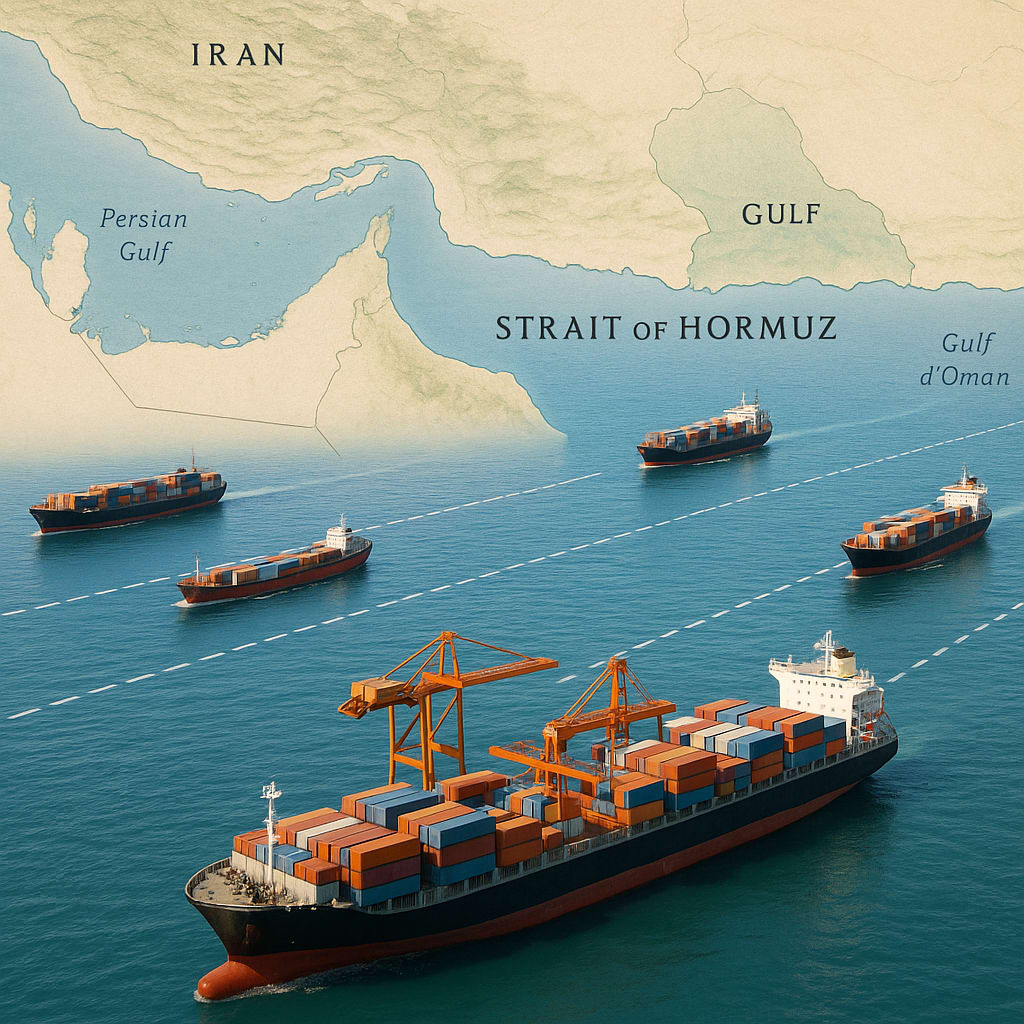
Iran, the United States and the Contest Over Practical Access to the Strait of Hormuz
Narrative Snapshot
The latest reporting presents the Strait of Hormuz as neither simply closed nor operating normally. U.S. Central Command says that approximately 97 percent of ships seeking passage have transited without being struck and describes the waterway as open, with American forces coordinating protection for thousands of vessels. The International Maritime Organization, however, reports a much more constrained operating environment: its secretary-general described a “double blockade,” said about 6,000 seafarers remained trapped, and advised against transit until guarantees were available. Ongoing movement therefore does not establish safe or unrestricted passage.
Iranian statements frame the same operating environment in different terms. The IRGC Navy says it is managing and controlling the strait, attributes several incidents to vessels using routes Tehran considers unauthorized, and warns that continued U.S. efforts to encourage shipping through a mined passage could widen the confrontation to American bases in the region. The Iranian position is consequently less about formal closure than about asserting authority over the conditions under which ships may pass.
The economic evidence complicates any claim that attacks have halted Gulf exports. Middle East Eye, citing Kpler, reports that Gulf states exported 24.6 million barrels per day in the week ending October 18, above the reported prewar level of 23.3 million barrels per day. Ship-to-ship transfers and routes through the Red Sea have helped sustain flows, even as they add operational complexity and may frustrate Iran’s effort to establish effective control. The central contest is therefore over the difference between nominal availability, commercially usable access and passage under military protection.
Read alongside the October 18 Nereid Atlas story, the October 20–22 reporting extends the issue from individual incidents to a broader struggle over who determines navigational legitimacy, who provides security and which risks commercial operators must accept. The immediate stakes include crews and vessels, but also the credibility of U.S. maritime guarantees, Iran’s coercive leverage, Gulf export resilience and the ability of diplomatic arrangements to regulate access.
What Happened
The recent incidents followed earlier attacks on commercial shipping, including the reported sinking of the Singapore-flagged, Cyprus-owned container ship GFS Pride after it was hit by an Iranian projectile, according to CENTCOM; Russia’s RT reported that the vessel struck a mine and later sank, while all 21 crew members were rescued. A second Singapore-registered vessel, GFS Giselle, sustained hull damage but continued under its own power. On October 17, Iranian authorities reported that two supertankers had struck mines, with one carrying more than two million barrels of crude. IRNA reported another supertanker explosion and fire on October 20. On October 22, the IRGC said four vessels involved in illegal oil transfers had been targeted and that three others had collided with mines. The condition of those crews was not reported by TASS.
Why It Matters
The dispute tests the practical meaning of freedom of navigation in a conflict environment where a waterway can remain physically traversable while becoming commercially hazardous. U.S. protection operations seek to preserve an international shipping regime in which passage is not subject to Iranian authorization. Iran’s claims of route control challenge that principle by asserting that ships using designated or approved channels can be distinguished from vessels operating under U.S. direction.
The consequences extend beyond naval signaling. Gulf governments are maintaining substantial export volumes through ship-to-ship transfers and alternative routes, but those adaptations can increase costs, delay cargoes and expose more infrastructure and crews to risk. Earlier reporting also alleged that Gulf states had downplayed damage to energy and port facilities from Iranian or Iran-linked attacks, although the supplied material does not independently establish the extent of that damage. For the IMO, the reported deaths, trapped seafarers and warnings against transit expose limits in existing maritime safety arrangements when commercial navigation becomes part of a military contest.
Diplomatically, Tehran’s seven-day initiative, as described by Iran’s foreign ministry in TASS, is conditional on the fulfillment of previously reached U.S. commitments. Qatar and France have called for the strait to be opened while also pressing for implementation of a Gaza ceasefire. That linkage places maritime access within a wider regional bargaining framework rather than treating it solely as a navigational or technical question.
Diverging Narratives
The most consequential disagreement concerns how the incidents occurred and what they demonstrate. Iranian military and state-linked accounts attribute the tanker and container-ship incidents to mines, unauthorized routes and, in one account, U.S. deception that induced vessels to disable positioning and radar systems. The IRGC says the GFS Pride used an “unauthorized and dangerous route” and argues that U.S. pressure to send ships through a mined passage has increased incidents. These claims are not independently verified in the supplied reporting, and Washington’s response to the allegation about disabling systems is not included.
U.S. officials present a different operational picture. CENTCOM says most attempted Iranian attacks have failed, that protected shipping continues to transit and that Iran has not achieved its objective of closing the strait. Its account identifies the GFS Pride as struck by an Iranian projectile, while RT reports a mine strike, illustrating a specific unresolved discrepancy in the record. The U.S. position also emphasizes the aggregate number of successful transits, whereas the IMO emphasizes the human and operational costs of the attacks that did occur.
Iran’s October 22 statement adds another layer by describing four vessels as targets in connection with illegal oil transfers, rather than presenting all incidents as accidental mine strikes. The available sources do not establish the vessels’ legal status, the evidence for the alleged transfers or whether the attacks were linked operationally. The result is a contest not only over access, but over the categories used to define legitimate shipping, military action and maritime security.
What Happens Next
The immediate decision point is whether commercial operators and states treat the strait as open in the U.S. sense or usable only under conditions that satisfy Iranian control claims and international safety concerns. A continuation of U.S.-coordinated escorts and successful transits would support CENTCOM’s account that passage remains operational, but repeated attacks, casualties or prolonged crew displacement would reinforce the IMO’s warning that transit is not safely available.
A second indicator is the durability of alternative logistics. Sustained export volumes through ship-to-ship transfers and Red Sea routes would reduce the immediate economic effect of Iranian pressure while increasing reliance on costlier and potentially more exposed arrangements. A decline in those flows would signal greater practical leverage for Tehran even without a formal closure.
Diplomatically, analysts should watch whether Washington responds to Tehran’s seven-day initiative and its demand that prior commitments be honored, and whether Qatar and France can connect reopening the strait with broader ceasefire implementation. The key question is whether access becomes part of a negotiated framework or remains governed by unilateral naval protection, Iranian warnings and contested rules for navigation.