
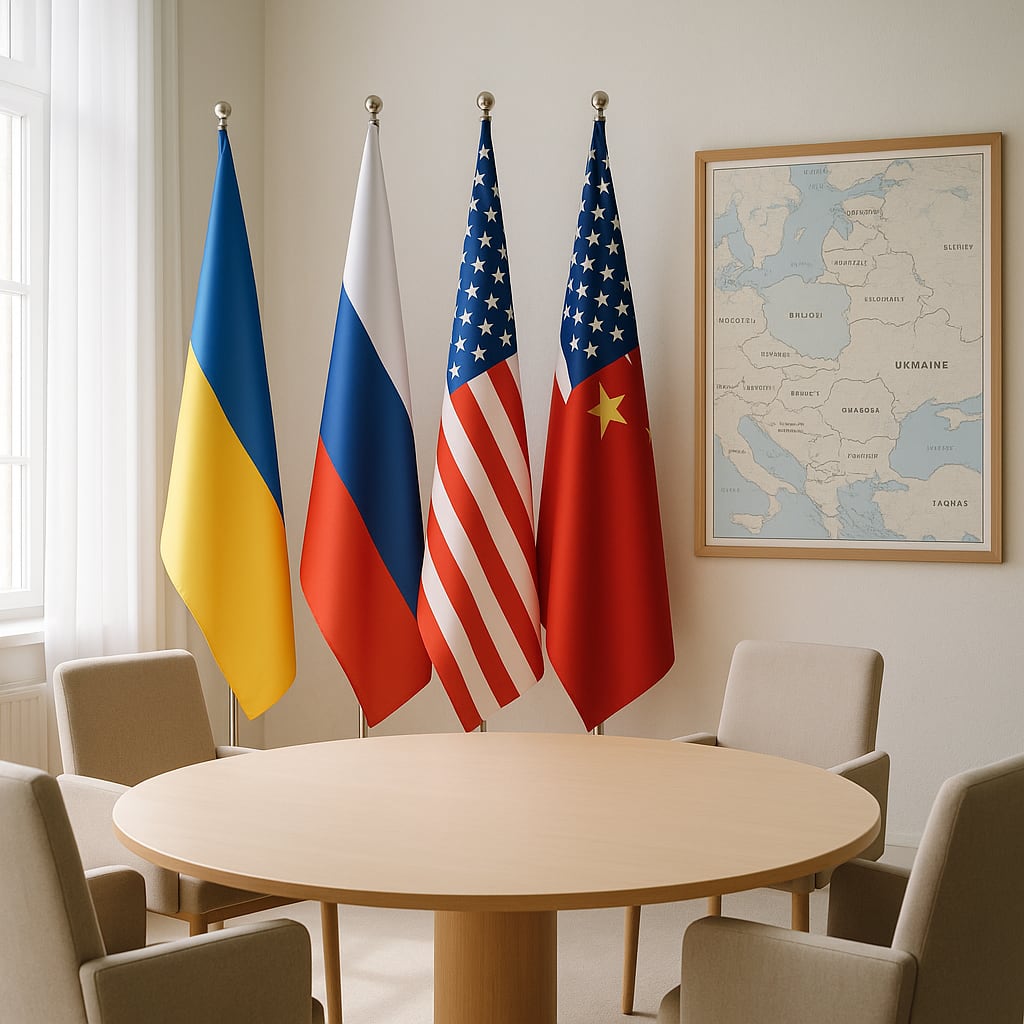
Russia Signals Readiness to Resume US-Russia-Ukraine Trilateral Talks After Witkoff-Putin Meeting
Narrative Snapshot
The sources broadly agree that the meeting between US envoy Steve Witkoff and Russian President Vladimir Putin produced a stated Russian willingness to resume negotiations involving Russia, the United States and Ukraine. Russian officials describe the discussions as potentially restarting in November, while US and Ukrainian accounts characterize the process more cautiously, emphasizing technical consultations and agenda-setting rather than a confirmed political meeting.
The main distinction across the coverage concerns Kyiv’s role. Russian statements reported by TASS, France24, the BBC and Al Jazeera explicitly refer to a trilateral format that includes Ukraine. Ukrainian President Volodymyr Zelenskyy likewise said that Ukraine, the United States and Russia would discuss the agenda for a possible meeting. The available reporting therefore supports Kyiv’s direct inclusion in the proposed format, while leaving unresolved whether Ukrainian participation would be at the leadership or technical level.
The timing and venue remain unsettled. Russian officials referred to around November 10 or mid-November, while Zelenskyy described early November as a possibility and said no exact date had been set. TASS reported that Abu Dhabi talks could involve experts, but the sources do not establish that Abu Dhabi has been confirmed as the venue for the broader process.
What Happened
On October 21, Witkoff met Putin in St Petersburg as part of US efforts to advance negotiations over Russia’s war against Ukraine. Kremlin adviser Yury Ushakov said afterward that Moscow was prepared in principle to resume trilateral negotiations around November 10, focused on establishing a “security system” for Russia and Ukraine after the conflict. Other Russian reporting placed a possible resumption in mid-November and said Putin would decide the composition of Russia’s delegation, potentially including officials and military officers. Witkoff said the discussions would continue at the technical level in a trilateral format. Zelenskyy said Ukraine, the United States and Russia would work on an agenda for a possible meeting, but that its date had not been finalized.
Why It Matters
A resumed trilateral process would restore a negotiating channel that formally places Ukraine alongside the United States and Russia, rather than treating the conflict solely as a bilateral US-Russia matter. That distinction is consequential for any discussion of security arrangements affecting Ukrainian territory and postwar governance. The sources also indicate that the process may initially be conducted by experts or at a technical level, suggesting an effort to clarify substantive issues before any higher-level political engagement. For Washington, the reported framework offers a mechanism for testing whether Russian and Ukrainian positions can be brought into a common agenda. For Kyiv, direct participation would preserve its role as a party to negotiations. For Moscow, the stated focus on a post-conflict security system keeps Russia’s security demands at the center of the process.
Diverging Narratives
Russian officials present the meeting as evidence that Moscow is ready to restart negotiations, but their formulation places emphasis on Russia’s preferred substantive objective: a security system for Russia and Ukraine after the war. Kremlin spokesman Dmitry Peskov, as reported by CGTN, said progress was theoretically possible but depended substantially on decisions by Kyiv, adding that the situation for Ukraine would worsen if it failed to make the necessary choices. That framing casts Ukraine as responsible for converting diplomatic potential into progress.
The US account reported by Ukrinform is narrower and procedural. Witkoff described continued discussions at the technical level, without confirming a political settlement or a final meeting date. Ukraine’s account similarly stresses preparation: Zelenskyy said the parties would work out an agenda for a trilateral meeting that could occur in early November. The sources therefore show agreement on a possible trilateral channel but not on its maturity, timetable or substantive agenda. Russian reports also refer to mid-November, while Ukrainian reporting says the date remains unsettled. None of the cited sources confirms that a meeting has been scheduled.
What Happens Next
The immediate decision point is whether the parties can convert the reported readiness into an agreed agenda and format. If technical-level consultations proceed, analysts should watch whether Ukraine, the United States and Russia identify common subjects beyond the general discussion of postwar security. A second indicator is the timing: Russian references to around November 10 or mid-November will matter only if matched by Ukrainian and US confirmation. The composition of delegations will also clarify the process’s intended level, since Russian officials say Putin will determine who participates and TASS reports that experts may be involved. A formally agreed date, venue and agenda would indicate that the trilateral channel has moved beyond an announced willingness to resume; continued ambiguity would leave it at the level of preliminary diplomacy.