
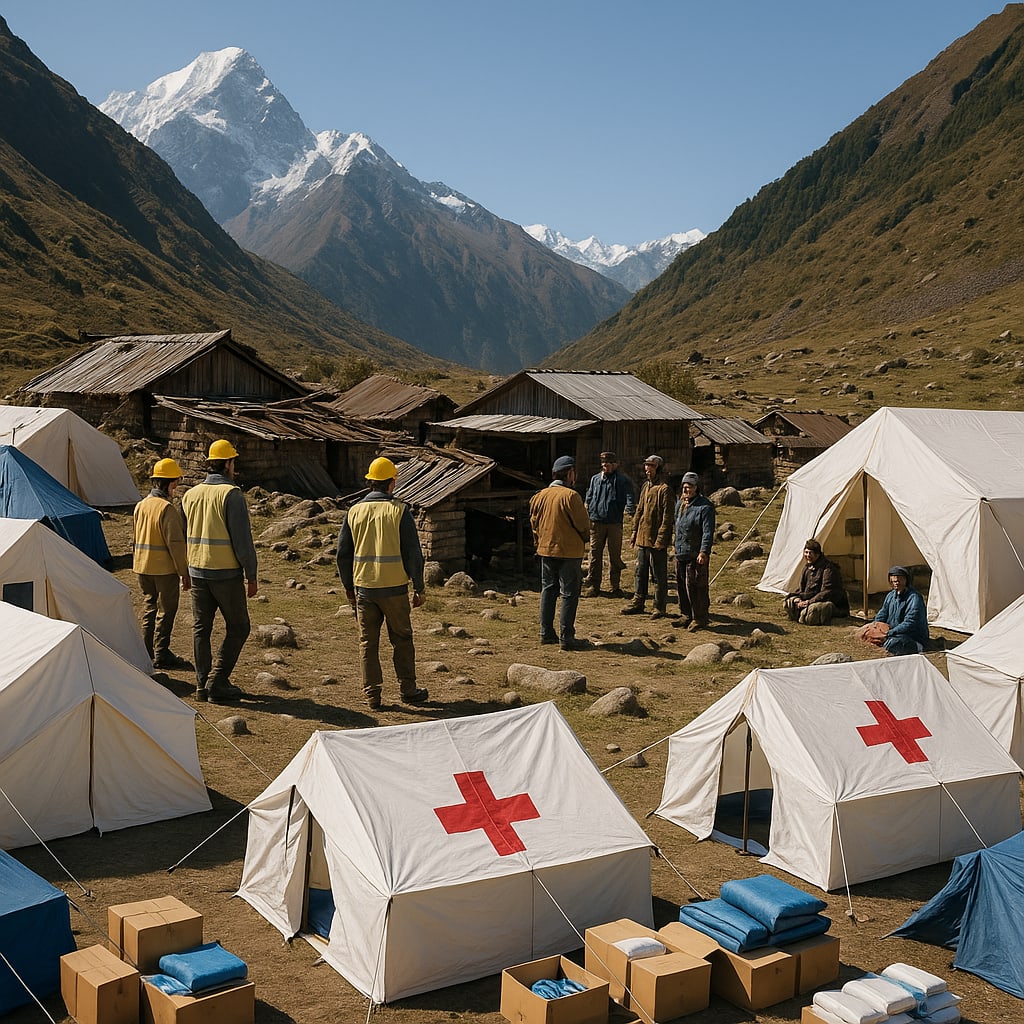
Magnitude-7 Earthquake in Tibet Kills at Least 16 and Collapses Hundreds of Homes
Narrative Snapshot
The coverage is broadly consistent on the earthquake’s magnitude, timing and location in the Nagqu area of China’s Tibet/Xizang region. Most reports rely on Chinese official sources, including the China Earthquake Networks Center, Xinhua, local authorities and state media. The strongest common emphasis is on the physical damage: hundreds of homes collapsed, along with livestock sheds, while rescue operations continued.
The main divergence concerns the reported number of injured. Early accounts cited 32 people, while later figures ranged from 46 to 54. The Hindu reported that 11 of the injured were in serious condition and 21 had minor injuries, indicating that at least some figures were tied to successive official updates rather than independent assessments.
Geographic framing also varies. Chinese and several international outlets describe the event as occurring in Xizang or Tibet, while reports differ over whether the area should be characterized as southwestern, northeastern or northern Tibet. Telesur gives greater prominence to the earthquake’s reported effects across the Himalayan region, including alerts in India, Myanmar and Nepal; most other coverage remains focused on the local rescue operation.
What Happened
The earthquake struck Baqen County in Nagqu City at 22:33 local time on 22 October, according to the China Earthquake Networks Center. The CENC placed the epicenter at 32.40 degrees north latitude and 93.79 degrees east longitude, at a depth of 10 kilometers. Other reporting located it roughly 190 to 202 kilometers from Nagqu and about 390 kilometers northeast of Lhasa. The shallow quake caused at least 339 homes and 20 livestock sheds to collapse. By the following morning, official figures recorded 16 deaths and between 46 and 54 injuries, while earlier reports had cited 32 injured. Search-and-rescue teams and Chinese government agencies were deployed as authorities assessed damage and reached affected communities.
Why It Matters
The event highlights the operational difficulties of disaster response in a remote, mountainous and sparsely populated part of the Himalaya. The reported depth and terrain help explain why a relatively limited urban population could nevertheless face substantial damage to homes, livestock facilities, roads and basic services. For Chinese authorities, the immediate test is the capacity of local and national institutions to coordinate rescue, medical treatment and infrastructure assessment under difficult access conditions.
The earthquake also has a regional dimension because Telesur reported that tremors were felt across neighboring Himalayan areas, including parts of India, Myanmar and Nepal. That does not establish comparable damage outside China, but it makes cross-border information-sharing and monitoring relevant to governments and regional emergency agencies. The varying casualty figures further underscore the importance of consistent, timely disaster reporting for international organizations and outside governments assessing whether assistance or technical coordination may be needed.
Diverging Narratives
The clearest unresolved issue is the casualty count. Al Jazeera, Bangkok Post and TASS initially reported 32 injured, while CBC and RT cited 46, and The Guardian and Corriere della Sera reported 54. The Hindu supplied a breakdown of 11 serious and 21 minor injuries, but the available sources do not explain whether later totals reflect newly identified victims, different reporting times or revised local data. The death toll remained at 16 across the reports examined.
There is also variation in geographic description. The CENC identified Baqen County in Nagqu City, while the US Geological Survey location cited by the South China Morning Post placed the epicenter about 190 kilometers east-northeast of Nagqu. Media descriptions alternately call the area part of southwestern China, northern Tibet or northeastern Tibet. These differences appear to reflect differing geographic reference points rather than a documented dispute over the epicenter. Finally, Deutsche Welle characterized the quake as the strongest to strike the remote Himalayan region in five years, a contextual claim not developed by the other reports.
What Happens Next
The immediate decision point is whether continuing searches produce additional victims or revised injury figures. Analysts should watch successive statements from Nagqu authorities, Xinhua, state media and the CENC for changes in fatalities, injuries, collapsed structures and the condition of those reported seriously hurt. A second indicator is whether rescue teams can restore access and basic services in the affected communities, particularly given the region’s mountainous terrain and reported infrastructure disruption.
A further question is whether the event remains a localized Chinese disaster or generates a broader regional emergency response. Reports that residents in India, Myanmar and Nepal felt the shaking warrant attention to official assessments from those countries, although the sources do not report comparable damage there. The evolution of China’s reported emergency response, including the Level-II activation cited by RT, will indicate the scale at which authorities continue to manage relief and reconstruction.