
Nigeria Reports First Ebola Case as Bundibugyo Outbreak Reaches West Africa
Narrative Snapshot
Coverage broadly agrees on the essential laboratory and epidemiological facts: Nigeria detected the Bundibugyo strain, the patient had travelled from Uganda, and the case represents the outbreak’s first reported arrival in West Africa. The Hindu adds that Nigerian authorities conducted three molecular tests before confirming the strain, while France 24, Al Jazeera English, and the South China Morning Post place the case within an outbreak that began in the Democratic Republic of Congo in May.
The principal difference lies in the scale and framing of the event. International and African outlets emphasize geographic expansion and the possibility of a wider regional emergency. The New York Times describes the outbreak as having its widest expansion ever; CBC focuses on growing concern about a pan-African crisis; and the WHO, as reported by several outlets, calls the situation “complex.” Africa CDC coverage places greater weight on collective responsibility, international solidarity, surveillance, and resistance to political blame.
The sources also vary in how they identify the patient. Most describe her as a woman who travelled from Uganda and was admitted to a private hospital in Abuja. AllAfrica, citing Premium Times, says she was born in Uganda, resides in Abuja, and spent several days there before her husband, a diplomat, joined her. Folha de S.Paulo describes the patient as a diplomat, a characterization not supported by the other reports. This distinction matters because the patient’s full travel history is central to determining where and when exposure occurred.
What Happened
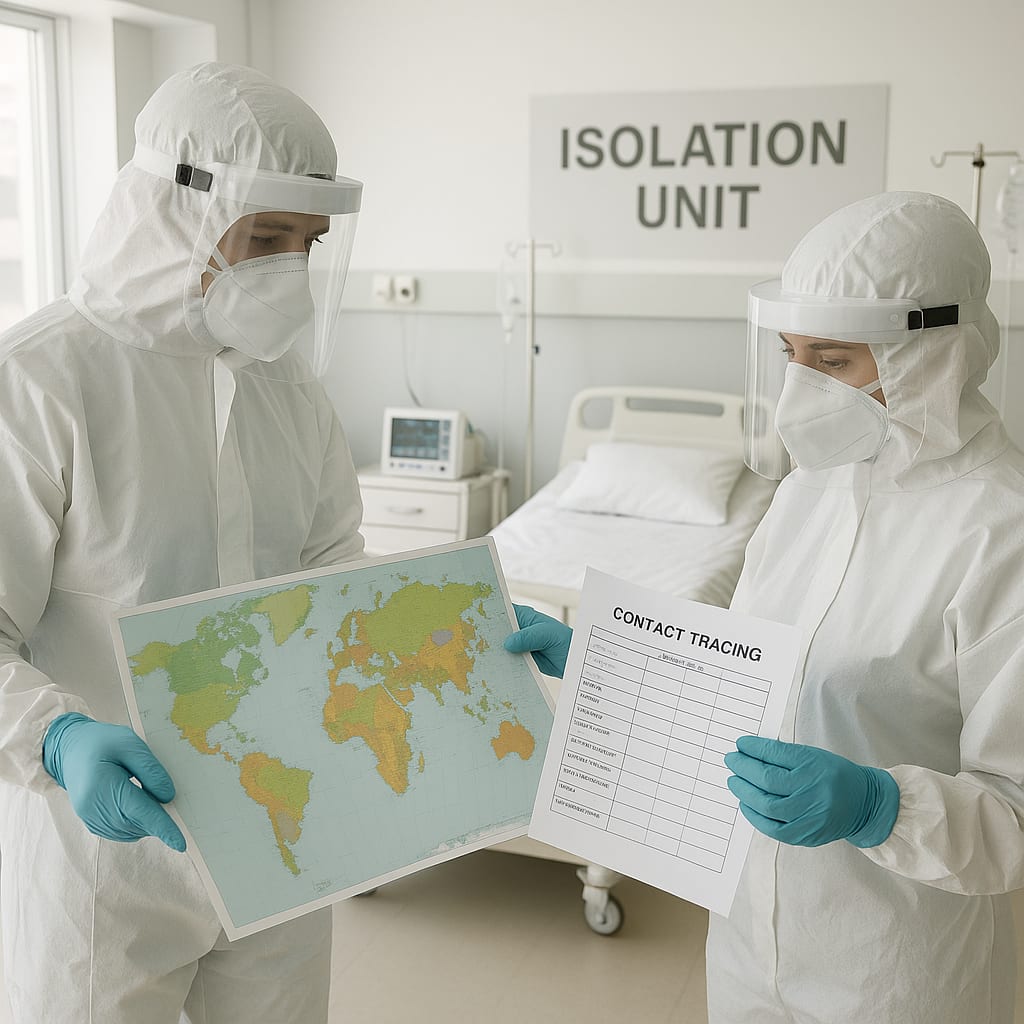
Nigeria’s Health Minister Muhammad Ali Pate announced on 21 October that a woman who arrived in Abuja on an international flight from Uganda had tested positive for Ebola. She had sought care at a private hospital and remained there for several days before laboratory confirmation. Nigerian authorities isolated her, began treatment, and identified 44 close contacts, according to Telesur English. The Nigeria Centre for Disease Control and Prevention confirmed the Bundibugyo strain after three molecular tests, the Hindu reported. Africa CDC Director General Jean Kaseya subsequently urged authorities to obtain the patient’s complete travel history. Reports identify the Democratic Republic of Congo as the outbreak’s origin and Uganda and Kenya as other affected countries, although some coverage describes Nigeria as the fourth affected country while WHO reports refer to the virus as present in three African countries.
Why It Matters
The case tests whether existing regional surveillance and response arrangements can contain transmission across Africa’s extensive air-travel networks. Nigeria’s status as the continent’s most populous country gives the development particular institutional and operational significance, even though the sources do not report secondary transmission there. The episode also recalls Nigeria’s experience during the 2014 West African Ebola epidemic, noted by Le Monde, and therefore places current containment efforts within an established public-health precedent.
For the Africa CDC and WHO, the policy issue is no longer confined to managing an outbreak in one national setting. Kaseya’s call for international solidarity, tighter surveillance, and an end to politicisation points to a need for coordinated information-sharing and contact tracing across borders. Governments must also maintain public confidence while avoiding finger-pointing, since the source of Nigeria’s case remains under investigation and the patient’s movements are central to the response.
Diverging Narratives
The sources do not substantially dispute that Nigeria’s case is linked epidemiologically to travel from Uganda or that it involves the Bundibugyo strain. Their divergence concerns how much should be inferred from that fact. Some coverage treats the case primarily as an imported infection requiring tracing and isolation. The New York Times and CBC instead foreground the possibility that the outbreak is entering a broader regional phase, while Africa CDC statements stress that the event has achieved an unprecedented geographic reach and cannot be treated as one country’s problem.
There is also variation in descriptions of the outbreak’s scale. Several reports call Nigeria the fourth African country affected, counting the Democratic Republic of Congo, Uganda, and Kenya. Al Jazeera English’s account of a WHO warning refers to the virus as present in three African countries, suggesting a difference in whether Nigeria is being counted alongside or in addition to the countries already experiencing infections. The patient’s status is another unresolved point: most reports identify her as the wife of a diplomat, whereas Folha calls her a diplomat. Finally, officials are still investigating where she was infected, so the reported travel route does not by itself establish the precise source of exposure.
What Happens Next
The immediate decision point is the quality and speed of Nigeria’s contact-tracing operation. Authorities have identified 44 close contacts, and the patient remains isolated. Analysts should watch whether officials expand that number, report symptoms or confirmed transmission among contacts, and publish a fuller account of her movements before and after travel. A contained investigation would support the interpretation of a single imported case; additional linked cases would increase the operational significance of the regional spread described by Africa CDC and WHO.
A second indicator is whether governments translate Africa CDC’s call for solidarity and non-politicisation into coordinated surveillance and information exchange. Kaseya has urged leaders to avoid blame, while WHO officials describe the outbreak as complex and call for tighter monitoring. The practical test will be whether Uganda, Nigeria, the Democratic Republic of Congo, Kenya, and international health bodies align their reporting and tracing efforts. The unresolved travel history remains the key factual input for determining which response pathway is required.