
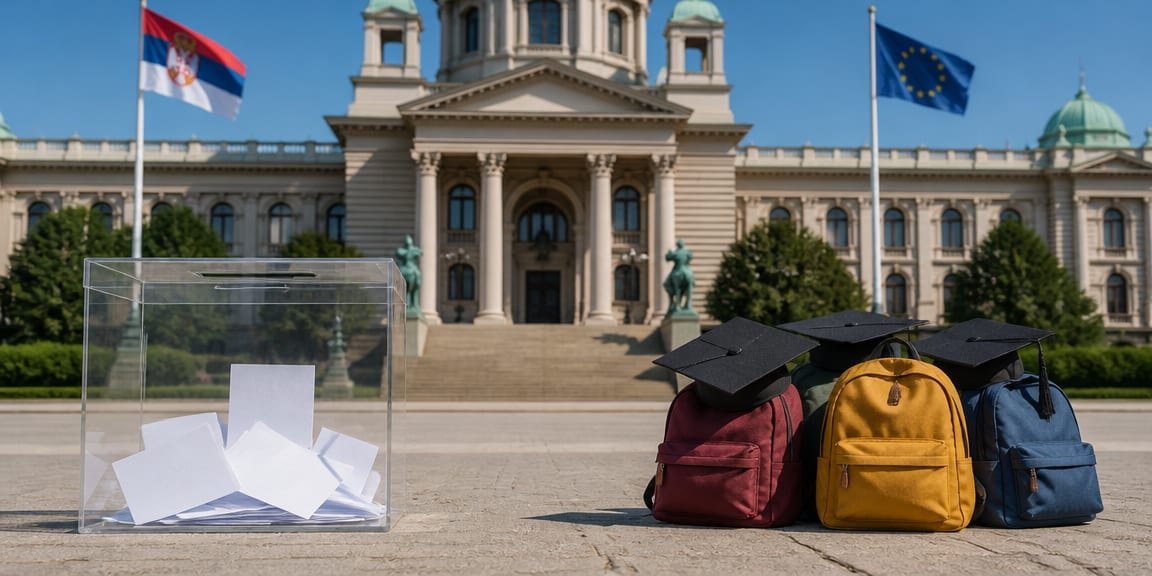
Serbia’s Student-Backed Movement Wins Parliamentary Election as Vučić Concedes Defeat
Narrative Snapshot
The international coverage broadly agrees that Serbia’s parliamentary election marks the end of Aleksandar Vučić’s Serbian Progressive Party dominance, but it assigns different meanings to the result. European and North American outlets emphasize the scale of the political rupture, describing a “seismic” shift, a “historic” election and the opening of a “new political era.” Regional coverage is more focused on the formal result and the end of 14 years of SNS rule. Several reports frame the vote as the electoral culmination of a prolonged student mobilization rather than a conventional contest between established parties.
The coverage also differs in how it characterizes Vučić. BBC News and other Western outlets describe him as a populist right-wing leader or strongman, while The Times of Israel emphasizes his pro-Israel positioning alongside allegations of corruption and creeping authoritarianism. RFE/RL places the result within Serbia’s external orientation, suggesting that a student-led government could move the country closer to Europe and farther from the Kremlin. Russian outlets, by contrast, highlight the election’s implications for the balance between Russia and the European Union without presenting the result primarily as a democratic realignment.
The strongest area of uncertainty concerns the precise institutional outcome. Initial projections cited by Vučić, Ipsos and the Centre for Free Elections and Democracy gave the Student List between 135 and 140 of the National Assembly’s 250 seats, while CGTN reported a projected vote share of 52 percent against 39.3 percent for the SNS-led coalition. These figures indicate an outright majority, but the reports were published before final official results. Coverage also varies in describing Vučić’s period in power, with references to 12 years of leadership and 14 years of Serbian Progressive Party rule.
What Happened
The election followed nearly two years of student-led protests triggered by the November 2024 collapse of a canopy at Novi Sad railway station, which killed 16 people. Protesters linked the disaster to corruption and demanded political accountability, while demonstrations expanded through university blockades, road occupations and large public rallies. The snap vote involved 18 electoral lists and 2,418 candidates competing for 250 seats in a single nationwide proportional constituency. Around 6.45 million voters were registered, and more than 16,000 domestic and foreign observers monitored the process, according to Telesur. France 24 reported turnout approaching 70 percent, the highest since the breakup of Yugoslavia in 1992. As preliminary results emerged, Vučić acknowledged that the Student List had won and said his coalition would receive roughly 105 seats.
Why It Matters
The result tests whether a protest movement can convert mass mobilization into governing authority through Serbia’s existing parliamentary institutions. A projected Student List majority would give the movement the formal capacity to form a government, but its leaderless, student-backed character raises questions about how candidates will organize executive power and establish a durable policy program. The election also affects Serbia’s external balancing. RFE/RL presents the outcome as potentially bringing closer alignment with Europe and distance from Moscow, while RT identifies relations with Russia and the EU as central strategic questions. For European governments and multilateral institutions, the immediate issues are likely to include Serbia’s democratic standards, accountability for the Novi Sad disaster, and the country’s future orientation in the Balkans. The vote therefore carries implications beyond a change of party control.
Diverging Narratives
The sources converge on the central electoral result but frame its causes and consequences differently. French, British, German, Canadian and US reporting largely presents the vote as a democratic breakthrough produced by sustained opposition to corruption, authoritarian practices and Vučić’s long tenure. The Hindu, South China Morning Post and France 24 place greater emphasis on the Novi Sad collapse as the triggering event, linking the protest movement directly to public anger over institutional failure. ANSA and Corriere della Sera foreground the celebrations and the reported 52 percent result, giving the story a clear electoral-verdict character.
Other accounts give more weight to geopolitical uncertainty. RFE/RL describes a possible European turn, whereas RT portrays the election as a test of Serbia’s balancing act between Moscow and the EU. RT also reports that Vučić’s mother was allegedly attacked on election day, citing the SNS statement; the supplied material contains no independent confirmation or parallel account. There is also a difference in political description: some sources call Vučić Serbia’s longtime strongman or populist leader, while others focus more narrowly on the SNS’s electoral defeat. Finally, the seat and vote estimates remain projections rather than final certified results, leaving the exact parliamentary composition unresolved in the available reporting.
What Happens Next
The first decision point is the transition from projections to certified results. Analysts should watch whether the official count confirms the Student List’s projected majority and whether the reported margin and seat allocation change materially. The second is organizational: a movement described as leaderless must determine how it will translate its parliamentary mandate into a government and a coherent governing program. The composition of that government will indicate whether the campaign’s central emphasis remains accountability over the Novi Sad disaster, anti-corruption measures and opposition to authoritarian practices.
Foreign-policy signals will be equally important. Statements by the incoming parliamentary majority on relations with the EU, Russia and Serbia’s broader European trajectory will clarify whether the shift described by RFE/RL becomes an explicit policy direction or remains an interpretation of the election. The handling of the transition, including respect for the vote and the treatment of political opponents, will also provide an early measure of institutional continuity and democratic standards.