
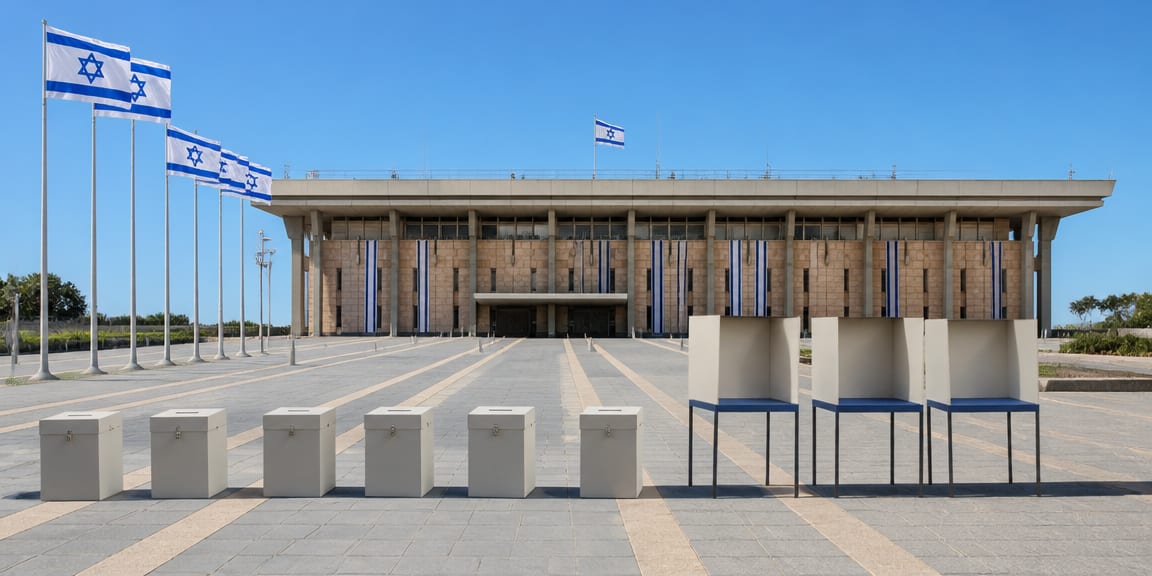
Israel Heads to First National Election Since October 7 Amid Security and Institutional Strains
Narrative Snapshot
The coverage broadly treats the election as a test of Benjamin Netanyahu’s political durability, but assigns different meanings to that test. Canadian, Italian, Brazilian and U.S. reports emphasize the contest’s referendum-like character, the possibility that Netanyahu’s long tenure could end, and the difficulty facing either major bloc in assembling the 61 seats required for a governing majority. Chinese state media adds institutional context, noting that the vote follows the first full four-year parliamentary term since 1988 despite Israel’s recent cycle of repeated elections.
Israeli coverage places greater weight on accountability, public trust and the practical pressures shaping voter behavior. Haaretz connects the campaign to demands for a state inquiry into the October 7 failures, protests by bereaved families and former hostages, military-service disputes, alleged misconduct involving a Netanyahu adviser, and a 20 percent rise in prices during his four-year term. Deutsche Welle highlights identity and trauma, including Gadi Eisenkot’s Moroccan background and its relevance in Likud strongholds.
Palestinian, Iranian and Qatari sources assess the election primarily through its consequences for Palestinians. Their focus is on settlement expansion, occupation, Gaza, the West Bank, the exclusion of Arab citizens from coalition politics and the limits of any change in Israeli leadership. Haaretz’s appeal to Arab citizens to vote and Middle East Eye’s reporting on disqualified Palestinian candidates frame political participation itself as an institutional question, rather than merely an electoral tactic.
What Happened
Israel will elect all 120 members of the Knesset on October 27, in the first national vote since Hamas’s October 7, 2023, attack. Netanyahu’s Likud faces Yashar, led by former military chief Gadi Eisenkot, alongside other parties competing for the coalition arithmetic needed to govern. Polls cited by several outlets show a close contest without a clear majority and, in some accounts, a narrow Yashar lead. The campaign has featured protests demanding an independent inquiry into October 7, rallies by victims’ families and former hostages, disputes over broadcasting those events, and renewed arguments over military-service exemptions. A reported investigation into Netanyahu adviser Yonatan Urich’s work for Qatar has added another accountability issue, while Netanyahu has promoted a security program centered on pre-emptive strikes, weapons production and border buffer zones.
Why It Matters
The election tests more than executive leadership. It bears on the capacity of Israel’s parliamentary system to produce a stable coalition after years of fragmented government, while placing security policy, military accountability and democratic safeguards within the same electoral framework. The treatment of Arab citizens and Palestinian candidates also exposes the limits of representation in a system where Arab parties are described by Middle East Eye as outside the governing arithmetic despite representing roughly 20 percent of citizens. For Palestinians, the consequences extend to settlement policy and the administration of occupied territory: Al Jazeera reports continuity in settlement expansion across changes of government, while Iranian and Palestinian outlets question whether the vote offers a meaningful policy alternative. International governments and organizations therefore face a familiar but consequential policy problem: whether a change in Israeli leadership would alter the conduct of the conflict, or chiefly its pace and presentation.
Diverging Narratives
The principal disagreement concerns what the election is actually deciding. International and Israeli accounts commonly present it as a judgment on Netanyahu’s leadership after October 7, the wars that followed and the government’s handling of security and economic pressures. Some sources also describe a possible transition from a long-serving prime minister to Eisenkot, whose military record is central to his appeal. Middle East Eye, however, argues that Netanyahu’s weakness should not be confused with the decline of the right, while Al-Quds and Tehran Times direct attention away from personalities toward occupation, Gaza and the West Bank.
There is also a dispute over the significance of electoral participation. Haaretz presents voting by Arab citizens as urgent amid possible future restrictions. Middle East Eye describes the disqualification of Palestinian lists and candidates, including Balad leader Sami Abu Shehadeh and Hadash lawmaker Ofer Cassif, as evidence that Palestinian representation remains conditional. By contrast, accounts centered on coalition formation treat Arab parties mainly as part of the parliamentary arithmetic. The sources also leave unresolved whether accountability demands will reshape policy: protests and allegations are prominent, but the reported security agenda remains strongly oriented toward deterrence and military initiative.
What Happens Next
The immediate decision point is whether Likud or Yashar can translate its electoral position into a coalition of at least 61 seats. The reported absence of a clear majority makes the composition and bargaining power of smaller parties the key indicator of governing capacity. A second question is whether a government formed after the vote responds to the October 7 inquiry movement, including demands from bereaved families and former hostages, or preserves the current approach to accountability. Analysts should also watch military-service legislation, since Haaretz reports that draft evasion has become a security concern even among former officials associated with the national-security establishment.
The most consequential external indicator will be policy toward Gaza, the West Bank and settlements. Sources identify Eisenkot and Netanyahu as differing on Palestinian issues, but also report continuity in settlement expansion across Israeli and U.S. leadership changes. The treatment of Arab parties and excluded candidates will indicate whether parliamentary participation broadens or contracts, while prices, emigration and public economic pressure will show whether domestic concerns can compete with security in the post-election agenda.