
International coverage examines AI’s uneven effects on jobs, skills and inequality
Narrative Snapshot
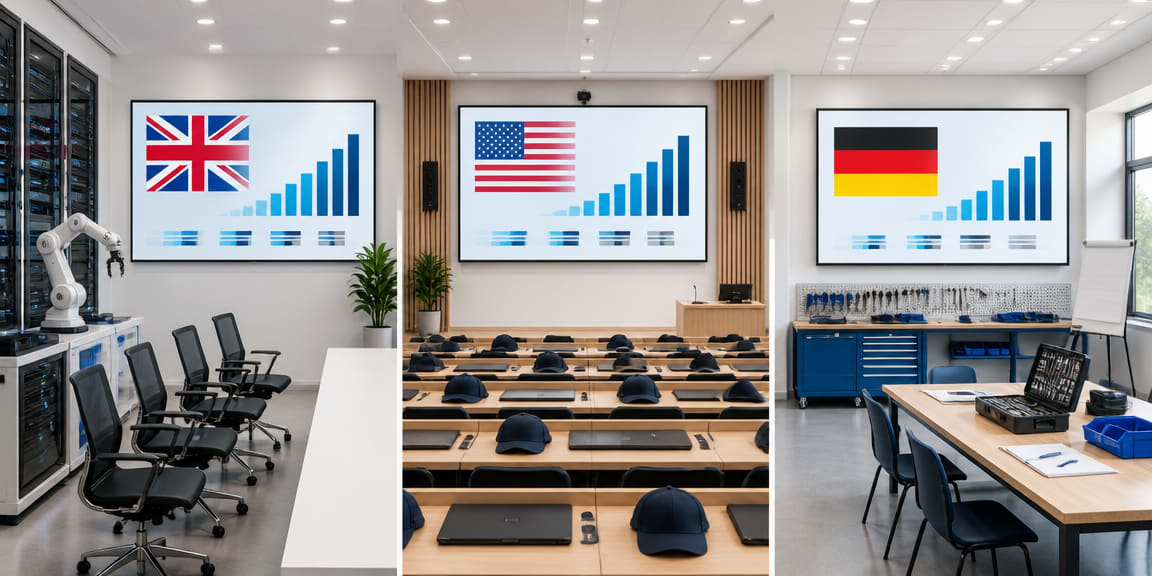
The sources broadly agree that artificial intelligence is already reshaping work and education, but they assign different weight to displacement, adaptation and institutional response. The Guardian presents the possibility of mass unemployment as a policy crisis that could bring a previously marginal proposal—a job guarantee—into mainstream debate. Al Jazeera instead emphasizes the United Kingdom’s unusually high rate of AI-linked job losses, reporting that it is twice the rate recorded in the United States and Germany.
Other coverage places greater emphasis on continuity than rupture. Fox News reports that 80% of employers still prefer candidates with college degrees, including for jobs that do not formally require them, and that six in ten employers retain high confidence in higher education. A Tecnológico de Monterrey rector, quoted by Clarín, anticipates a more differentiated education system in which some fields restrict AI use while others make it compulsory. These accounts treat institutions as adapting rather than becoming obsolete.
The social effects are presented as unevenly distributed. The Japan Times focuses on India, where AI may raise the productivity of experienced workers while weakening the early-career opportunities through which younger employees acquire skills. Le Monde describes young professionals in France leaving occupations they believe have lost meaning because of generative AI and moving into less automated manual work. Folha de S.Paulo highlights a gap within companies, reporting that executives are optimistic about AI while employees fear replacement.
The geographic frame also differs. Al Jazeera’s UN-focused report treats unequal access to AI as a potential source of widening global inequality, while the Guardian’s account of Britain’s NEETs crisis links employment prospects to welfare policy and regional disparities in services for young people. Taken together, the coverage places labor markets, education systems, welfare institutions and international inequality within the same policy field.
What Happened
Between 19 and 25 October 2026, coverage tracked AI’s effects from immediate employment indicators to longer-term institutional choices. Al Jazeera reported that UK AI-linked job losses were running at twice the rate of those in the US and Germany. The Guardian revived the idea of a job guarantee in response to warnings of large-scale AI unemployment, while separately reporting Andy Burnham’s call for major changes to welfare policy to address the NEETs crisis. In the United States, Fox News cited Gallup findings on employers’ continuing preference for college graduates. Coverage from India, France and Brazil examined weakened early-career skills, professional retraining and workplace anxiety. Clarín reported Rector Juan Pablo Murra’s view that future degree programs may distinguish between fields where AI should be prohibited and those where its use should be mandatory.
Why It Matters
The reporting points to a policy problem that cannot be contained within technology regulation or labor-market forecasting. Employment displacement raises questions about income protection and public provision, while changing skill formation challenges how universities and employers define preparation for work. The Guardian’s discussion of a job guarantee and Burnham’s welfare proposals place the state’s role at the center of the response; the UK’s regional disparities in youth services show that institutional capacity is already uneven.
The international dimension is equally significant. If access to AI is unequal, as the UN official cited by Al Jazeera warns, productivity gains may accrue disproportionately to better-resourced countries and workers. For governments and multilateral institutions, the relevant choices include whether to expand social protection, redesign education, preserve entry-level training routes and reduce technological access gaps. Employers’ reported preference for degrees also suggests that formal credentials remain an important gatekeeping mechanism even as the content of work changes.
Diverging Narratives
The sources differ most sharply over the scale and meaning of disruption. The Guardian begins from the possibility of a crisis severe enough to make a job guarantee politically viable. Fox News presents a more restrained account, arguing that current employer behavior does not support claims that higher education or human labor is becoming economically irrelevant. These positions are not fully incompatible: one concerns a potential future crisis, while the other describes present hiring preferences, but they imply different policy priorities.
There is also a distinction between replacing workers and weakening the pathways through which workers become skilled. The Japan Times reports that AI can make experts more productive while hollowing out junior employees’ learning opportunities. Le Monde describes professionals changing occupations because their work has lost meaning, whereas the Brazilian report emphasizes a communications gap between optimistic executives and fearful employees. Murra’s formulation introduces a governance question rather than a simple forecast: institutions may need to determine where AI is restricted and where it is required.
Finally, the sources locate responsibility at different levels. Some focus on employers and universities, others on national welfare systems, and the UN account on international inequality. The material does not establish whether these responses are coordinated or whether they would distribute AI’s gains and costs evenly.
What Happens Next
A first decision point is whether governments respond to displacement through expanded income and employment guarantees or through narrower welfare reforms. The job-guarantee proposal and Burnham’s call for changes to the welfare system provide the reported policy reference points; future debate will turn on whether employment support is framed as universal provision or as a response targeted at NEETs and affected workers.
A second is whether education systems preserve existing degree pathways while modifying how AI is used. Employers’ continued preference for graduates supports institutional continuity, while Murra’s proposed distinction between fields where AI is prohibited and those where it is mandatory points toward more differentiated curricula. Analysts should watch employer hiring data, university policy and the treatment of entry-level work.
A third is distributional. The UN warning makes access to AI a key indicator of whether productivity gains are broadly shared or concentrated among richer countries and already-skilled workers. Developments in national access, workplace adoption and early-career training will determine how far the opportunity divide identified in the coverage becomes an institutionalized inequality.