
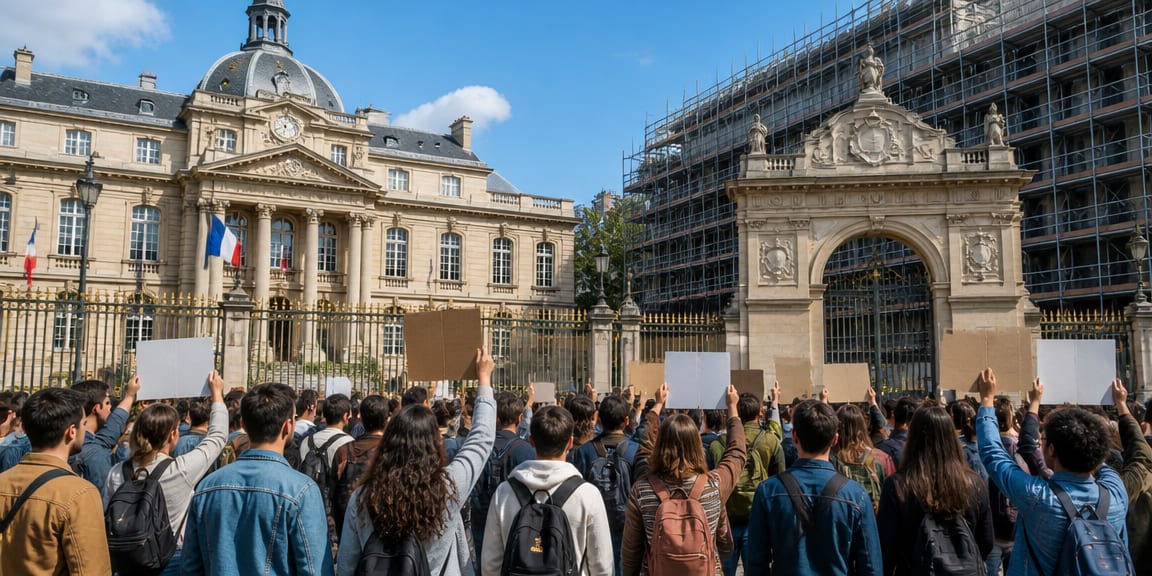
French government pledges education funding and reforms as student-led protests persist
Narrative Snapshot
Across European outlets, there is broad agreement that student-led protests over education conditions have forced high-level engagement and new policy pledges while mobilization continues. France 24 and the Guardian both highlight that student union leaders, after finally meeting the prime minister, are calling for “continued mobilisation,” including further school blockades and a new protest date. Deutsche Welle and the South China Morning Post underscore a dual message from President Emmanuel Macron: imminent “strong measures” to address unrest alongside recognition that students’ grievances are “legitimate.”
Coverage diverges sharply on the framing of unrest and public order. France 24 stresses that a state of emergency has been ruled out “for now” and that October 17 saw some of the worst rioting in years, while Le Monde records large, largely peaceful nationwide marches on October 24 with limited clashes at day’s end. Al Jazeera argues the government is leaning on a “riots” narrative to delegitimise demands. Earlier reporting from CGTN centers on localized curfews and an “absolute” determination to restore order.
International perspectives also vary on the protests’ political and structural implications. The Hindu situates the movement within France’s cost-of-living pressures and sluggish growth, calling it the “beginning of the end of Macronism.” Telesur emphasizes opposition momentum and leftist leader Jean-Luc Mélenchon’s warnings of weekly demonstrations and a coming general strike, while critiquing government outreach as an attempt to divide the movement. By contrast, Clarin foregrounds concrete policy specifics in education spending and reforms, and the Guardian flags civil liberties concerns over a fast-tracked “vandals pay” bill. Fox News frames the mobilizations within a transnational protest ecosystem narrative.
What Happened
After weeks of student-led unrest over teacher shortages, decrepit school buildings, and broader cost-of-living strains, French Prime Minister Sébastien Lecornu met student representatives on October 26. Student leaders welcomed access to talks but urged continued mobilization and fresh demonstrations on October 31. Macron promised “strong measures” in response to recent unrest while acknowledging students’ “legitimate” concerns. The government, seeking to stem the crisis, trailed an education package that includes loans of €4 billion for secondary school renovations, a class size cap of 28, €1 billion for university infrastructure, indexed student grants, 15,000 new higher-education places, and a phased reform of university admissions beginning in 2027 with broader changes in 2028. Student groups criticized the measures as insufficient. Authorities earlier imposed localized curfews in several cities; a nationwide state of emergency has been ruled out for now. Protests on October 24 were large and mostly peaceful, with limited clashes.
Why It Matters
The contest over education resources and access is colliding with fiscal constraints, complicating near-term implementation. Reported measures—capital investments for secondary schools, more university places, and inflation-indexed student aid—aim directly at capacity and equity concerns, but the admissions overhaul is scheduled to start in 2027–2028 and, by government admission, hinges on the next administration. That defers core distributional decisions to a post-election horizon, potentially prolonging uncertainty in the French higher education pipeline.
Institutionally, the government is balancing rights and order through targeted curfews and a decision, for now, against a state of emergency. A fast-tracked bill to make protesters liable for vandalism they did not commit has become a separate civil liberties flashpoint. The combined effect tests France’s protest management norms and state capacity amid inflation pressures and sluggish growth, with implications for policy prioritization and legitimacy as Macron’s term nears its end.
Diverging Narratives
Two storylines run in parallel. One, emphasized by France 24, DW, and SCMP, features responsive policymaking and calibrated security: students’ grievances are legitimate, meetings are happening, measures are imminent, and a state of emergency is off the table. The other, reflected in Al Jazeera’s critique and Telesur’s accounts, stresses attempts to delegitimize or fragment the movement, with student representatives rejecting announcements as inadequate and warning of more blockades and marches.
Representation of unrest also varies. France 24 notes severe rioting on October 17, whereas Le Monde documents largely peaceful nationwide mobilization on October 24, with limited incidents. CGTN foregrounds curfews and the government’s resolve to restore order. The Guardian adds a rule-of-law dimension, reporting pushback to a “vandals pay” bill fast-tracked by the government and criticized for risking the right to protest. International framing diverges further on stakes: The Hindu reads a broader political reckoning for Macron’s centrism; Fox News situates events within a wider “Chaos Inc” protest ecosystem; Clarin focuses on granular policy inputs rather than movement dynamics.
What Happens Next
Key decisions now revolve around implementation credibility and protest trajectory. The government’s promised package—renovation financing, class size limits, expanded places, indexed grants, and admissions reform—faces two tests: whether student unions accept the scope and pacing, and whether timelines extending into 2027–2028, and contingent on the next government, blunt momentum. Student leaders have already called for renewed mobilization on October 31 and for continued school blockades.
On public order, analysts should watch whether authorities maintain localized curfews or escalate measures, given Macron’s current stance against a state of emergency. The fate of the “vandals pay” bill will signal the balance struck between deterrence and protest rights. Finally, the scale and frequency of upcoming demonstrations—amid warnings of weekly marches and a potential general strike—will shape whether negotiations deepen or harden, and whether additional fiscal commitments become politically unavoidable.