
María Corina Machado returns to Venezuela after nearly a year in exile
Narrative Snapshot
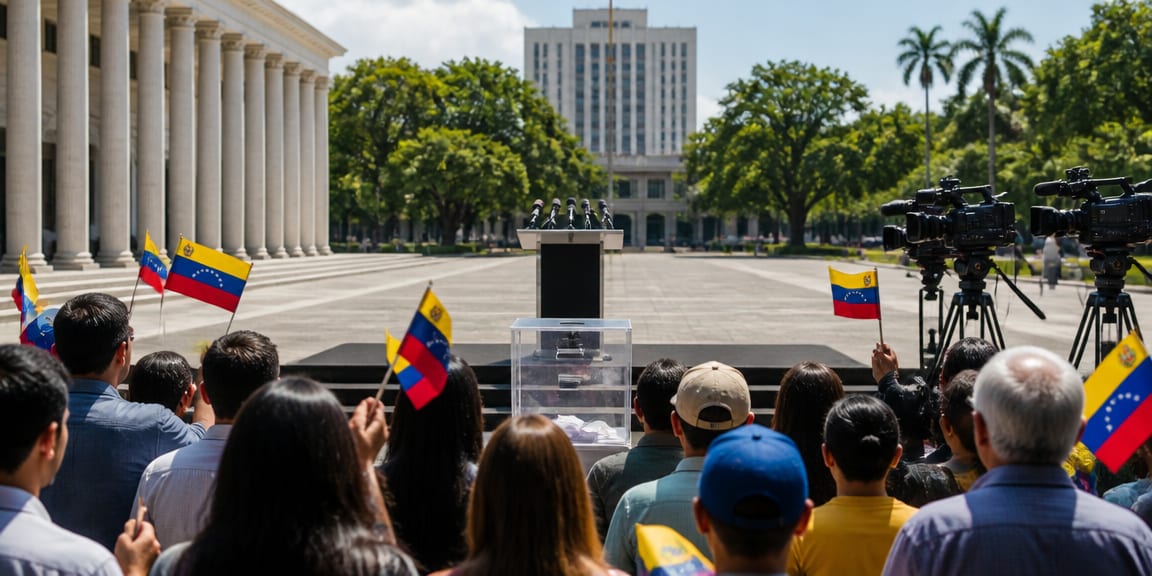
Across outlets, there is broad agreement on the symbolic weight of María Corina Machado’s reappearance and on her elevated profile since receiving the 2025 Nobel Peace Prize. Coverage consistently highlights the scale of her reception and the visibility she regained on arrival, with reports of large crowds in Caracas and fresh images of early stops in Lara state (NBC News; Deutsche Welle; South China Morning Post; Corriere della Sera).
Where accounts diverge is in their treatment of the United States’ role and of Venezuela’s interim leadership. Several outlets foreground an extended interim arrangement under acting president Delcy Rodríguez without a firm election timetable, framing Machado’s return against deepening doubts about democratic rules of the game (The Hindu; Fox News; France24; Toronto Star). Others stress that the interim authority operates with U.S. backing or oversight, sharpening the external-dimension lens on domestic legitimacy (Folha de S.Paulo; Bangkok Post; BBC News).
A second axis of difference concerns Washington’s positioning toward Machado personally. U.S. and Asian outlets describe a strained or delicate relationship with President Donald Trump, even as he voiced benign public comments and signaled continued support for Rodríguez (Folha de S.Paulo; South China Morning Post; Japan Times). Meanwhile, proponents within the U.S. administration claim credit for facilitating conditions that enabled opposition figures, including Machado, to return from exile, citing ongoing reconciliation talks and prisoner releases (Clarín).
Finally, European reporting emphasizes process and possibility: a potential re-energizing of the opposition, signs she may pursue dialogue with Rodríguez, and competing narratives from the interim leadership, which publicly dismissed her reception while being cast as a prospective interlocutor (Le Monde; France24; The Guardian).
What Happened
María Corina Machado, Venezuela’s opposition leader and 2025 Nobel Peace Prize laureate, returned to the country on October 25 after roughly ten months abroad. She announced her presence on social media with the message “I’m here. With you all,” and appeared in Lara state, including in Barquisimeto and the Plaza del Pueblo de Santa Rosa, before being greeted by large crowds in Caracas, according to her team’s images and multiple outlets (South China Morning Post; Corriere della Sera; ANSA; Guardian; NBC News; Deutsche Welle). Several reports note she left Venezuela covertly in late 2025 to receive the Nobel (France24; BBC News). Her return unfolds under acting President Delcy Rodríguez, who, despite an initial 90‑day mandate, has not called elections and remains in office (The Hindu; Fox News). The interim arrangement has U.S. backing, with Washington signaling continued support for Rodríguez even as President Trump said he was not informed of Machado’s plan to return (Folha de S.Paulo; Bangkok Post; Folha de S.Paulo).
Why It Matters
Machado’s return tests the institutional trajectory of an interim system that has outlasted its original timetable and lacks a scheduled presidential vote, raising questions about the durability of transitional commitments and executive accountability (The Hindu; Fox News). The episode spotlights the extent and modalities of U.S. involvement in Venezuela’s political architecture—ranging from claims of facilitating reconciliation talks and the return of exiles to continued endorsement of the acting presidency—at a moment when doubts about democratic restoration are mounting (Clarín; Folha de S.Paulo; France24; Toronto Star). For decision-makers, this convergence of domestic mobilization and external leverage will affect recognition strategies, election sequencing, and the credibility of negotiation frameworks. Public positioning by U.S. leaders—who both bless Machado’s presence and back Rodríguez—signals a balancing act that could shape opposition cohesion, regime-opposition talks, and international engagement with transitional authorities (BBC News; Folha de S.Paulo; South China Morning Post; Japan Times).
Diverging Narratives
Sources describe competing interpretations of whether Machado’s re-entry is integrative or confrontational. Some frame it as potentially galvanizing opposition pressure that could hasten an election, with suggestions she is prepared to meet Rodríguez, even as the acting president disparages her reception as a “show” (Le Monde). Others cast the move as a direct challenge to a U.S.-backed interim government with no imminent polls, highlighting the unresolved question of electoral timing and the extension of the acting mandate beyond its initial term (Bangkok Post; Fox News; The Hindu).
Accounts also differ on the U.S. role and coherence. One thread holds that U.S.-facilitated talks produced measurable outcomes—political prisoner releases and pathways for exiles to return—implying her arrival reflects diplomatic progress (Clarín). Another underscores ambiguity at the top of the U.S. executive: President Trump said he was unaware of her return while indicating continued support for Rodríguez, even making extraneous remarks about oil and her Nobel, which complicates readings of Washington’s priorities (Folha de S.Paulo; Fox News). A third thread stresses that her return risks straining ties with the Trump administration, while simultaneous reporting says she comes back with Trump’s “blessing,” suggesting a delicate, possibly tactical tolerance rather than alignment on end-states (South China Morning Post; Japan Times; BBC News).
What Happens Next
Three decision points emerge. First, whether and when an election is scheduled: the acting presidency has exceeded its initial 90 days and there is no vote on the calendar, so formal moves by Rodríguez to set a timeline—or continued inaction—will signal the institutional path ahead (The Hindu; Fox News). Second, whether dialogue occurs: Machado has been portrayed as ready to meet Rodríguez, while the acting leader has dismissed her return; any public meeting, agenda announcement, or joint communiqué would indicate a negotiated channel, whereas continued rhetorical hardening would reinforce a confrontational track (Le Monde). Third, U.S. positioning: statements by President Trump and Secretary of State Marco Rubio will clarify whether Washington maintains unqualified backing for Rodríguez, broadens support to encompass Machado’s participation in talks, or conditions support on electoral benchmarks; shifts here would affect incentives for both camps (Folha de S.Paulo; Clarín; BBC News). Analysts should watch for crowd mobilization patterns, announcements from reconciliation talks, and concrete steps on political prisoner cases as practical indicators of momentum.