
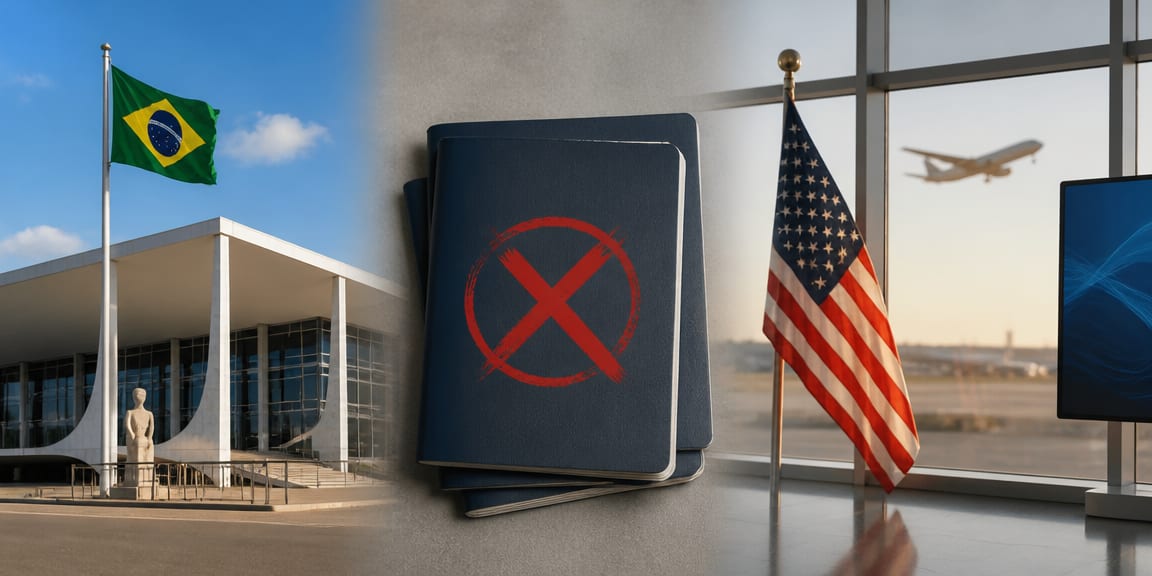
Reports of Flávio Bolsonaro’s flight to the United States after runoff defeat spur legal and diplomatic fallout
Narrative Snapshot
Across outlets, there is broad alignment that Brazil’s Supreme Federal Court ordered Senator Flávio Bolsonaro to surrender his passports and barred him from leaving the country, followed by the Federal Police canceling his documents when he failed to comply. Many international and Brazilian outlets then reported he left for, and in some cases arrived in, the United States, often citing unnamed sources close to the family or local outlets such as Metrópoles and CNN Brasil. The tone diverges: European and U.S. coverage tends toward cautious attribution (“reportedly,” “according to sources”), while Venezuelan state-linked media present his departure as established fact and emphasize evasion of justice.
Where narratives split most sharply is on U.S. facilitation and political framing. Several reports state or imply the Trump administration approved or would approve visas for Flávio and family, while Folha de S.Paulo quotes President Donald Trump saying he would back entry but did not know the senator’s whereabouts. Left-leaning Latin American outlets connect the case to alleged corruption and foreign funding probes; Russian state media cast the episode within a U.S.-vs.-Lula geopolitical frame. Argentine and Brazilian sources stress the bilateral implications with Washington. Uncertainty remains on precise itinerary and immigration status, even as multiple outlets report he reached Florida and met his brother Eduardo.
What Happened
After losing Brazil’s October 25 runoff to President Luiz Inácio Lula da Silva, Senator Flávio Bolsonaro was ordered by Supreme Federal Court Justice Alexandre de Moraes to surrender his regular and diplomatic passports within 24 hours and was barred from leaving Brazil; the Federal Police canceled the documents when he did not comply. Brazilian and international outlets then reported he had departed, with some specifying a route via Argentina to the United States and others stating he arrived on October 27, often citing people close to the family or local media. A Metrópoles report, relayed by Telesur English, said he met his brother Eduardo in Florida and planned a U.S. press conference. Lawmakers from Lula’s Workers’ Party asked a court to order Flávio’s preventive detention and trigger an Interpol Red Notice, alleging flight to evade probes into money laundering and related offenses. Flávio’s staff denied early reports he would flee, according to ANSA.
Why It Matters
The episode tests Brazil’s ability to enforce high-profile judicial measures post-election and probes the resilience of its separation of powers, as the Supreme Federal Court asserts control over an opposition figure accused of financial crimes. Internationally, it spotlights law-enforcement cooperation with the United States: an Interpol Red Notice request and any extradition or immigration actions would require coordinated responses, with potential precedential effects for handling politically exposed fugitives. Reporting that U.S. authorities would grant, or have granted, visas—and Trump’s stated willingness to approve entry—injects a diplomatic variable into Brazil–U.S. relations already strained by contested narratives around the vote. Parallel scrutiny of alleged foreign funding of Flávio’s campaign, including references to the conservative U.S. network Rockbridge co-founded by Vice President J.D. Vance, underscores growing cross-border entanglement of campaign finance and legal exposure. Regionally, Lula’s win and subsequent reactions from Latin American leaders frame a political environment in which judicial accountability and claims of persecution collide.
Diverging Narratives
Multiple outlets agree on the court’s passport order and cancellation; they differ on the certainty and specifics of Flávio Bolsonaro’s departure. Corriere della Sera and ANSA initially highlighted uncertainty over his whereabouts, while Deutsche Welle, the New York Times, The Hindu, and TASS (citing CNN Brasil) reported that he was en route or had arrived in the U.S. Telesur English reported he met his brother in Florida and planned a press event, whereas ANSA noted his staff denied plans to flee. Accounts of route and logistics vary, from a private jet out of Puerto Iguazú reported by Telesur’s correspondent to Metropoles-sourced claims of a small group coordinating with the Trump administration.
On visas, Le Monde, RT, Japan Times, and Clarín relay that the Trump administration would grant or had granted entry; Folha de S.Paulo quotes Trump saying he would approve a visa but did not know Flávio’s location, and Telesur cites a U.S. State Department confirmation to UOL that visas would be granted without specifying category. Motivations are also framed differently: Telesur and Clarín describe an escape from Brazilian justice; RT and prior statements about Eduardo Bolsonaro’s move to the U.S. cite fears of political persecution. Coverage of related investigations diverges in emphasis: La Repubblica underscores a Supreme Court probe into foreign funds, including Rockbridge, while mainstream international reporting focuses more narrowly on money laundering inquiries and the immediate legal measures.
What Happens Next
Key decision points cluster around judicial, law-enforcement, and diplomatic tracks. In Brazil, the pending request by Workers’ Party lawmakers for preventive detention and an Interpol Red Notice will test how the Supreme Federal Court and Federal Police translate the passport order into cross-border enforcement; any court action activating Interpol will signal an escalation. Internationally, confirmation of Flávio Bolsonaro’s immigration status—visa category, any asylum claim, or alternative legal basis for stay—will shape the scope of U.S. cooperation on detention or extradition, particularly if Brazilian authorities formalize a request. Analysts should watch for official statements from Brazil’s judiciary and Justice Ministry; Interpol’s public notices; the U.S. State Department’s and Department of Homeland Security’s positions; and any press appearance by Flávio in the U.S., as reported by Telesur. Parallel developments in the foreign funding probe referenced by La Repubblica, and diplomatic messaging flagged by Clarín about bilateral strains, will indicate whether the case remains narrowly judicial or broadens into a political dispute affecting Brazil–U.S. ties.