
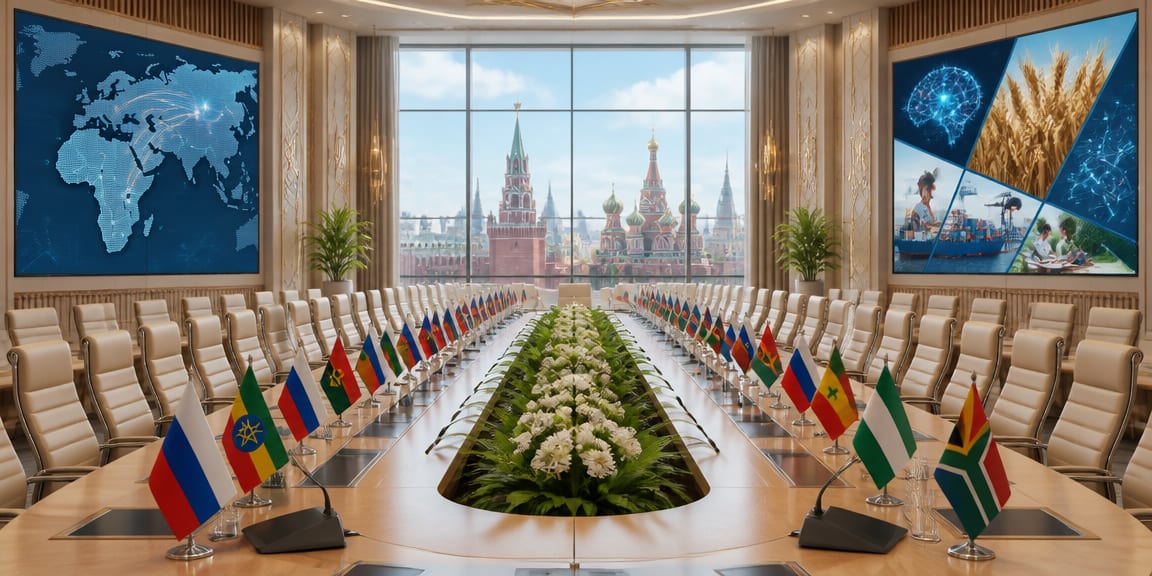
Moscow opens third Russia–Africa summit with 48 delegations as agenda spans trade, security, grain, AI, and education
Narrative Snapshot
Across outlets, there is broad agreement that Moscow is using the summit to deepen ties with African governments through a mix of political signaling and practical cooperation. Coverage converges on the central pillars of the agenda—trade, security and arms, grain supplies, and institutional agreements—while also noting the presence of pan-African bodies that could give the outcomes a regional frame.
Differences emerge in emphasis and framing. Russian state media highlights the summit’s importance for expanding cooperation and points to education as a growing linkage, citing a sharp rise in African students in Russia. Several international outlets foreground influence-building and geopolitical positioning, with one describing African states as “natural allies” for Moscow vis-à-vis the West and others depicting the event as a bid to expand Russia’s footprint. Sympathetic coverage underscores anti-colonial rhetoric and the prospect of concrete deliverables, such as declarations and an action plan, whereas regional reporting stresses the summit’s dense schedule of bilateral talks and agreements.
What Happened
Russia opened the third Russia–Africa Summit in Moscow on October 28, accompanied by an Economic and Humanitarian Forum. Delegations from 48 African countries are in attendance, alongside representatives of the African Union and the African Continental Free Trade Area. Reporting differs on head-of-state turnout, with references to “nearly two dozen” leaders, “dozens of African leaders,” and broader participation by leaders and government delegates.
The Kremlin framed the gathering as an effort to expand cooperation, with discussions spanning trade, security and arms deals, and grain supplies. Russian President Vladimir Putin coupled this with an emphasis on education, stating that African enrollment in Russian universities has risen 1.5-fold since 2020 to a record 40,000 students. The program includes two plenary sessions expected to yield a final declaration on cooperation, a separate declaration on artificial intelligence, and an action plan for the Russia–Africa Cooperation Forum covering 2027–2029.
Why It Matters
The summit consolidates a structure for Russia–Africa engagement that blends political messaging with formal instruments, including declarations and a multi-year action plan under the Russia–Africa Cooperation Forum. If adopted as described, these texts could channel cooperation through continental frameworks like the African Union and AfCFTA, signaling a pivot from ad hoc bilateralism toward more institutionalized ties.
Substantively, the agenda’s mix—security and arms, trade, grain supplies, AI, and education—touches core policy domains for many African governments. Grain pledges intersect with food security priorities; defense talks relate to ongoing security cooperation; AI and education link to capacity building and human capital. Several outlets present the summit as part of Moscow’s effort to expand its influence, and one reports the Kremlin’s characterization of African countries as “natural allies” against the West. For decision-makers, the key is whether outcomes move beyond rhetoric to operational mechanisms that can align with, or potentially compete with, existing continental initiatives.
Diverging Narratives
Russian and pro-summit coverage emphasizes partnership and deliverables. A Kremlin aide said the goal is to expand cooperation, and Putin spotlighted education flows as evidence of deepening ties. Telesur’s account highlights anti-colonial framing and enumerates expected outputs—a final declaration, an AI cooperation declaration, and a 2027–2029 action plan—with AU and AfCFTA participation.
Other outlets stress influence-building and geopolitical positioning. France24 frames the summit as an effort to woo African leaders on trade, security, arms, and grain, while the Toronto Star describes it as part of Moscow’s push to expand its continental influence. The Bangkok Post cites language portraying African states as “natural allies” against the West, accentuating the summit’s oppositional dimension. Al Jazeera presents two angles: a primer on the summit’s aim to strengthen economic and security ties, and a human-interest piece on African students in Moscow who view education as a bridge. Attendance is also framed differently—ranging from “nearly two dozen” leaders to 48 national delegations—reflecting varied emphasis on the summit’s political versus institutional breadth.
What Happens Next
Outcomes will hinge on whether the summit adopts the documents flagged in advance: a final declaration on cooperation, a declaration on AI, and the 2027–2029 action plan. Their language and scope will indicate how far cooperation is institutionalized and whether it engages AU and AfCFTA frameworks in a substantive way. Analysts should watch the closing statements by Putin and the African Union chair for details on implementation mechanisms and timelines.
Bilateral talks reported on the sidelines are another decision point. The volume and sectoral spread of any agreements will signal where near-term cooperation will materialize, particularly in security, trade, and grain supplies. Follow-through on Putin’s pledge to increase grain deliveries will be a practical test. Education linkages—already reflected in the reported 40,000 African students in Russia—may feature in new scholarship or exchange commitments. Finally, any explicit geopolitical framing in the final declaration, given references to “natural allies” and anti-colonial rhetoric, will indicate how participants balance partnership language with broader alignments.