
Serbia’s student-led victors confront pro-government media; RTS chief resigns
Narrative Snapshot
Across outlets, there is convergence that the first post‑election flashpoint is the information sphere. Reporting in Italy and Qatar spotlights protesters entering a pro‑government television outlet in Belgrade and pressing journalists over partial coverage, while U.S. coverage singles out a pro‑government tabloid as a target and notes an unusual public apology by a separate outlet for “one‑sided” reporting. The common thread is a challenge to media organizations closely associated with the former ruling camp.
The U.K. podcast framing widens the lens to a student‑driven electoral upset, asking whether a movement repeatedly described as leaderless can translate protest tactics into governance. That question meets a concrete institutional development in regional reporting: the director‑general of Serbia’s public broadcaster resigned after acceding to Student List demands, leaving uncertainty over the direction of a pivotal state media institution.
What Happened
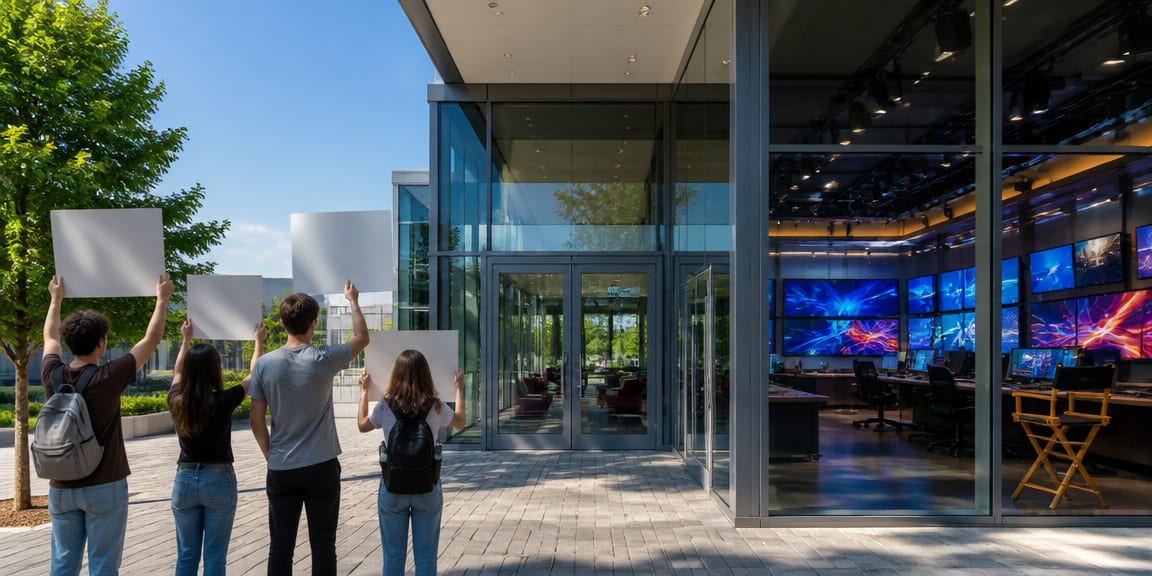
After an opposition movement led by student activists won Sunday’s election, its supporters moved quickly to confront media they accuse of favoring the former ruling camp. The New York Times reports that backers of the victorious, leaderless movement stormed the offices of a pro‑government tabloid, and that another outlet issued an apology for years of “one‑sided” coverage. Corriere della Sera and Al Jazeera English describe protesters entering a pro‑government, pro‑Vučić television station in Belgrade, demanding that journalists make amends for partiality; President Aleksandar Vučić called the incident an attack on free speech and journalism. By Wednesday evening, Balkan Insight reports, the director‑general of public broadcaster RTS, Manja Grcic, resigned after meeting Student List demands, prompting speculation about who will take charge of the country’s most significant public media institution.
Why It Matters
The episode places Serbia’s media system at the center of an immediate post‑election reordering. Multiple outlets document protesters’ efforts to hold pro‑government media to account for perceived partiality, while one newsroom’s apology signals recalibration inside parts of the press. In parallel, the leadership vacuum at RTS, reported by Balkan Insight after the director‑general resigned in response to Student List demands, underscores the institutional stakes: who runs the public broadcaster will help determine whether information norms shift or persist.
The Guardian’s account of a student‑led, leaderless victory, and the New York Times’ similar characterization, frame a governance test that extends to the media domain. Al Jazeera English records President Vučić’s claim that the protest at a TV station was an attack on free speech, highlighting a tension between demands for redress over “one‑sided” coverage and protections for journalistic freedom that Serbia’s next leadership will have to navigate.
Diverging Narratives
Coverage diverges on targets and framing. The New York Times centers on a pro‑government tabloid as the focus of protesters’ anger and underscores a separate outlet’s apology for “one‑sided” reporting, emphasizing accountability claims within the media. Corriere della Sera and Al Jazeera English highlight a pro‑government, pro‑Vučić television station as the site of a breach, foregrounding demands that journalists “make amends” for partiality. These differences point to varied focal points across the media ecosystem rather than a single, uniformly reported incident.
There is also a sharp contrast in how the confrontation is interpreted. Protesters’ position, captured by Corriere della Sera and the New York Times, is that partisan coverage warrants redress; President Vučić, cited by Al Jazeera English, frames the same actions as an attack on free speech and journalistic freedom. The Guardian and the New York Times both stress the movement’s leaderless character, raising uncertainty about how it will institutionalize media reforms. Balkan Insight adds that RTS leadership change has already occurred under Student List pressure, but leaves open what editorial or governance model will follow.
What Happens Next
The most immediate decision point is at RTS: as Balkan Insight reports, the director‑general’s resignation after acceding to Student List demands leaves succession unresolved. Analysts should watch for the selection process and any stated criteria for leadership, which will signal whether public broadcasting policy moves toward continuity or reform.
A second hinge is how the Student List articulates and implements its media agenda. Corriere della Sera and the New York Times document demands for corrective action from outlets seen as partial, while Al Jazeera English records counter‑claims about threats to free speech. Public guidance from the movement on press standards, accountability mechanisms, and safeguards for journalistic independence will be instructive. Finally, newsroom behavior—whether further apologies or editorial shifts follow the initial admission of “one‑sided” coverage reported by the New York Times—will indicate how far media recalibration proceeds without coercive pressure.