
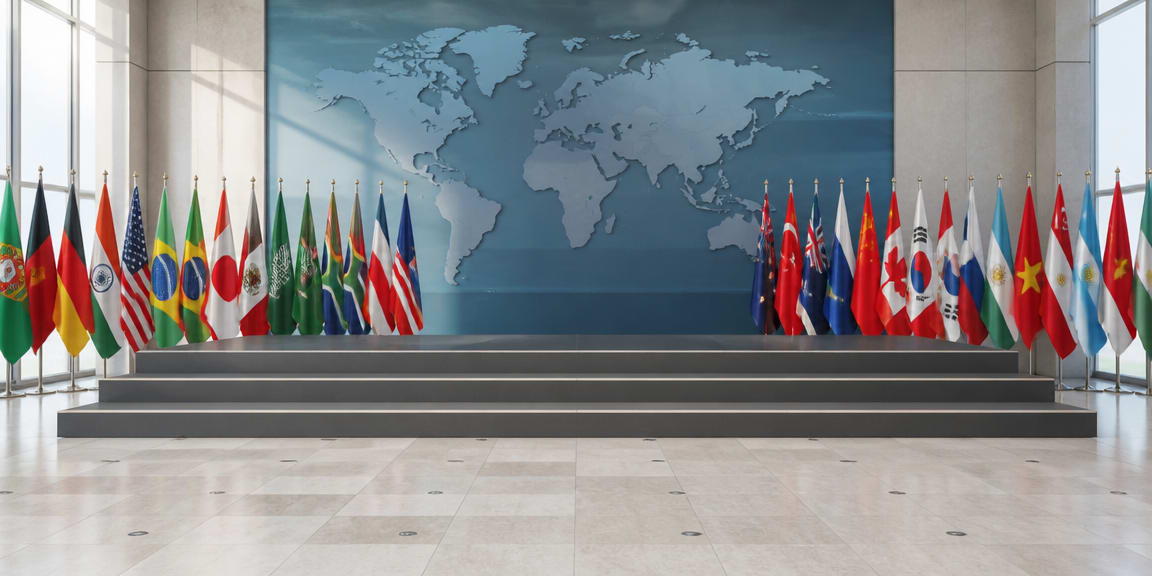
G20 foreign ministers open Atlanta talks without ‘family photo’ after European refusal to stand with Russia’s Lavrov
Narrative Snapshot
Across outlets, the clearest point of agreement is the symbolic rupture: the United States scrapped the traditional group photo after several European ministers, joined by the UK and Australia, refused to appear alongside Russia’s Sergei Lavrov. British and international reporting concentrates on that decision and its choreography, naming the boycotting states and noting that Marco Rubio, as host, opted to cancel the photo rather than stage a partial tableau. Eastern European and Ukrainian coverage amplifies the “no normalization” stance with direct quotes from German officials, while Canadian reporting underscores a policy of engagement to deliver a pointed message rather than confer legitimacy.
Where outlets diverge is in framing what the confrontation is about. Al Jazeera tethers the dispute to a wider docket—Ukraine, an Iran war, and Hormuz disruptions—while The Hindu centers economic security, energy, and supply chains. Russian and some European outlets train attention on Lavrov’s conduct and contacts: TASS offers minimal color beyond his arrival; ANSA spotlights a “dignified” exchange with Rubio and signals Moscow’s openness to meetings with specific European leaders. For Argentine and Italian audiences, the lens widens to the U.S. political backdrop and Lavrov’s long arc as a diplomat; Clarin links the meeting to energy prices and U.S. electoral dynamics, while Corriere della Sera profiles Lavrov as Putin’s hardened emissary now engaging a Trump administration. What is most at stake, as several outlets imply, is whether the G20 can still function as an economic coordination forum when core members treat protocol and presence as instruments of wartime signaling.
What Happened
Foreign ministers from G20 countries convened in Atlanta on October 30–31, hosted by U.S. Secretary of State Marco Rubio, with the U.S. agenda framed around energy, supply chain strains, and insulating economic security from geopolitical shocks, according to The Hindu’s reporting of a State Department brief. Multiple outlets report that the United States canceled the customary “family photo” after European ministers, joined by the UK and Australia, refused to be pictured with Russia’s Sergei Lavrov. RFE/RL flagged that the gathering was expected to expose ongoing divisions among Western governments over Russia’s war in Ukraine. ANSA reported Lavrov described a brief, “dignified” conversation with Rubio as Europeans insisted there would be “no normalization,” while Deutsche Welle quoted Lavrov declining to discuss Russia’s participation in December’s G20 summit and saying that Volodymyr Zelenskyy should travel to Russia if he wanted talks with Vladimir Putin.
Why It Matters
Several outlets tie the episode to the G20’s core purpose and its present limits. The Hindu notes that scrapping the photo deepened concerns about the forum’s ability to reach consensus on contentious issues, even as Washington sought to focus discussion on energy and supply chain resilience. Al Jazeera’s emphasis on Ukraine alongside an Iran war and Hormuz disruption positions the G20 at the intersection of parallel crises with direct implications for global trade and pricing. RFE/RL’s framing of divisions among Western governments suggests that even within a nominally aligned camp, approaches to isolating or engaging Russia vary, complicating coalition management in multilateral settings. For policymakers, this signals a higher transaction cost for coordinating sanctions, crisis-response measures, and economic stabilization tools, while Clarin’s linkage to U.S. electoral incentives around energy prices underlines how domestic pressures can shape negotiating bandwidth and priorities at global forums.
Diverging Narratives
Anglophone coverage converges on the optics and agency: the Guardian reports Rubio canceled the photo after roughly a third of countries threatened to boycott it, with BBC and Sky News emphasizing UK and European refusals to stand with Lavrov. The Kyiv Independent relays a German minister’s categorical stance that Europeans would not appear in any photo with Russia’s envoy, reinforcing a deliberate non-normalization posture. Canada’s Toronto Star adds that Ottawa opposed Moscow’s presence but used the meeting to confront Lavrov directly.
By contrast, Russian and some European reporting foreground interaction over isolation. TASS simply records Lavrov’s arrival, while ANSA highlights his account of a “dignified” exchange with Rubio and notes European insistence on “no normalization,” alongside its claim that Putin is open to meeting specific European figures. Deutsche Welle captures Lavrov’s dismissive line on summit participation and his suggestion that Zelenskyy travel to Russia for talks, an inversion of Western expectations. Al Jazeera broadens the canvas to Iran-related tensions and the Strait of Hormuz, while The Hindu keeps the focus on economic security. The New York Times documents prior European splits over outreach to Putin, situating the Atlanta dispute within longer-running intra-European disagreements over engagement versus isolation. Corriere della Sera contextualizes Lavrov’s role and posture vis-à-vis a Trump administration interlocutor. Clarin links the U.S. host’s agenda to energy price management and reports a softening of U.S. sanctions and a planned Miami summit, placing the meeting within U.S. domestic political calculations.
What Happens Next
Two decision points emerge from the reporting. First is whether ministers can craft any shared language on the agenda’s hardest files. The Hindu warns of poor prospects for consensus; analysts will watch end-of-meeting statements for indications of even limited convergence on energy, supply chains, or conflict references. Second is Russia’s participation in the December G20 summit: Deutsche Welle notes Lavrov declined to comment, so any subsequent Russian or host-nation statements will be an immediate signal.
European engagement choices remain fluid. ANSA’s claim that Putin is open to meetings with specific European leaders and the New York Times’ account of splits over a phone call to Putin point to watchpoints around potential bilateral outreach or its rejection. On the host side, Al Jazeera cites Rubio urging collective action to defend the economic order, while Clarin reports U.S. efforts tied to energy prices and sanction adjustments; observers will look for concrete U.S. initiatives or policy moves that align with those reported aims. Finally, any G20 discussion touching Iran or Hormuz, as flagged by Al Jazeera, will indicate whether members can compartmentalize security crises to stabilize economic cooperation.