
Poland’s top court standoff escalates after judge suspends tribunal chief; protests and presidential crisis talks follow
Narrative Snapshot
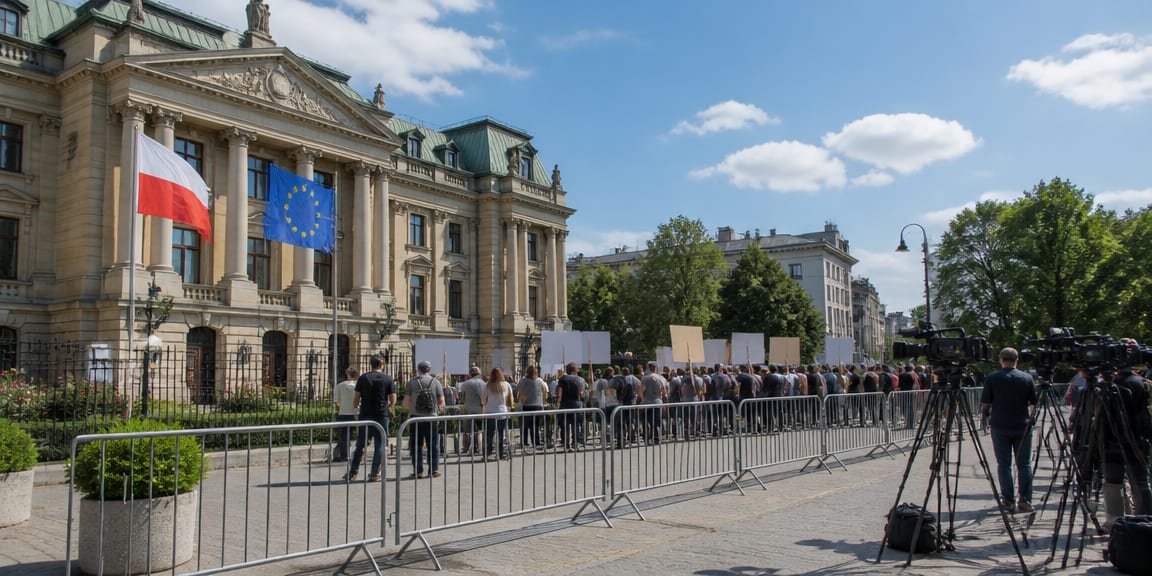
Across outlets there is broad agreement on the immediate contours of the confrontation and its visibility in the streets: an internal move at the Constitutional Tribunal triggered late‑night police deployments, a fortified perimeter, and detentions after attempts to breach the court grounds. Reporting converges on the fact that Anna Korwin-Piotrowska signed an order sidelining the court’s leadership and that police interventions drew protests that opponents framed as a defense of the tribunal against government overreach. Where emphasis differs is in causality and remedy.
European outlets extend the frame to Brussels and institutional deadlock. Le Monde highlights the European Commission’s call for President Karol Nawrocki to validate new judicial appointments as a pathway out of the impasse, while also noting that the president’s consultations with parties produced no tangible results. Italian coverage blends institutional stakes with political signaling: Corriere della Sera underscores the government’s claim that the tribunal had been politicized by Law and Justice (PiS) and records Lech Wałęsa’s public support for Prime Minister Donald Tusk; ANSA flags Tusk’s prime‑time address and continuing right‑wing anger at police presence around the court.
Other international outlets center the security and legality narratives now competing for primacy. TASS leads on the machinery of crisis management, noting the president’s meetings with coalition figures. CGTN stresses the tribunal’s constitutional role and Tusk’s pledge to ensure it functions “in accordance with the law,” while France 24, Deutsche Welle, and the Toronto Star/AP document protester claims that the suspension was unlawful and the arrests that followed. Telesur and Al Jazeera present the opposing legitimacy claims most starkly: Telesur quotes both a “coup d’état” accusation from the tribunal’s camp and Nawrocki’s allegation of a forcible takeover; Al Jazeera amplifies the government’s framing of a push to restore judicial independence after years of political interference.
What Happened
On Friday, the Constitutional Tribunal announced that its longest‑serving judge, Anna Korwin‑Piotrowska, had signed an order suspending tribunal president Bogdan Święczkowski and vice‑president Bartłomiej Sochański for a month and assumed the court’s leadership. A statement from within the tribunal denounced her move as a “coup d’état,” while Prime Minister Donald Tusk defended the intervention as necessary to restore the rule of law. Protests quickly formed outside the court in Warsaw; police reinforced the perimeter and detained several people after attempts to breach fencing, with one account citing three arrests. President Karol Nawrocki went to the tribunal during the night, accused the government of a forcible takeover, demanded police withdrawal, and on Saturday convened urgent consultations with parliamentary parties, beginning with Deputy Prime Minister Władysław Kosiniak‑Kamysz. That evening, Tusk delivered a televised address, vowing to proceed with changes to ensure the tribunal functions lawfully.
Why It Matters
This confrontation sits at the intersection of Poland’s domestic rule‑of‑law reset and its obligations within the European legal order. The tribunal arbitrates constitutional compliance, so its effective leadership and composition bear directly on legislation, executive authority, and the balance between branches of state. European reporting underscores Brussels’ involvement: the European Commission has urged President Nawrocki to validate new judicial nominations, situating the dispute within ongoing EU oversight of judicial independence. Italian coverage relays a warning that failure to install new judges could invite infringement proceedings, signaling that stalemate carries legal and financial risks beyond Warsaw. The Hindu’s depiction of a paralysed institution points to degraded institutional capacity as a structural trend, with practical consequences for policy implementation. For decision‑makers, the stakes include legal certainty for governance, credibility of judicial redress in contested reforms, and the durability of commitments made to partners during Poland’s efforts to unwind prior politicization of the bench.
Diverging Narratives
The government’s position, echoed by Deutsche Welle, the Guardian, the Times of Israel, and Al Jazeera, is that extraordinary but lawful steps are required to restore a tribunal hamstrung by prior political interference. Corriere della Sera adds the claim that the court under Święczkowski had been politicized by PiS, and reports Wałęsa’s endorsement of Tusk’s course. In contrast, President Nawrocki and figures aligned with the suspended leadership frame events as an assault on constitutional order. Telesur quotes the tribunal’s denunciation of Korwin‑Piotrowska’s move as a “coup d’état” and Nawrocki’s description of a forcible takeover; France 24 and AP/Toronto Star note protesters’ view that the suspension of the court’s president was unlawful.
Two unresolved questions run through the coverage. First is the legitimacy of competing appointments and internal tribunal procedures, with The Hindu noting each side’s refusal to recognize the other’s nominees. Second is operational control over the court’s premises and proceedings, given the police presence and the president’s demand for their withdrawal. Le Monde reports the Commission’s call for validating new judges as a route to clarity, but its own assessment that the president’s weekend consultations yielded no concrete progress underscores how contested the path to a functioning tribunal remains.
What Happens Next
Key decision points now turn on appointments, security posture, and inter‑branch coordination. One path is the presidential validation of new tribunal judges, as urged by the European Commission; Le Monde suggests this could unlock institutional functionality if paired with an internal leadership settlement. Alternatively, continued refusal to recognize opposing nominees sustains paralysis, a dynamic The Hindu has already identified, with the additional risk—flagged in La Repubblica’s interview—that failure to install new judges could trigger EU infringement action. On the ground, the president has demanded police withdraw from the court, while reporting by France 24 and ANSA indicates heightened security continues; any change will signal whether the standoff is de‑escalating. Analysts should watch the outcomes of Nawrocki’s consultations noted by TASS, formal court communiqués on leadership and case management, European Commission statements on compliance, and Tusk’s implementation steps following his pledge, reported by CGTN, to ensure the tribunal operates “in accordance with the law.”