
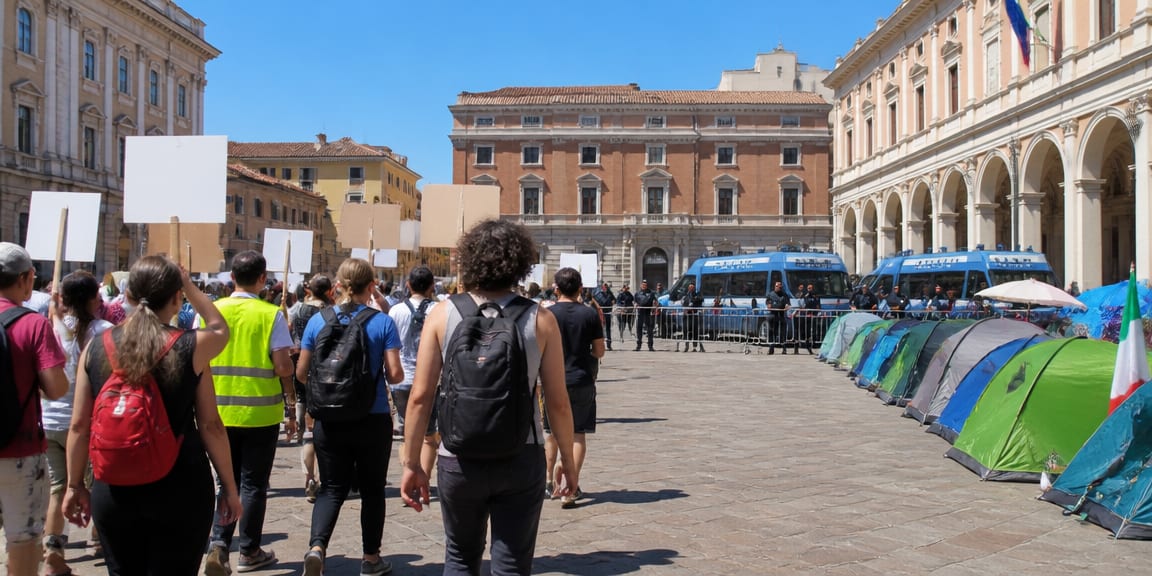
Across Italy, students and workers march over living costs, school funding, and military spending under heavy police presence
Narrative Snapshot
European outlets largely converge on the breadth and composition of the mobilization: marches in dozens of cities, led by students and workers, under a conspicuous security deployment, with isolated scuffles but predominantly peaceful crowds. Le Monde and Deutsche Welle underscore the nationwide footprint and place the actions in the context of weeks of school occupations and opposition to higher military spending. Al Jazeera, NBC News, and the Bangkok Post echo the cost-of-living and budget priorities throughlines, with the Bangkok Post stressing the overall peaceful character.
Coverage diverges on scale, framing, and symbolism. TASS highlights organizer claims of up to 100,000 in Rome and later reports minor police injuries in Venice, while Clarin describes “millions” mobilized and links the moment to Italy’s 2027 electoral horizon. Telesur English frames the day as a general strike led by the Unione Sindacale di Base (USB), explicitly opposing Prime Minister Giorgia Meloni and “rearmament,” and notes a protest camp planned in Rome. The Times of Israel singles out Palestinian flags and anti-Israel posters, a detail less visible elsewhere, while The Hindu and Le Monde foreground the heavy policing and sporadic clashes. What is most at stake across accounts is the political salience of budget trade-offs—education, social relief, and defense—amid visible social organization by students, unions, and allied groups.
What Happened
Students and workers demonstrated across Italy on Friday, with marches reported in dozens of cities including Bologna, Genoa, Naples, Turin, Milan, Florence, and several in Sicily. Protesters demanded increased funding for schools and relief from rising living costs; several outlets linked the actions to opposition to higher military spending and weeks of school occupations. A heavy police presence accompanied the events. While most demonstrations were peaceful, minor skirmishes were reported, including at the outset in Turin and in Venice, where seven police officers sustained minor injuries according to ANSA as cited by TASS. Organizers claimed up to 100,000 participants in Rome, where a protest encampment outside the Colosseum was planned to remain through Sunday, Telesur English reported. The day was presented by Telesur English as part of a general strike called by the USB and backed by students, public-sector workers, and housing groups.
Why It Matters
The protests concentrate public pressure on Italy’s fiscal choices that multiple outlets identify—education funding, cost-of-living relief, and increased military spending—creating visible constraints for policymakers as they weigh budget trade-offs. Several sources frame the mobilization as sustained rather than episodic, citing weeks of school occupations and a multi-day encampment in Rome, signaling organizational capacity among student and labor networks that could shape agenda-setting beyond a single news cycle. Clarin explicitly links the unrest to the political calendar ahead of 2027 elections, suggesting potential repercussions for party positioning and coalition dynamics. The heavy security posture, noted by European and Asian outlets, puts policing strategy under scrutiny amid mostly peaceful crowds and isolated clashes. Parallel reporting of large cost-of-living protests in France the same weekend and youth-led mobilization in Peru on affordability and governance issues provides comparative context that national governments and international observers will read as evidence of broader pressures around social protection and public investment.
Diverging Narratives
Quantifying turnout is a central point of divergence. Several outlets describe “thousands,” while TASS relays organizer claims of up to 100,000 in Rome, and Clarin refers to “millions” nationwide. Characterizations of the day’s tone also vary: the Bangkok Post and Al Jazeera describe peaceful mass actions, The Hindu and the Times of Israel note minor scuffles, and TASS cites injuries among police in Venice. Framing of causality and targets splits along editorial lines. Deutsche Welle and Le Monde emphasize education funding and living costs, with DW tying the moment to earlier school occupations and protests against higher military spending. Telesur English centers opposition to “rearmament” and to Prime Minister Giorgia Meloni, portraying the mobilization as a general strike led by the USB and embedded in a broader social bloc of students, public-sector workers, and housing activists. TASS adopts “war economy” language to describe the Rome rally. The Times of Israel highlights Palestinian flags and anti-Israel posters, an aspect not foregrounded elsewhere. These differences shape interpretations of whether the protests are primarily socioeconomic, anti-government, anti-militarization, or linked to international solidarity frames.
What Happens Next
Two decision points emerge. First, budget direction: outlets consistently report demands for school funding, cost-of-living relief, and opposition to increased military spending. If the government signals movement on education or social support, it could alter the mobilization’s focus; if it maintains current spending trajectories, reporting from Deutsche Welle and Telesur English on sustained school occupations and strike calls suggests actions could continue. Analysts should watch for concrete measures or statements on education budgets, energy or housing relief, and defense allocations.
Second, mobilization strategy and policing: Telesur English reports a planned encampment in Rome through Sunday and a USB-led general strike frame, indicating potential for extended actions. The heavy police presence noted by Le Monde, The Hindu, and others, alongside minor clashes and the Venice injuries reported by TASS, sets parameters for how future demonstrations unfold. Indicators include whether the encampment persists, whether USB announces further strike dates, the scope of any renewed school occupations, and official crowd and incident reporting that could recalibrate risk assessments and turnout narratives.