
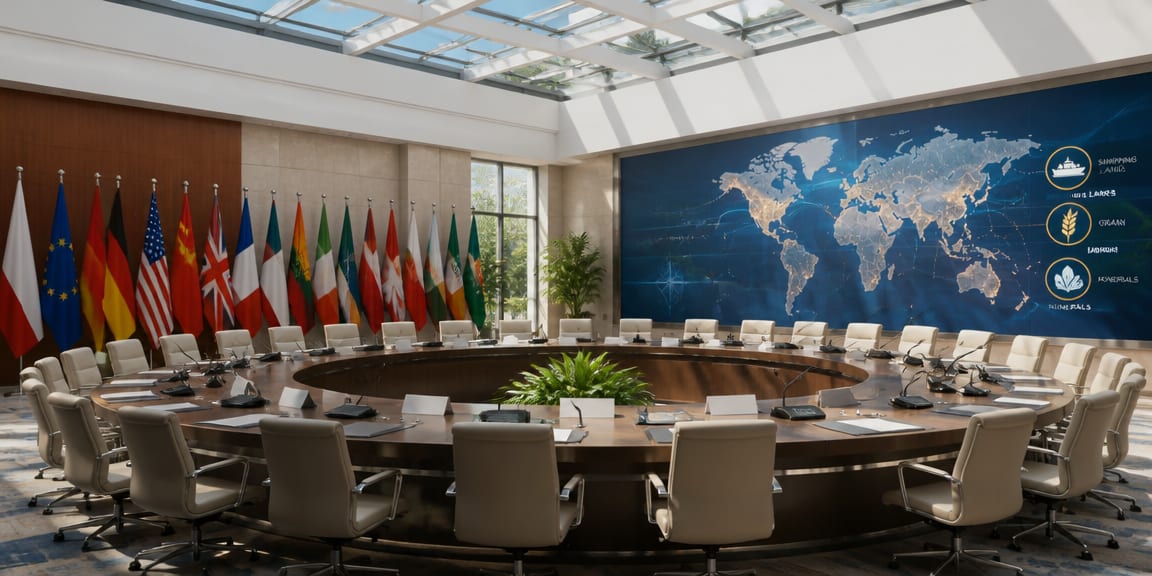
G20 foreign ministers end Atlanta talks without joint communiqué amid splits over Ukraine, security and trade
Narrative Snapshot
Across outlets, the throughline is procedural failure paired with a crowded agenda. Indian and Chinese coverage both underscore the absence of a joint communiqué, while highlighting that participants engaged on supply chains, energy, food security and maritime access. Southeast Asian and Latin American reports echo Washington’s messaging on avoiding the use of food trade for leverage. The shared floor is clear: critical minerals, freedom of navigation, food security and supply-chain resilience are important, but actionable convergence proved elusive.
Divergence lies in emphasis and framing. The Hindu foregrounds how Russia’s war in Ukraine overshadowed deliberations, and separately spotlights a parallel Quad statement warning against “economic coercion,” including via arbitrary export restrictions. The South China Morning Post centers Washington’s push to loosen China’s dominance over critical minerals and to “secure strategic trade routes.” CGTN stresses “deep divisions” linked to the Ukraine crisis and the US–Iran conflict and gives space to Beijing’s Global Security Initiative as a conceptual anchor. Telesur characterizes the sticking points as the “U.S.-Israeli war against Iran” and Ukraine, tying disruptions to tariffs and regional maneuvers, and flags the December leaders’ summit hosted by U.S. President Donald Trump. TASS injects a practical angle, reporting Rubio’s comment that Turkey has submitted Black Sea grain-shipping proposals to Washington. What is most at stake across these accounts is whether the G20 can translate broad recognition of risks into shared guardrails for chokepoints, food markets, and strategic materials.
What Happened
G20 foreign ministers concluded two days of talks in Atlanta without a joint communiqué. The Hindu reports that divisions over Russia’s war in Ukraine overshadowed the meeting, with U.S. Secretary of State Marco Rubio set to issue a chairman’s statement instead. CGTN says the agenda covered geopolitical tensions, energy security and supply chains, and quotes Rubio emphasizing freedom of navigation in the Strait of Hormuz and the Black Sea, critical mineral supply chains, and food security, while conceding the group was not close to “universally accepted solutions.” The South China Morning Post highlights Washington’s bid to reduce China’s dominance over critical minerals and Rubio’s claim of “universal recognition” of the issues’ importance. Bangkok Post and Clarín note U.S. calls to avoid using food trade for “economic or political coercion,” with Clarín adding that conflicts in Iran and Ukraine complicated agreement. TASS reports Rubio said Turkey submitted Black Sea grain-shipping proposals to the U.S. A Quad statement in Atlanta, reported by The Hindu, expressed “grave concerns” over economic coercion, including arbitrary export restrictions.
Why It Matters
The inability to produce a joint communiqué signals sustained limits on the G20’s capacity to set common guardrails on interlocking security–economy risks. Across sources, ministers acknowledged the salience of critical minerals, supply-chain resilience, food security, and maritime access at chokepoints such as the Strait of Hormuz and the Black Sea; Telesur also cites Rubio highlighting the Bab al‑Mandeb Strait. The Hindu’s report on the Quad statement points to coalition-based responses to “economic coercion,” while CGTN’s account of Beijing advancing the Global Security Initiative illustrates competing security frameworks vying for uptake in multilateral venues. For policymakers, this episode underscores that consensus on principles may not translate into operational norms on export restrictions, grain flows, or mineral supply diversification. It also frames the runway to the leaders’ summit noted by Telesur as a test of whether political directives can bridge ministerial divides on Ukraine- and Iran-related fault lines.
Diverging Narratives
The sources agree on process—the meeting ended without a joint communiqué—but they differ on causality and remedy. The Hindu attributes the breakdown primarily to the overhang of Russia’s war against Ukraine, whereas CGTN broadens the fault set to include the US–Iran conflict and presents China’s Global Security Initiative as a constructive pathway. The South China Morning Post emphasizes a U.S.-led agenda to dilute China’s hold over critical minerals and to harden supply chains and trade routes, casting the outcome as recognition without agreement. Clarín and Bangkok Post reflect U.S. messaging that food trade should not serve as “economic or political coercion,” linking geopolitical disputes to food security frictions. Telesur frames the geopolitical backdrop more starkly—citing a “U.S.-Israeli war against Iran,” tariffs, and regional maneuvers—as root causes of disruptions and situates the meeting as a prelude to a Trump-hosted leaders’ summit. TASS, by contrast, surfaces a transactional opening: Turkish proposals on Black Sea grain shipping reportedly conveyed to the U.S., suggesting discrete bilateral or sub-group initiatives are advancing even as G20-wide consensus stalls.
What Happens Next
Attention now turns to the chairman’s statement The Hindu says Rubio will issue, a document that will signal minimal consensus and delineate redlines on minerals, maritime access, and food trade. Analysts should watch for whether language on avoiding “economic or political coercion” in food trade, cited by Bangkok Post and Clarín, appears and whether it echoes the Quad’s Atlanta statement reported by The Hindu. The feasibility of maritime and food-security workarounds bears monitoring: TASS reports Rubio said Turkey submitted Black Sea grain shipping proposals to Washington; any U.S., Turkish, or regional follow-up would indicate movement despite G20 gridlock. On supply chains, SCMP’s reporting of a U.S. push to reduce China’s minerals dominance and CGTN’s account of China promoting the Global Security Initiative define competing frames; their uptake in preparatory texts for the leaders’ summit noted by Telesur will be a key indicator of whether broad recognition can translate into shared operational guidance.