
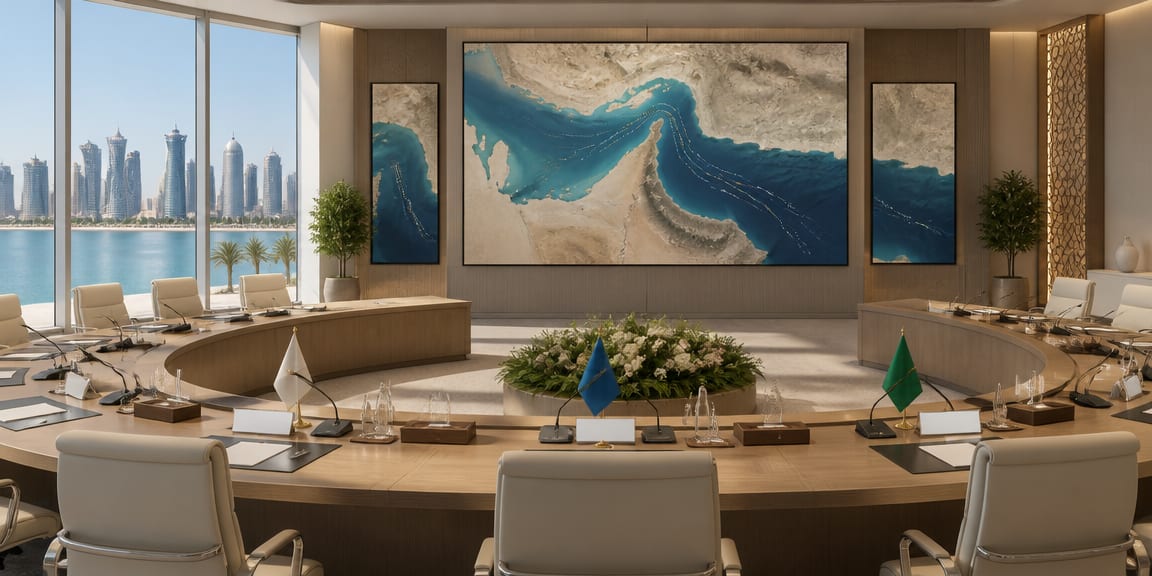
Mediated US–Iran contacts proceed in Doha as Gulf states brace for potential post‑midterm strikes
Narrative Snapshot
Across regional and international outlets, there is broad agreement that mediated contacts between Washington and Tehran have resumed, with Qatar hosting and facilitating channels that include a focused discussion on maritime de-escalation. Iranian Foreign Minister Abbas Araghchi described recent US outreach as a positive step during talks in Qatar, while Iran’s state news agency reported consultations on a “two-day plan” to reopen the Strait of Hormuz without a definitive outcome yet. US statements signal patience and continued engagement, even as regional reporting underscores that the window sits alongside explicit preparations for a potential resumption of hostilities.
Coverage diverges most sharply over Tehran’s negotiating posture. Iranian executive-branch messaging to Al Jazeera and TASS emphasizes openness to diplomacy coupled with readiness for “all scenarios,” whereas a senior parliamentary figure quoted by Middle East Eye declared Iran has “no intention” of entering talks or negotiating on the nuclear issue. US political signaling also varies by outlet: President Donald Trump is cited as saying negotiations are ongoing and “going fine,” while a Wall Street Journal–sourced report relayed by Middle East Eye has Washington warning Gulf partners to expect a short, intense campaign against Iran after the US midterms.
A second line of divergence concerns who leads de-escalation. Haaretz frames US diplomatic outreach as partly driven by anxiety that regional actors are opening competing channels to Tehran. Chinese and regional media highlight precisely those alternatives: Qatar’s advocacy for a sovereignty-based regional security framework, the Mecca Defence Alliance’s high-level visit to Tehran to build security independent of Washington, and the UAE’s public stance of hoping for a diplomatic breakthrough while preparing for worst-case scenarios. Russian engagement with Iran at a Moscow summit further underscores a multipolar diplomatic field.
Finally, coercive signaling remains intertwined with diplomacy. The reported US–Israeli preparations to pressure Tehran back to talks, the Iranian Foreign Minister’s stress on enhanced military readiness, and reported maritime incidents in and around Hormuz reflect a bargaining environment in which military risk and economic chokepoints are central to the negotiating calculus. Within Iran, reporting of outreach to a hardline figure and rising domestic calls for “the atomic” point to internal pressures shaping how Tehran calibrates both deterrence and diplomacy.
What Happened
Regional and mediated efforts intensified through late October into early November. The Mecca Defence Alliance—Saudi Arabia, Turkey, and Pakistan—held talks in Tehran on 26 October to seek an end to the conflict and promote a security framework independent of Washington. Qatar confirmed on 27 October that its delegation visited Tehran as part of ongoing mediation and publicly called for a regional security architecture grounded in sovereignty and non‑aggression. On 28 October, Middle East Eye reported, citing the Wall Street Journal, that Washington warned Gulf partners to prepare for intense strikes on Iran after the 3 November US midterms; the same day in Moscow, Russia’s president met Iran’s president, who said regional issues could be resolved without US involvement. By 30–31 October, US and Iranian officials acknowledged outreach: Haaretz reported Washington’s offer to return to diplomacy; Iran’s foreign minister called it positive, yet Iran’s IRNA said there was no breakthrough on a “two‑day plan” to reopen Hormuz. On 1 November, outlets quoted Trump saying talks were “going fine,” even as the UAE said it was braced for the worst while hoping mediation in Qatar could avert a new round of confrontation.
Why It Matters
The reporting points to a structural shift toward regionally led security management in the Gulf, with Qatar’s mediation and the Mecca Defence Alliance’s Tehran visit presenting alternatives to US‑centric crisis handling. Haaretz explicitly frames US outreach as responsive to such competing channels, while CGTN and Middle East Eye highlight calls for sovereignty‑based regional frameworks. This diffusion of mediation authority intersects with great‑power alignment dynamics: Moscow’s visible support to Tehran, ongoing nuclear energy cooperation, and public statements discounting the need for US involvement indicate that external backstops to Iran are active.
For decision‑makers, the Strait of Hormuz is again a focal risk. IRNA’s reference to a “two‑day plan” to reopen the waterway amid reported maritime incidents underscores the economic leverage embedded in shipping flows. Parallel reporting that Washington and Israel may employ limited strikes to coerce negotiations, contrasted with the UAE’s warning that military options lack quick off‑ramps, highlights the policy trade‑off between deterrence and escalation control. Domestically in Iran, outreach to a hardline figure and rising calls for “the atomic” reported by La Repubblica suggest that interlocutor choice and internal consensus will condition any diplomatic pathway.
Diverging Narratives
Iranian messaging splits between executive pragmatism and parliamentary defiance. Araghchi told Al Jazeera the US move was a positive step and, via TASS, expressed hope Washington would choose diplomacy while noting Iran’s increased military strength. In contrast, Middle East Eye quoted the Iranian parliament’s deputy speaker as saying Tehran has “no intention” to engage in talks with the United States or negotiate on the nuclear issue. This intra‑elite divergence contrasts with US‑side statements that, according to Al Jazeera and the Times of Israel, Iran wants to keep negotiating and that talks are proceeding.
Assessments of progress also differ. Al Jazeera’s characterization that negotiations are continuing and “going fine” sits alongside IRNA’s on‑the‑record caution that there is “no definitive outcome” from consultations in Doha, specifically regarding a short‑term plan to reopen Hormuz. The risk environment is framed unevenly: Middle East Eye, citing the Wall Street Journal, reports US warnings to Gulf states about potential post‑midterm strikes intended to push Iran towards talks; the UAE publicly argues that military solutions offer no quick exit from crisis, as reported by the Toronto Star and the South China Morning Post. Meanwhile, the Times of Israel relays an IRGC Navy claim of tanker explosions in Hormuz after unauthorized routing, underscoring maritime coercion dynamics that other sources do not independently corroborate. Haaretz synthesizes these tensions by arguing both Washington and Tehran are using the threat of renewed war as leverage to return to talks.
What Happens Next
Key decisions hinge on whether Washington executes, defers, or rescinds the post‑midterm military option reported by Middle East Eye, and whether Tehran consolidates behind the foreign ministry’s mediated track or hardline voices opposing talks. Indicators include US post‑election guidance to Gulf partners, presidential statements on negotiations, and Iranian parliamentary versus executive signaling captured by Al Jazeera, TASS, and Middle East Eye.
In the Gulf, watch whether Qatar’s mediation produces concrete steps on IRNA’s “two‑day plan” to reopen Hormuz and any publicized de‑confliction mechanisms. UAE messaging—simultaneously urging diplomacy and bracing for the worst in SCMP, the Toronto Star, and Clarin—will reflect regional threat perceptions and willingness to underwrite a sovereignty‑based framework advocated by Qatar. Regionally, follow whether the Mecca Defence Alliance’s engagement in Tehran evolves into a structured security initiative, and externally, whether Russia–Iran coordination deepens following the Moscow meeting reported by CGTN.