
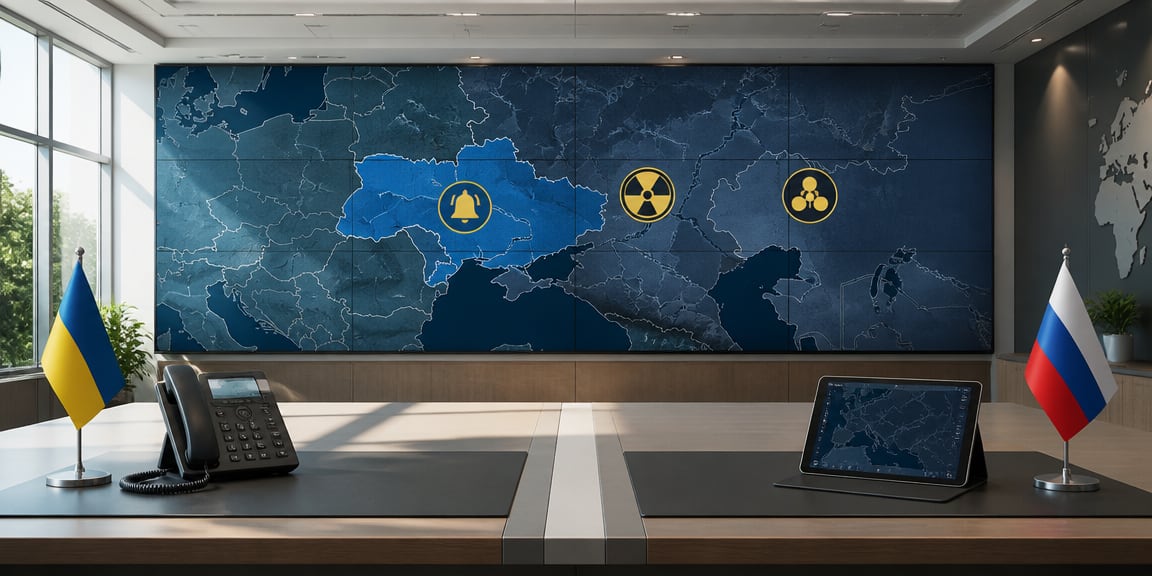
Ukraine and Russia report hacks of emergency alert apps as Kherson ceasefire lapses
Narrative Snapshot
Across outlets, there is broad agreement that both Ukraine and Russia reported compromises of their public emergency alert apps, with false messages pushed to civilians and authorities urging calm. Ukrainian and Western reporting centers on the disruption inside Ukraine’s air-raid alert ecosystem, including highly specific false notices about nuclear and chemical hazards and even street fighting. Italian coverage dwells on the civilian experience of panic in Kyiv as phones lit up overnight, while the BBC emphasizes government guidance to verify information through official channels.
Attribution and intent are framed differently. Al Jazeera reports that Kyiv blamed Russia for the false alerts, whereas Russia’s state news agency TASS focuses on its Emergencies Ministry app being hit by a “massive cyberattack” and says technical work is underway. Corriere della Sera underscores that the authors and links to the attacks remain unknown. French and German outlets place the cyber incidents alongside the expiry of the localized Oleshky ceasefire, noting no reported violations during the truce but continued strikes elsewhere. The Hindu and Japan Times explicitly tie the timing to the truce’s end, with The Hindu adding Kyiv’s claim that Moscow declined an extension.
The stakes in this coverage are civilian confidence and the integrity of crisis communications during ongoing hostilities. Reports of loudspeakers in Kyiv and urgent false nuclear or chemical alerts point to the potential for panic; public advisories to stay calm highlight how authorities must reassert control over contested information channels as localized truces expire and combat activity continues beyond them.
What Happened
Late on November 1, Ukraine’s Air Force said the country’s air-raid alert system was hacked as sirens sounded nationwide and users received false notifications of nuclear, chemical, and street-fighting threats. Authorities told residents there was no radiation danger and urged them to rely on official channels for updates, according to the Kyiv Independent and the BBC. Fox News detailed that the app warned of a “radiation hazard” and a “chemical attack” in Kyiv, showed multiple areas under a nuclear alert, referenced a hypersonic “Oreshnik” missile, and coincided with loudspeaker messages advising precautions. By November 2, Russia’s Emergencies Ministry said its own mobile app suffered a “massive cyberattack,” with “false information” posted and work underway to fix the vulnerability, as reported by TASS, Al Jazeera, and the Japan Times. La Repubblica noted that after hours of panic in Kyiv, Moscow users were later flooded with false messages. These developments followed the expiry of the localized Oleshky ceasefire, which ended without reported violations even as Russian strikes hit other Ukrainian regions, Deutsche Welle and Al Jazeera reported.
Why It Matters
Both Kyiv and Moscow acknowledging cyber disruptions to public warning systems underscores a contested domain that directly affects civilian protection. With a US-brokered humanitarian truce in Oleshky ending and fighting documented elsewhere, reliable alerting becomes a critical public good; false notices about nuclear or chemical hazards risk eroding trust and complicating crisis response, as multiple outlets indicate. The BBC’s emphasis on verifying information through official channels highlights an immediate governance challenge: securing and authenticating life-safety communications amid conflict.
These incidents also intersect with broader wartime bargaining and defense provisioning. Deutsche Welle reports President Volodymyr Zelenskyy said Ukraine would halt refinery strikes if the United States supplied Patriot systems, signaling that air defense resourcing and cross-border strike policy remain active levers. In this context, cyber operations against alert infrastructure are part of a wider toolkit shaping coercion, civilian behavior, and negotiating space, raising questions for governments and international partners about resilience standards and norms for civilian warning systems in interstate conflict.
Diverging Narratives
Kyiv’s attribution to Russia, reported by Al Jazeera, contrasts with Moscow’s portrayal of itself as a target of a “massive” attack on its Emergencies Ministry app, as carried by TASS. Italian coverage in Corriere della Sera stresses that the perpetrators are unknown, reflecting the absence of publicly presented technical evidence in the reporting to date. La Repubblica frames the events as a sequence—panic in Kyiv followed hours later by false messages in Moscow—while German and French outlets keep the focus on the concurrence with the Oleshky truce’s end, avoiding claims about causality.
Outlets also differ in emphasis. Fox News foregrounds granular, alarming details of Ukraine’s false alerts and, within its coverage, references a ballistic missile attack on Kyiv; the BBC, by contrast, highlights official reassurances and guidance to remain calm. On the truce dynamics, The Hindu cites Kyiv’s claim that Russia refused an extension, whereas Deutsche Welle and Al Jazeera emphasize that the localized ceasefire concluded without reported violations even as strikes continued elsewhere, leaving the precise relationship between the cyber incidents and ceasefire politics undefined in the available reporting.
What Happens Next
Immediate outcomes hinge on technical remediation and public communication. Russia’s Emergencies Ministry says it is addressing vulnerabilities to restore normal app operations, and Ukrainian authorities have urged reliance on official channels; analysts should watch for implementation of authentication measures and whether both governments report stabilized alerting. Future statements from Kyiv and Moscow may seek to firm up attribution or deterrence narratives; given conflicting claims and acknowledged uncertainty in several reports, official investigative updates will be key signals.
On the battlefield-diplomatic track, the expiration of the Oleshky ceasefire, noted by France24 and Le Monde, raises the question of whether localized pauses can be renewed; The Hindu’s report that Kyiv says Moscow refused an extension sets one constraint. Separately, Deutsche Welle’s report on Zelenskyy linking a halt to refinery strikes to potential US Patriot deliveries points to decisions in Washington that could shape Ukraine’s air defense posture and, by extension, the salience of civil warning systems amid continuing strikes elsewhere.