
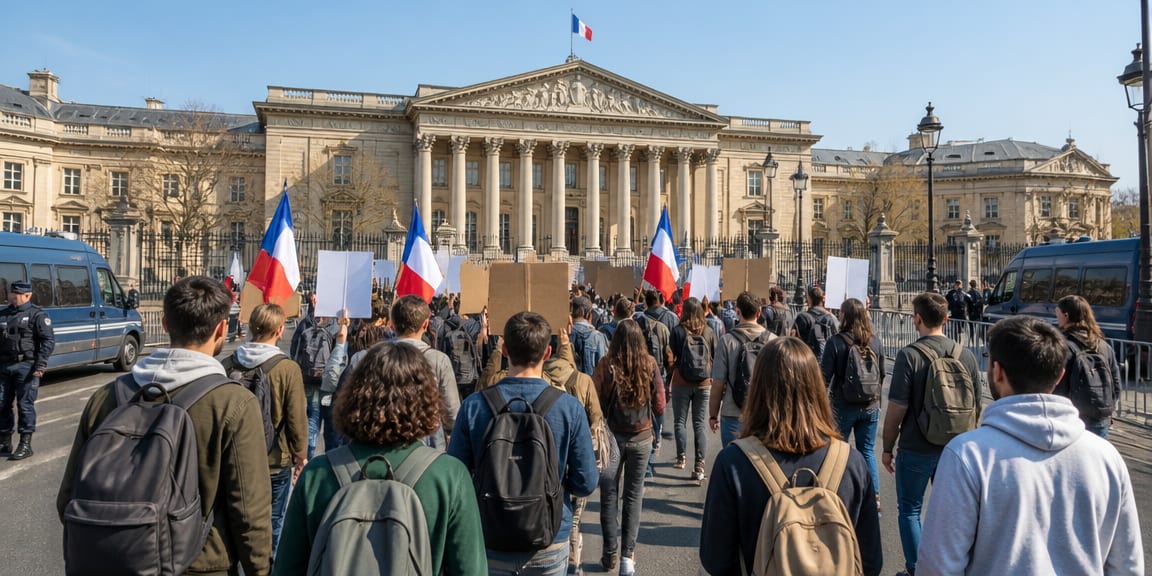
France’s third weekend of mass protests draws hundreds of thousands; arrests mount as student groups plan renewed blockades
Narrative Snapshot
Across outlets, there is broad agreement that France’s third consecutive weekend of nationwide demonstrations brought hundreds of thousands into the streets and that policing was extensive. Where coverage diverges most is on scale and severity. Authorities’ turnout figures cluster around 320,000, while organizers cite roughly 500,000, with a particularly large Paris contingent; both frames recur across international reporting. Assessments of public order range from “largely peaceful” to confrontation-focused, reflecting different editorial choices about whether to foreground the majority of nonviolent marches or the significant clashes and arrests that accompanied them.
French and European angles emphasize state capacity and legal constraints. British and Italian coverage highlights the preemptive deployment of 70,000 officers and a Council of State decision restricting a symbolic Paris venue, while French reporting pairs crowd counts with the Interior Ministry’s arrest totals. Latin American and Asian outlets stress arrest figures and organizer claims of scale. Several sources link the protests to the student movement’s organizational role and to an ongoing government policy response on education that has yet to defuse mobilization. Others spotlight specific flashpoints, including flag burnings in Lyon and parallel demonstrations elsewhere in Europe.
What Happened
France entered a third consecutive weekend of protests over living costs and the state of schools, with authorities estimating about 320,000 participants nationwide and organizers claiming close to 500,000, including 200,000 in Paris. The Interior Ministry deployed 70,000 police, warning of a high risk of disorder after earlier incidents of looting on 17 October. Clashes occurred in several cities; police used tear gas and water cannons, and arrests ranged from more than 290 to 779 depending on outlets and timing of counts. In Lyon, protesters burned US and Israeli flags amid mass rallies. Italy’s ANSA reported that the Council of State barred access to the Bastille area for demonstrators. Earlier in the week, the French government presented education measures intended to address long‑standing problems, but student organizations called for renewed blockades beginning Monday and on specific days the following week, aligned with a union strike.
Why It Matters
The protests test the French state’s capacity to manage simultaneous pressures on cost‑of‑living policy and education reform while preserving public order and assembly rights. The Council of State’s restrictions on central Paris locations, as reported by ANSA, illustrate how security considerations are shaping the legal environment of protest, with implications for the balance between administrative authority and movement tactics. Government adjustments to education policy that revisit reforms from both Macron presidencies acknowledge structural issues flagged for a decade, yet have not quelled mobilization, underscoring the challenge of policy recalibration during sustained social protest. For European partners, the scale of policing and the spillover of youth-led demonstrations to other countries signal a broader regional context. For international organizations and bilateral counterparts, the persistence of large, recurrent gatherings and student-led disruptions in the education sector are decision-relevant indicators for social stability, labor actions, and public service continuity.
Diverging Narratives
Turnout and arrest metrics are the most visible points of divergence. Authorities’ estimates center on roughly 320,000 participants, while organizers cite nearly 500,000, including a 200,000 Paris figure. Arrests reported range from “more than 290” to 779, reflecting different reporting windows and sources; some outlets register 560–565, while others adopt the Interior Ministry’s higher national total. Characterizations of the day likewise split between “largely peaceful” framing with limited clashes and emphasis on confrontations requiring tear gas and water cannons. French and British reporting foreground the preventive security posture and the Interior Ministry’s warnings of disorder, while France24 underscores that most demonstrations remained peaceful even as arrests climbed.
Legal and symbolic terrain also diverges across coverage. ANSA highlights a Council of State ruling precluding protesters from the Bastille area, a focal point for movement visibility. Meanwhile, several outlets concentrate on the movement’s social composition and trajectory, noting the student-led origins and a deepening politicization among youth six months before a presidential election. Others elevate specific flashpoints, such as flag burnings in Lyon and parallel rallies in neighboring countries, presenting a transnational frame that is largely absent from domestic policy analyses.
What Happens Next
Two decision points will shape immediate dynamics. First is the government’s policy response on education and purchasing power. Le Monde reports measures aimed at long‑standing issues, while student leaders and major student federations publicly reject them and plan renewed school blockades. If authorities adjust or expand these measures, watch for coordinated statements from student unions and labor confederations; if not, monitor school disruption levels on the dates student groups have identified and their participation in the Nov. 5 union strike.
Second is the state’s security posture and legal management of protest routes. The Interior Ministry’s large deployments and ANSA’s report of a Council of State restriction in Paris indicate a willingness to tighten controls. Analysts should look for updated Interior Ministry arrest tallies, any extensions of location bans or route changes, and whether police use of force trends toward de-escalation or remains robust. Coverage noting lower mobilization than prior weeks suggests possible attenuation; confirmation would come from converging organizer and official turnout figures over successive weekends.