
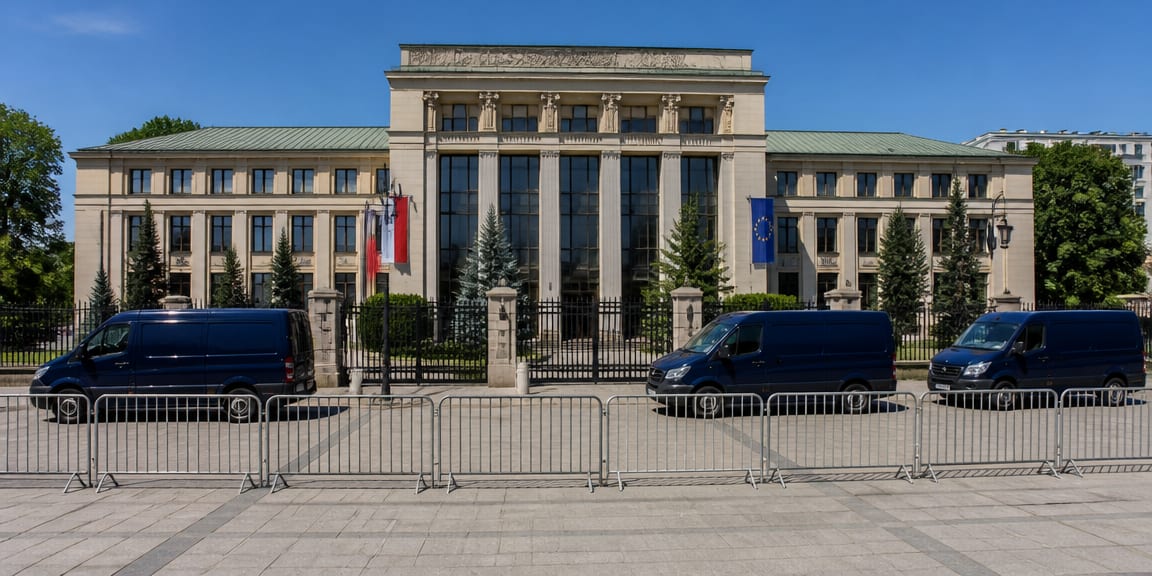
Police secure Poland’s Constitutional Tribunal after judge suspends its chief, as EU urges president to recognize new appointees
Narrative Snapshot
Across outlets, there is broad agreement on the trigger: Judge Anna Korwin-Piotrowska moved to suspend Tribunal President Bogdan Święczkowski and his deputy, prompting police deployment around the court and President Karol Nawrocki’s abrupt return from an overseas trip. International reporting converges on the intensity of the confrontation—riot police at the court, protests outside, and competing claims of legality from the court’s leadership and government figures—while highlighting different facets: physical control of the building, the court’s online communications, and who is recognized as having authority to appoint or swear in judges.
Coverage diverges most clearly on framing and attribution of legitimacy. European outlets underscore Brussels’ position that the Sejm has the constitutional power to appoint new members and urge the president to recognize them, situating events within EU rule-of-law concerns. Russian and Latin American outlets foreground the Tribunal’s characterization of a “coup d’état” and the president’s warnings about internal security, while also amplifying pushback against the government, including Prime Minister Donald Tusk’s unsubstantiated claim about “Russian bots.” Regional and Asian reporting emphasizes the standoff’s operational consequences—police control, protest dynamics, and whether the Tribunal can function—alongside political timing before next year’s parliamentary race. What is most at stake in this mapping is not only who leads the court, but whether the institution can adjudicate at all amid rival chains of authority.
What Happened
On October 30, Judge Anna Korwin-Piotrowska ordered the suspension of Poland’s Constitutional Tribunal president, Bogdan Święczkowski, and vice president Bartłomiej Sochański; the Tribunal’s existing leadership rejected the move and labeled it a “coup d’état.” Riot police secured the court’s premises in Warsaw as protests flared; officers reported dangerous objects thrown, and President Karol Nawrocki turned his plane around from an Africa trip and convened urgent consultations with parliamentary parties, citing a threat to internal security. The Tribunal’s official account alleged an unlawful takeover of its website as the leadership dispute unfolded. The European Commission urged Nawrocki to recognize new judges appointed by the governing majority, with a spokesperson stating that appointing eight new members lies within the Sejm’s constitutional powers. Prime Minister Donald Tusk vowed not to back down and accused the opposition of stoking violence; he also alleged “Russian bots” supported rivals without providing proof.
Why It Matters
The episode concentrates a decade of contention over judicial authority into an immediate test of institutional continuity. The Hindu and the Guardian trace the confrontation to earlier reforms under Law and Justice (PiS) and to presidential veto and swearing-in powers that have constrained the current government’s attempts to reset the court. The European Commission’s intervention—affirming the Sejm’s appointment powers and urging recognition of new judges—links the clash to EU rule-of-law priorities and to Brussels’ leverage in shaping member-state judicial governance. Le Monde and France24 emphasize that no compromise has emerged a year after elections and that the confrontation precedes a closely contested parliamentary race, raising the prospect of prolonged institutional paralysis flagged by ANSA. For decision-makers, the Tribunal’s operational capacity and recognized leadership will condition constitutional review of legislation and the balance among the presidency, parliament, and government, with spillovers for EU-Poland relations.
Diverging Narratives
Two incompatible legal-political frames dominate. The Tribunal’s current leadership and President Nawrocki allege a forcible takeover and “violation of constitutional order,” casting the suspensions as an attempted coup and invoking internal security to justify emergency consultations. By contrast, Tusk and allied outlets present the move as restoring the rule of law, with CGTN noting Korwin-Piotrowska’s seniority and European sources highlighting the Sejm’s authority to appoint judges and Brussels’ call to recognize them. The Guardian’s reference to “government-appointed” judges suspending Święczkowski differs from CGTN’s description of the suspending judge as the court’s longest-serving member, illustrating uncertainty over procedural legitimacy.
Descriptions of street dynamics also diverge: Fox News reports “dozens” of protesters and specific anti-government slogans, Telesur cites “thousands” and episodes of violence, while the South China Morning Post and Bangkok Post focus on the security perimeter and the president’s return. RT adds a partisan layer by highlighting Tusk’s claim of an “army of Russian bots” without evidence and quoting rivals calling him a “pathological liar.” Finally, TASS projects near-term normalcy—saying the Tribunal will resume work in weeks and prioritize citizens’ claims—whereas Le Monde reports fruitless cross-party talks and no compromise, underscoring unresolved questions about who can lawfully lead and reconstitute the court.
What Happens Next
Three decision points will shape the trajectory. First, whether President Nawrocki recognizes and swears in the new appointees urged by the European Commission; acceptance would align with Brussels’ position, while continued refusal, previously justified by alleged selection flaws, would prolong the standoff and the court’s leadership ambiguity. Second, operational control of the Tribunal: TASS reports a plan to resume work in “several weeks,” but which leadership signs decisions—and whether police remain or withdraw, as the president demanded—will signal whose authority is prevailing. Third, political escalation ahead of next year’s election: France24 notes a close race, ANSA says PiS is preparing for battle, and Japan Times reports Tusk will not back down; watch for outcomes of the president’s consultations, any further EU statements reinforcing the Sejm’s role, and on-the-ground indicators such as court communications, website leadership listings, and police-protest dynamics.