
Youth-led cost-of-living protests surge in Germany and France, with nighttime rioting in Frankfurt
Narrative Snapshot
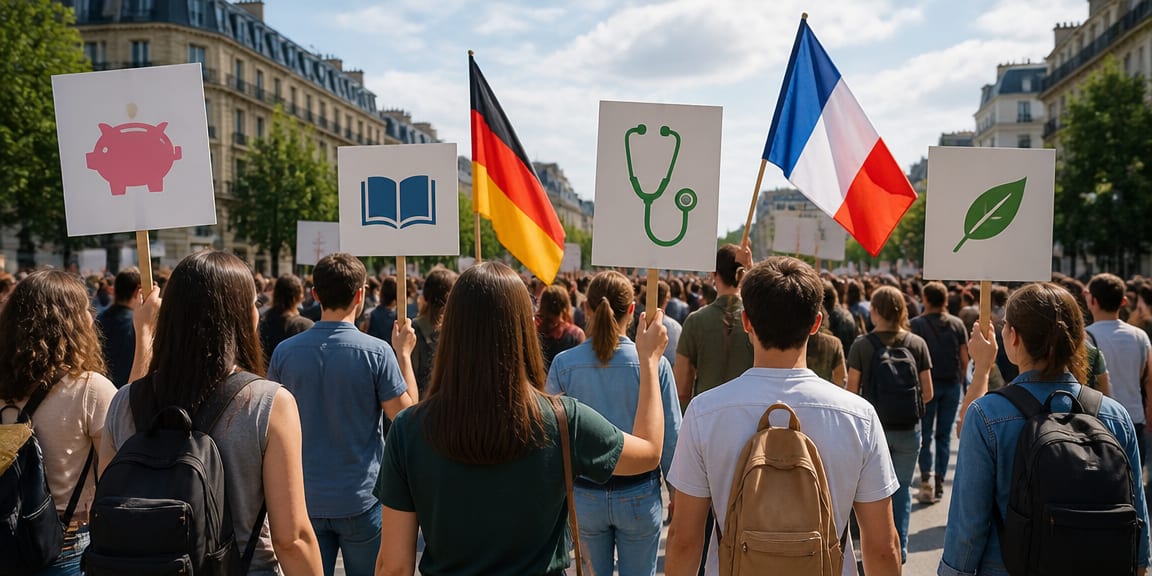
Across outlets, there is broad agreement on the scale and youth-driven character of the mobilizations and on the core demands: relief from rising living costs, investment in education and health, and—distinctively in Germany—opposition to a return of compulsory military service. German and French media describe tens of thousands rallying in roughly 30–34 German cities under the Gen Z regelt banner, with cross-border diffusion from earlier French student-led actions to Portugal, Italy and beyond, as noted by France24 and The Guardian. International desks from NBC News to Al Jazeera and Deutsche Welle similarly emphasize the breadth of participation.
Coverage diverges most sharply on how to characterize the protest day. Le Monde’s initial account stresses that marches from Cologne to Berlin proceeded “without incident” and centered on social demands and rejection of conscription; Deutsche Welle’s early take aligns with that emphasis. By contrast, BBC News, NBC News, France24, and the Japan Times foreground later clashes and looting in multiple cities, with Frankfurt singled out as the flashpoint. Corriere della Sera isolates a tactical moment—water cannons in Cologne—while Canadian and Indian outlets (CBC News, The Hindu) prioritize ministerial vows of a forceful response.
Responsibility framing is another fault line. France’s interior ministry projected a hard security posture ahead of Halloween with 70,000 officers (France24 live; Fox News), while Telesur reports a combined deployment of 220,000 across Germany and France and highlights Jean‑Luc Mélenchon’s call for peaceful rallies. Post‑event, Le Monde quotes a senior German figure blaming “left‑wing” elements and “troublemakers from the migrant community,” and RT amplifies a Hesse official’s assertion that many Frankfurt rioters had migrant backgrounds. Other outlets caution against letting violence eclipse demands: Bangkok Post notes cross‑party criticism of the clashes alongside reminders to keep the focus on grievances, and Le Monde reports Germany’s left condemning violence while insisting the agenda remain visible.
What Happened
A youth‑led protest wave crested over the Halloween weekend, spreading across Germany and reigniting marches in France. In Germany, rallies organized by Gen Z regelt took place in roughly 30–34 cities, including Berlin, Frankfurt, Cologne, Hamburg, and Munich, drawing tens of thousands and calling for better education and healthcare, more affordable living, climate protection, and rejection of compulsory military service (Deutsche Welle; Le Monde; France24; Telesur). Demonstrations were largely peaceful by day but turned violent in several cities after dark, most notably Frankfurt, where rioters looted stores and set barricades alight; more than 100 police were injured and 54 people arrested, according to authorities in Hesse cited by CBC News and RT. Cologne police used water cannons before organizers dissolved the rally (Corriere della Sera). France pre‑positioned about 70,000 security personnel, closed metro stations, and braced for renewed unrest; a Paris march set off from Porte de Bagnolet (France24 live; Fox News; Tehran Times; Telesur).
Why It Matters
The events sit at the intersection of Europe’s inflationary squeeze, long‑criticized gaps in education and public services, and a revived German debate over military conscription. The protest agenda—investment in social systems over “war,” lower living costs, and youth political voice—surfaced consistently in German and French coverage (Le Monde; Deutsche Welle; France24). They also unfold alongside organized labor pressures: IG Metall launched warning strikes after pay talks collapsed, signaling a potential convergence between youth‑led street action and formal industrial action (Deutsche Welle). In France, the government’s concessions to students—presented as “concrete” and “strong measures”—were described by France24’s analysis as tactically shrewd yet insufficient to address structural problems, with the movement already broadening to unions and Yellow Vests. For decision‑makers, the balance struck between public‑order policing, engagement with socioeconomic demands, and the framing of responsibility for violence will shape the policy space for fiscal, education, and security reforms.
Diverging Narratives
Two interpretive tracks dominate. One, emphasized by Le Monde and early Deutsche Welle reporting, foregrounds the breadth and largely orderly character of daytime mobilizations and their social focus: cost of living, housing, and refusal of conscription. The other, led by BBC News, NBC News, France24, Japan Times, and North American outlets, centers on the evening escalation in Frankfurt and other cities, with images of looting, fires, and injuries to police defining the news value.
Attribution for the violence is contested. In France, officials framed the risk through a security lens ahead of Halloween, with Interior Minister Laurent Nuñez promising an “extremely firm response” and Macron blaming “ultra‑left groups” (France24 live; Fox News). In Germany, Le Monde quotes Alexander Dobrindt accusing “left‑wing” groups and “troublemakers from the migrant community,” while RT cites Hesse’s Roman Poseck saying many rioters had migrant backgrounds. Counter‑frames stress protest legitimacy: Bangkok Post reports politicians warning the clashes should not overshadow demands; Le Monde notes Germany’s left condemning violence while insisting on the grievances; Telesur highlights Mélenchon’s call for peaceful marches and French student leaders accusing the government of trying to divide organizations. Security posture is another point of contrast: France24 and Fox News detail a nationwide deployment of about 70,000 in France, while Telesur reports 220,000 across both countries and closures in Paris.
What Happens Next
Organizers’ and authorities’ next moves will set the trajectory. In Germany, Gen Z regelt has called for further demonstrations to maintain pressure (Deutsche Welle). Watch for signals of engagement—such as invitations to dialogue on education, housing, and conscription—or a tilt to deterrence, indicated by additional bans, enhanced crowd‑control measures, or prosecutorial briefings on arrests, after ministers pledged tough action in the wake of Frankfurt (CBC News; The Hindu).
Labor dynamics are an immediate overlay: IG Metall’s warning strikes after pay talks collapsed could align timelines with youth‑led protests or remain distinct; indicators include strike expansion or coordination with student groups (Deutsche Welle). In France, the government has already announced measures but faces renewed student‑led blockades and plans to join a Nov. 5 union mobilization (Le Monde; Telesur; France24). Analysts should track whether authorities pair security deployments and targeted bans with substantive policy adjustments—or double down on public‑order framing—and whether official investigations substantiate competing claims about the composition of rioters reported by Le Monde and RT.