
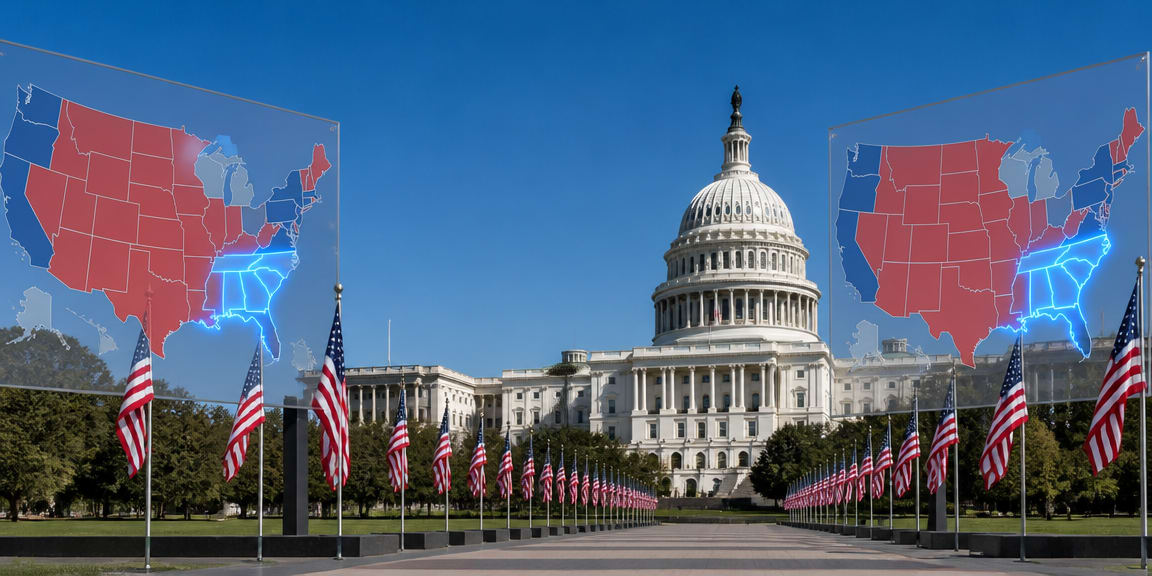
Democrats regain control of US Senate and House in 2026 midterms, flipping North and South Carolina
Narrative Snapshot
Across international and US outlets, coverage converges on the scale of the Democratic gains and the institutional consequences, with most describing the result as a direct check on President Donald Trump’s agenda. European and global outlets emphasized the leverage shift: Deutsche Welle and the Guardian foregrounded Democrats’ new control of the Senate, including the power to stall legislation and confirmations, while Al Jazeera and the Bangkok Post framed the outcome as a repudiation of Trump’s party. US network and wire citations carried by the Kyiv Independent highlighted the projection-based nature of the calls, with AP and NBC referenced for Senate and House control.
There were distinct emphases in race-level reporting. France24 and BBC News spotlighted the Carolinas as emblematic flips, with Roy Cooper’s win in North Carolina and Annie Andrews’ victory in South Carolina, the latter marking the state’s first Democratic senator in nearly three decades. Fox News anchored the story in North Carolina’s individual contest, detailing Cooper’s margin over Michael Whatley and amplifying Democrats’ cost-of-living and health care message. Italian coverage added candidate biography and context, stressing Andrews’ pediatrics background and South Carolina’s 2024 tilt toward Trump.
Issue framing diverged most on foreign policy and identity. Middle East Eye centralized Abdul El-Sayed’s projected Michigan Senate win as a historic first and quoted his sharp criticism of US support for Israel; Haaretz situated the elections in the context of domestic divisions over Israel policy. Meanwhile, Russian state outlet TASS presented spare seat-count updates and cited Bloomberg’s 51-seat Senate threshold, reflecting a more transactional lens. Several outlets also framed the outcome within turnout and mobilization dynamics, noting record-breaking early voting and a surge in Latino early votes reported by Voto Latino and covered by Telesur.
What Happened
Major outlets reported that Democrats secured control of the US Senate and were projected to win the House. Deutsche Welle and the Guardian said Democrats gained the Senate, with TASS relaying Bloomberg’s estimate of at least 51 seats. Al Jazeera reported a House majority, echoed by projections cited by the Kyiv Independent. Race coverage emphasized high-profile flips: Fox News and the Guardian projected former North Carolina governor Roy Cooper defeating former RNC chair Michael Whatley to take a GOP-held Senate seat. BBC News and France24 reported South Carolina elected Democrat Annie Andrews over Darline Graham, handpicked by Trump, the state’s first Democratic senator in nearly 30 years; Corriere della Sera noted Andrews is a pediatrician and that Trump carried the state by 18 points in 2024. Middle East Eye said Abdul El-Sayed declared victory in Michigan’s Senate race as the first Muslim elected senator, though AP had not yet called it. France24 also noted Democrats held Georgia and New Hampshire. Early voting reached record levels per Le Monde, with Telesur highlighting Latino mobilization.
Why It Matters
Senate control reconfigures interbranch bargaining, enabling Democrats to slow or block Trump’s legislative priorities and personnel—cabinet and judiciary—authority underlined by the Guardian’s focus on confirmation power and the Supreme Court’s stakes. A Democratic House majority, reported by Al Jazeera and projected by US networks via the Kyiv Independent, implies a leadership handover that Middle East Eye says could make Hakeem Jeffries the first Black speaker, shifting committee agendas toward cost-of-living and health care, priorities Democrats emphasized in Fox News’ North Carolina coverage. Internationally, oversight of executive foreign policy could intensify, particularly on Israel, given Haaretz’s account of election-year fractures over Israel and Middle East Eye’s reporting of El-Sayed’s critical stance on US funding. Record early voting and Latino turnout, cited by Le Monde and Telesur, signal coalition and mobilization trends likely to inform resource allocation, messaging, and policy positioning heading into 2028.
Diverging Narratives
Outlets differed in causal framing. The Guardian, Deutsche Welle, Al Jazeera, and the Bangkok Post cast the outcome as a rebuke to Trump and Republicans, whereas Fox News localized the narrative to North Carolina’s race and Democrats’ pocketbook messaging without broader referendum language. France24 and BBC News tied the scale of Democratic gains to unexpected flips in the Carolinas, with BBC analysis noting some once-battleground Senate contests became “slam-dunks.” Middle East Eye and Haaretz advanced issue-centric interpretations, highlighting the salience of Israel policy and identity milestones through El-Sayed’s projected win and rhetoric, while Russian outlet TASS abstained from interpretation, reporting control and minimum seat counts.
Timing and certainty also varied. The Kyiv Independent stressed that some projections relied on AP and NBC calls while counting continued; Middle East Eye noted AP had not called Michigan even as other outlets did. Earlier real-time coverage from Le Monde and others hedged that Democrats “could” take one or both chambers before later pieces reported they had. Finally, mobilization and expectations received different weight: Telesur emphasized unprecedented Latino early turnout, while Folha de S.Paulo pointed to the limitations of prediction markets as a lesson from prior elections, underscoring caution in pre-election probabilistic narratives.
What Happens Next
Committee and confirmation strategy in the Democratic Senate is the immediate decision point. The Guardian’s emphasis on appointment leverage suggests scrutiny of Trump’s cabinet and judicial picks will intensify; analysts should watch committee rosters and hearing calendars for signals of pacing and thresholds of opposition. In the House, Middle East Eye’s reporting that Republicans are on track to lose the speakership to Hakeem Jeffries frames leadership elections as the next test; whip counts and caucus rules meetings will indicate the scope of Democratic unity and agenda-setting capacity. Policy prioritization will likely align with messages cited by Fox News and the DSCC on health care and costs, so initial bill introductions and markup schedules will be instructive. Foreign policy oversight may sharpen on Israel given Haaretz’s and Middle East Eye’s coverage; committee hearing topics and member statements, particularly from new voices like El-Sayed, will clarify how far intra-party debates shape oversight. Final certified results, including outstanding AP calls noted by the Kyiv Independent and Middle East Eye, will determine margins and thus procedural room to maneuver.