
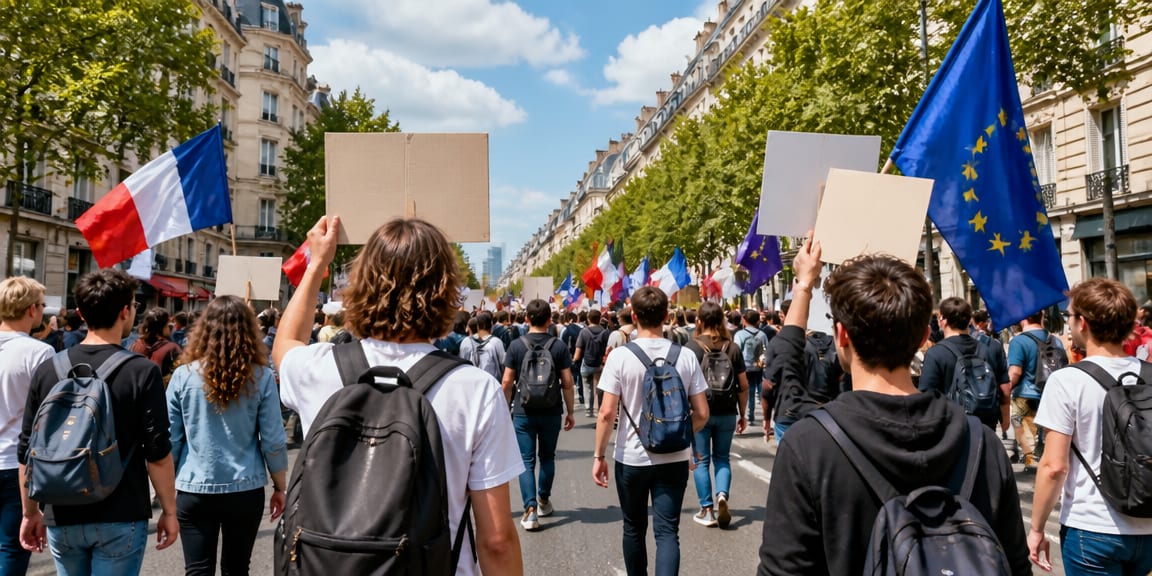
Youth-led cost-of-living protests intensify in France and prompt broader European mobilization calls
Narrative Snapshot
Across outlets, coverage converges on the scale, persistence, and youth profile of the protests, with France as the immediate focal point and a broader European contour taking shape. Reporting from France and international media aligns on the third consecutive weekend of mass demonstrations in France, substantial police deployments, and a mix of largely peaceful marches punctuated by clashes. France 24 situates these events within a continent-wide wave driven by living costs and eroding trust in institutions, while Le Monde highlights cross-border coordination by unions and associations from seven countries for late-November actions.
The main divergences lie in event metrics and framing. Organizers’ and authorities’ estimates of turnout and arrests vary substantially across outlets, and narratives oscillate between “largely peaceful” mobilizations and accounts emphasizing disorder. Some outlets foreground the French government’s initial policy concessions on education reforms, while student groups, covered by Telesur English and The Hindu, amplify calls for renewed blockades and broader participation in union-led strikes.
Geographically, several sources present these protests as part of a wider European pattern. Telesur English reports planned youth-led mobilizations in Germany focused on cost of living, education funding, and conscription debates. CGTN’s coverage of demonstrations in Lisbon over a police operation to clear housing encampments underscores how housing and budget politics intersect with youth and social protest agendas.
A political undercurrent emerges in French coverage: Le Monde notes the government’s attempt to recalibrate contested education policies without quelling mobilization, and documents how participation is accelerating political socialization among young people months before a presidential election. This sits alongside policing and legal-management angles stressed by UK and Italian outlets, which cover risk assessments, route restrictions, and court rulings that shaped Paris protest logistics.
What Happened
France entered a third straight weekend of nationwide protests over living costs and education, with authorities reporting around 320,000 participants and most marches remaining peaceful, while clashes in several cities prompted police use of tear gas and water cannon, according to France 24, Al Jazeera English, Deutsche Welle, and Japan Times. Organizers cited higher figures, with Folha de S.Paulo reporting their claim of nearly 500,000 participants nationwide, including 200,000 in Paris. France deployed 70,000 police across roughly 150 planned demonstrations and warned of a very high risk of public disorder, The Guardian reported, following earlier incidents of looting. Arrest tallies differed by outlet and cutoff: Deutsche Welle cited more than 290 arrests, Japan Times “more than 500,” Clarin 565, CGTN 779, and France 24 “more than 770.” In Paris, authorities tightened routes, with ANSA noting a State Council decision against allowing access to the Bastille. Student leaders called for renewed school blockades and support for union-led strikes, Telesur English and The Hindu reported.
Why It Matters
The protests expose a multi-issue, youth-driven mobilization that spans cost of living, education, and housing—domains where state policy capacity is already strained. France’s attempt to defuse the education dimension by rolling back elements of reforms from both Macron presidencies has not ended mobilization, Le Monde reported, suggesting limited short-term efficacy of incremental policy reversals in the face of entrenched grievances. The France 24 characterization of a broader European wave, together with Le Monde’s report of coordinated calls from organizations in France, Spain, Italy, the UK, Portugal, Greece, and Belgium to rally millions in late November, indicates cross-border organizational reach.
Operationally, policing and public-order management are central. The Guardian detailed France’s large-scale deployments, and Telesur English reported extensive police mobilizations in Germany and France, alongside preemptive closures in Paris. Parallel housing protests in Lisbon, reported by CGTN amid Portugal’s budget debate, illustrate how fiscal choices intersect with street mobilization. For decision-makers, these dynamics test the balance between public-order controls and policy concessions across education, housing, and social protection frameworks.
Diverging Narratives
Outlets differ on scale and intensity. Authorities’ counts of approximately 320,000 participants, carried by Al Jazeera English, Deutsche Welle, and France 24, diverge from organizers’ claims of nearly 500,000 reported by Folha de S.Paulo. Assessments of arrests range widely—from more than 290 (Deutsche Welle) to 779 (CGTN, citing the Interior Ministry)—and France 24 and Japan Times note both largely peaceful marches and police use of tear gas and water cannon against rioters. The Guardian emphasizes a “very high risk of public disorder” and references earlier looting, contrasting with France 24’s “largely peaceful” characterization of the latest weekend.
Narratives also diverge on state response. Le Monde reports the French government proposing to undo contested reforms in education but acknowledges the measures did not extinguish mobilization, whereas student organizations quoted by Telesur English accuse the government of attempting to divide groups and call for renewed blockades and strike participation, echoed by The Hindu’s coverage of planned school actions. ANSA’s reference to the State Council barring access to the Bastille encapsulates tensions between crowd management imperatives and protest-route claims, while CGTN’s Lisbon coverage centers on policing of housing encampments and ensuing injuries, highlighting issue-specific grievance frames beyond France’s education and inflation focus.
What Happens Next
Student leaders’ calls to resume school blockades and join union actions set near-term tests of momentum, with Telesur English noting planned blockades on specified weekdays and The Hindu reporting a restart from Monday. The late-November multi-country mobilizations flagged by Le Monde establish a cross-border inflection point: turnout across France, Spain, Italy, the UK, Portugal, Greece, and Belgium will indicate whether organization scales beyond national contexts. In France, watch for any further government adjustments beyond the initial education measures referenced by Le Monde and whether policing remains at the levels described by The Guardian and Telesur English. In Germany, Telesur English reported organizers expected large demonstrations across multiple cities; realized participation will signal whether the movement consolidates regionally. In Portugal, CGTN’s account of protests during the budget debate suggests that legislative handling of housing and public-order issues will be a barometer for further mobilization around encampments and policing practices.