
Oleshky evacuations proceed under six-day truce as Kherson shelling resumes; Europe schedules non‑offensive support force drill in Poland
Narrative Snapshot
European and Ukrainian outlets converge on the picture of a tightly bounded, U.S.-brokered pause that held locally, enabled limited civilian relief, and then gave way to renewed violence elsewhere. Deutsche Welle emphasizes the procedural integrity of the ceasefire in the Kherson region, noting no violations before it lapsed, even as drones and missiles struck other parts of Ukraine. Le Monde foregrounds the humanitarian dividend in Oleshky, describing mass deprivation in a frontline “no man’s land” and reporting that roughly 700 people escaped during the six days. Ukrinform complements this with granular data from the Ukrainian-controlled right bank—173 evacuees across 10 communities, including vulnerable groups.
Where outlets diverge is in emphasis and implications. Bangkok Post underscores Kyiv’s claim that this was the longest truce since 2022 and reports Russian fire resuming against the city of Kherson immediately after it ended, while the Kyiv Independent highlights a political ceiling: the Kremlin has ruled out similar humanitarian operations for now, even as President Volodymyr Zelensky publicly welcomes more localized pauses. In parallel, France 24 and the Bangkok Post place the developments in a wider European planning frame, detailing a Franco‑British–led, non‑offensive multinational force set to exercise in Poland, explicitly designed to support Ukraine after a potential ceasefire rather than to fight.
What Happened
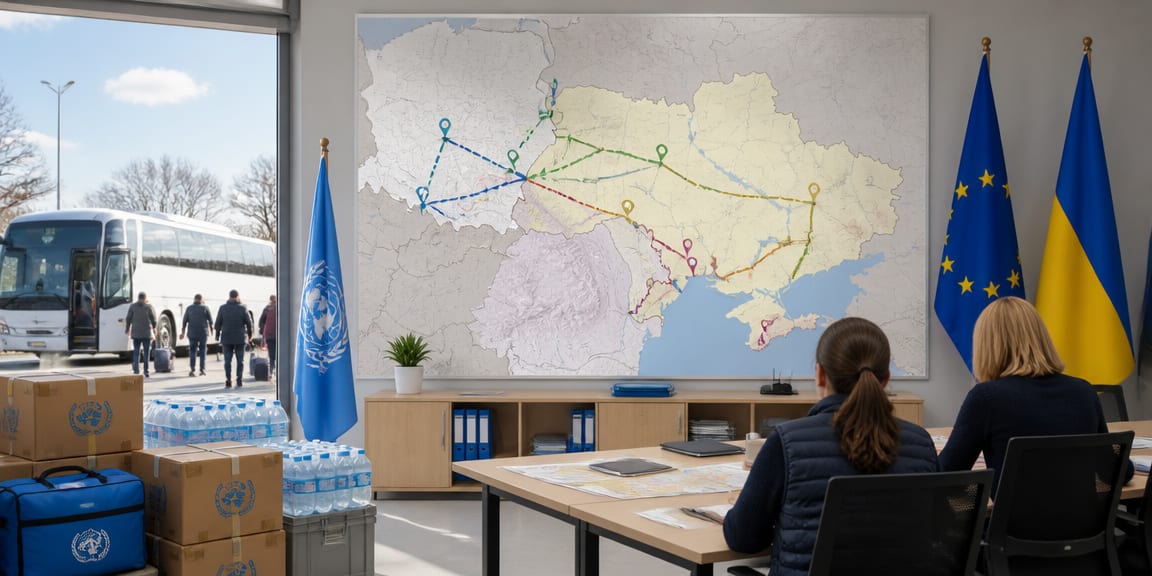
A six-day, U.S.-brokered ceasefire in Ukraine’s southern Kherson region ended Sunday night without reported violations, Deutsche Welle reported, enabling limited civilian evacuations before lapsing. Le Monde said approximately 700 residents left Oleshky, a frontline “no man’s land” plagued by severe shortages, during the pause. Ukrinform separately reported 173 people evacuated from 10 right-bank communities, including 24 with limited mobility and 21 children, with no minors remaining in Stanislav or Beryslav. After the truce expired, Bangkok Post reported that Russia resumed strikes on the city of Kherson, while Deutsche Welle said Russian drones and missiles hit other Ukrainian regions. The Kyiv Independent noted the Kremlin has ruled out further humanitarian operations like Oleshky for now, even as Zelensky told Fox News he would welcome more localized ceasefires. Meanwhile, France 24 and Bangkok Post reported that about 2,800 troops from 10 European countries will drill in Poland from November 9–22 to test a Franco‑British–led, non‑offensive support force for Ukraine after a potential ceasefire.
Why It Matters
The episode tests whether narrowly scoped humanitarian pauses can function amid continuing hostilities elsewhere. With Deutsche Welle noting a locally observed truce and Le Monde and Ukrinform documenting evacuations on both banks of the Dnipro in Kherson, the case offers a concrete, recent precedent for time‑bound, U.S.-facilitated arrangements that yield civilian relief without broader battlefield de‑escalation. Bangkok Post’s report that Kyiv casts it as the longest truce since 2022 underscores its outlier status rather than a new norm.
Europe’s announced exercise, reported by France 24 and Bangkok Post, signals planning for post‑ceasefire support that is explicitly non‑offensive and led by France and Britain. By rehearsing the mechanics of a multinational force designed to assist Ukraine after a potential ceasefire, European capitals are preparing institutional tools that could underpin stabilization or monitoring functions without direct combat roles. For policymakers, this combination—localized humanitarian corridors under U.S. brokerage and European contingency structures—illustrates a division of labor that could shape crisis management options if similar pauses are contemplated elsewhere.
Diverging Narratives
Outlets align that the Kherson ceasefire held its terms locally and facilitated evacuations, but they highlight different stakes. Deutsche Welle frames the truce as procedurally intact while noting continued Russian strikes beyond the ceasefire zone. Bangkok Post stresses Kyiv’s characterization of the pause as the longest since 2022 and the immediacy of renewed Russian shelling of Kherson city once it ended, emphasizing fragility and the limits of localization.
Humanitarian impacts are reported at two scales: Le Monde’s estimate of roughly 700 evacuees from Oleshky, a frontline area suffering acute shortages, contrasts with Ukrinform’s quantified right‑bank operations moving 173 people across 10 communities, including vulnerable residents. These figures are not contradictory but reflect different geographic lenses and editorial priorities.
On prospects for repetition, the Kyiv Independent reports a clear split: the Kremlin has ruled out further operations like Oleshky “for now,” while Zelensky publicly welcomes more humanitarian ceasefires elsewhere along the front. Looking ahead, France 24 casts Europe’s upcoming, non‑offensive drill in Poland as a test of a support force intended for a post‑ceasefire environment, whereas Bangkok Post presents it as the first exercise of a new multinational force in support of Ukraine, underscoring institutional readiness without addressing political conditions for its eventual deployment.
What Happens Next
Two decision points emerge. First is whether additional localized humanitarian pauses materialize. The Kyiv Independent reports the Kremlin has ruled out repeats “for now,” while Zelensky has signaled openness; any shift will likely be telegraphed by statements from Moscow, Kyiv, or Washington, which Deutsche Welle credits with brokering the Kherson pause. Analysts should watch for corridor-specific negotiations, evacuation tallies akin to Le Monde’s and Ukrinform’s reporting, and whether strikes resume immediately after any future pauses as Bangkok Post described in Kherson.
Second is how Europe operationalizes its planned non‑offensive support force. France 24 and Bangkok Post say 2,800 troops from 10 European countries will exercise in Poland from November 9–22 under Franco‑British lead, to support Ukraine after a potential ceasefire. Indicators include participation details, scenario design that clarifies “support” functions, and official statements on the conditions under which the force could be activated in a real post‑ceasefire setting.