
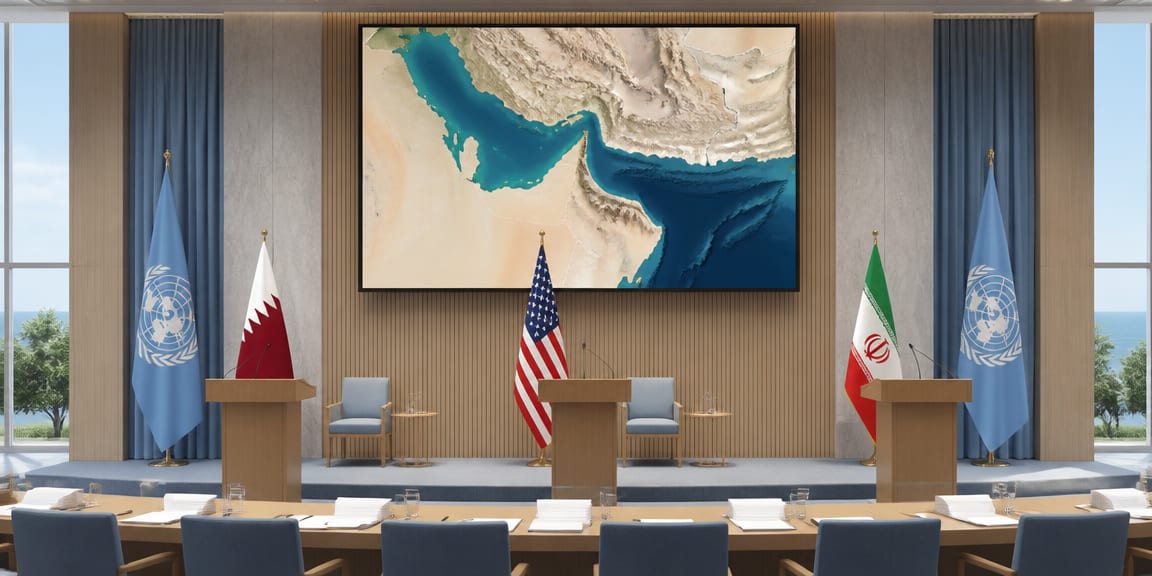
Qatar says U.S. and Iran reviewing mediation proposals as draft text circulates; Iranian team departs Doha to consult
Narrative Snapshot
Across official and regional outlets, the through line is continuity of Qatari-led mediation and active review of proposals by Washington and Tehran. Qatari officials quoted by Al Jazeera English and Iran’s IRNA emphasize that both parties remain engaged, are studying ideas, and that regional governments are coordinating to support a diplomatic outcome. Russian agency TASS adds operational detail: a draft agreement has been circulated for feedback, and Iran’s delegation left Doha to review settlement proposals at home.
Iranian and Gulf sources differ in tone on momentum and risk. IRNA underscores that consultations on a “two-day plan” to reopen the Strait of Hormuz have yet to yield a definitive outcome, while Qatari spokespeople cited by Middle East Eye say Doha is working toward an interim deal to build confidence and secure on-the-ground commitments. Gulf commentary in South China Morning Post, Toronto Star, and Clarin highlights the United Arab Emirates’ dual approach: hoping for a breakthrough while preparing for worst-case scenarios.
Coverage from Israel’s Haaretz frames the talks within a bargaining dynamic: both Washington and Tehran want diplomacy while wielding the threat of renewed war, with the U.S. signaling readiness to return to talks if Iran addresses the nuclear issue. Risk markers appear in several reports—The Hindu notes concerns about post–November 3 U.S. midterm escalation, and Middle East Eye reports fresh U.S. strikes on Iran’s Qeshm island that Qatari officials warn could complicate negotiations.
What Happened
Qatar has intensified mediation between the United States and Iran, with its Foreign Ministry spokesman saying both sides remain committed to negotiations and are reviewing proposals from mediators, including Doha. TASS reports that a draft agreement has been circulated among participants for feedback and that an Iranian delegation departed Doha to review settlement proposals. IRNA confirms ongoing efforts to bridge differences and notes coordination among regional states, while separately stating there is no breakthrough yet on a “two-day plan” concerning the reopening of the Strait of Hormuz. Middle East Eye reports Qatar is working toward an interim deal to prevent renewed fighting and cautions that further escalation, including reported U.S. strikes on Iran’s Qeshm island, could complicate talks. The Hindu describes Iranian negotiators in Doha amid concerns of potential escalation after the November 3 U.S. midterm elections. CGTN highlights Qatar’s call for a regional security framework based on sovereignty and non-aggression.
Why It Matters
The talks are nested in broader questions about Gulf security architecture and crisis management mechanisms. IRNA’s reference to a “two-day plan” for reopening the Strait of Hormuz spotlights the fragility of a critical energy chokepoint and the premium regional actors place on restoring predictable maritime flows. Qatar’s appeal, reported by CGTN, for a sovereignty- and non‑aggression–based security framework suggests a push to institutionalize de-escalation norms beyond episodic crisis diplomacy. Haaretz’s focus on the nuclear file indicates the potential for any interim arrangement to become a bridge to more formal discussions on longstanding proliferation concerns. Meanwhile, the UAE’s public hedging—seeking diplomatic progress while bracing for deterioration—signals how Gulf states are calibrating risk exposure and contingency planning around U.S.–Iran signaling. For decision-makers, these strands underscore the importance of synchronizing tactical de-escalation steps with credible pathways to address structural issues that repeatedly trigger crisis cycles.
Diverging Narratives
Sources diverge on the state of progress and the locus of leverage. TASS points to concrete process steps—a draft text in circulation and Tehran’s delegation returning home to consult—while IRNA cautions there is “no definitive outcome” on a specific Hormuz reopening plan, tempering expectations. Qatari messaging, as relayed by Al Jazeera English and Middle East Eye, stresses commitment to talks and hopefulness for an interim deal that would lock in confidence-building measures, whereas Haaretz interprets both sides’ posture as talk-ready but leverage-driven, with the U.S. conditioning a return to broader diplomacy on nuclear discussions.
Risk assessments also vary. The Hindu flags timing sensitivities around U.S. domestic politics and potential post‑election escalation. Middle East Eye introduces an immediate friction point by reporting fresh U.S. strikes on Qeshm island and quoting a Qatari warning that further escalation could complicate negotiations. In contrast, IRNA highlights ongoing regional coordination to support diplomacy, and CGTN echoes Doha’s emphasis on a rules‑based regional security framework. Finally, Al Jazeera notes an Iranian commander articulating five conditions for regional security, indicating Tehran’s preference to frame de‑escalation within wider security guarantees, even as concrete negotiating details remain largely undisclosed in public reporting.
What Happens Next
Three decision points emerge from the reporting. First, whether the circulated draft and reviewed proposals coalesce into an interim deal: Qatar’s spokesperson describes efforts to secure “commitments on the ground,” so confirmation of reciprocal, verifiable steps would signal movement; Iranian statements acknowledging specific confidence measures would be a corroborating indicator. Second, disposition of the Hormuz “two-day plan”: IRNA’s note of no breakthrough yet makes subsequent Iranian or Qatari announcements on maritime access a key marker; any facilitation measures at the Strait would reflect tangible de-escalation. Third, scope linkage to the nuclear file: Haaretz reports U.S. willingness to return to diplomacy if Tehran discusses nuclear issues; watch for U.S. and Iranian public references to nuclear parameters in the mediation track. Across all paths, incidents like those reported by Middle East Eye and the post–November 3 timing sensitivity highlighted by The Hindu will affect negotiating space and sequencing.