
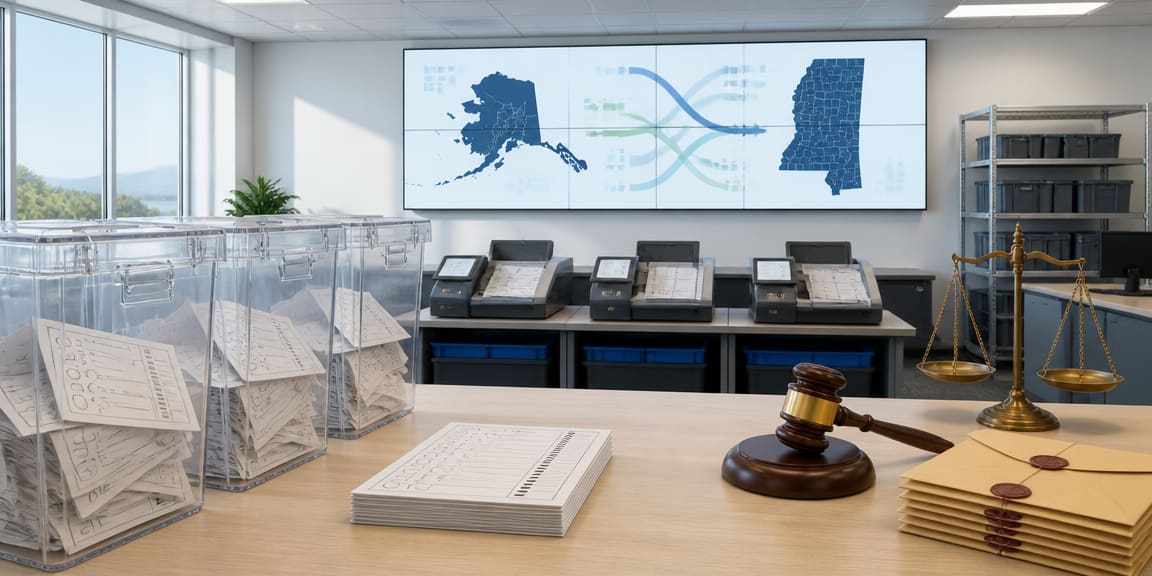
Alaska’s ranked-choice count and “Decoy Dan” probes keep Senate result unsettled as Mississippi stays razor-thin
Narrative Snapshot
Across outlets outside the United States, coverage focuses on unresolved outcomes and the mechanics behind them. Al Jazeera English and the Toronto Star highlight process-driven delays, noting that Alaska’s ranked-choice voting could determine the Senate seat and that Alaskans were prepared for additional tabulations, while Mississippi’s Senate race remains on a “knife’s edge.” France 24 and the Bangkok Post emphasize that these are among the last uncalled races, with the Bangkok Post and Argentina’s Clarín placing them against a backdrop of broader Democratic gains nationally.
US-based Fox News centers its reporting on an alleged scheme to field a “decoy” candidate named Dan Sullivan to confuse voters, featuring denials from Democrat Mary Peltola, sharp accusations from Republican Sen. Dan Sullivan, and the Republican National Committee’s framing of the episode as fraudulent rather than a bipartisan norm. The Guardian adds that “ballot stacking” is not illegal and reports that federal subpoenas were issued and that the US president and the Justice Department took legal steps concerning certification if the incumbent lost. The point of convergence across sources is that Alaska’s winner remains undecided; where they diverge is over whether the controversy reflects criminal manipulation, a rough-edged but lawful tactic, or simply a process story about ranked-choice tabulation and slow counts.
What Happened
Newsrooms report two unresolved Senate contests. In Mississippi, France 24 describes a neck-and-neck race, and Al Jazeera says the result is still on a knife’s edge. In Alaska, the Toronto Star and Al Jazeera say the count could require ranked-choice tabulations, with Clarín adding that Alaska’s slow count may extend into mid-November.
Multiple outlets detail an Alaska dispute after the New York Times reported that Democratic operatives sought a challenger with the same name as the Republican incumbent, Dan Sullivan. Fox News reports that Alaska’s governor ordered a state investigation and that the Justice Department filed a lawsuit to delay or block certification; The Guardian reports federal subpoenas and says the president and Justice Department acted pre-emptively should the incumbent lose. A federal judge dismissed the DOJ suit, per Fox News and Al Jazeera, and the DOJ says it will appeal, also reported by Clarín. Al Jazeera adds that Sen. Sullivan pledged to honor the outcome. The Bangkok Post notes accusations of cheating around the Alaska race and frames both races amid wider Democratic victories.
Why It Matters
These races test how election institutions handle close outcomes and disputed tactics. Alaska’s ranked-choice system, highlighted by Al Jazeera and the Toronto Star, is designed to diminish “spoiler” dynamics, yet the name-similarity allegations reported by Fox News and The Guardian probe the boundary between lawful ballot tactics and potential voter confusion. The DOJ’s failed bid to delay certification, with an appeal pending (Fox News; Clarín), raises recurring questions about federal intervention in state election administration and how courts balance ballot secrecy against inquiries into voter intent.
For decision-makers, the episode underscores three structural dynamics: the operational demands and communications burdens of ranked-choice implementation; the legal and political contestation around certification authority, noted by The Guardian and Fox News; and the reputational stakes of election-legitimacy narratives, with Fox News juxtaposing Democratic warnings about threats to democracy against the Alaska allegations. International outlets’ emphasis on process and outcomes, alongside reports of Democratic gains (Bangkok Post; Clarín), situates the disputes within broader national power calculations.
Diverging Narratives
Outlets and actors frame the Alaska dispute in sharply different terms. Fox News amplifies claims of a “fraudulent” scheme, quoting the RNC’s rejection of “both sides do it” arguments and Sen. Sullivan’s charge that Democrats would “do anything” to gain power. It also features a former FEC member arguing that prior federal prosecutions have set a precedent for the current DOJ probe. Mary Peltola publicly denies any involvement, as carried by Fox News, while a Democratic strategist on MS NOW, cited by Fox News, characterizes such maneuvers as something that “happens all the time.”
The Guardian stresses that “ballot stacking” is not illegal and reports subpoenas and a pre-emptive legal move involving the president and the DOJ should the incumbent lose, framing the episode as legal acrimony rather than a settled criminal matter. Al Jazeera and the Toronto Star largely bracket the controversy, focusing on ranked-choice procedures and the pending count, while the Bangkok Post and France 24 keep attention on the fact that both Alaska and Mississippi remained uncalled. Clarín emphasizes Democrats’ historic advances while noting Alaska’s and Mississippi’s unresolved counts. These strands cohere around an unsettled result but diverge on whether the core story is potential misconduct, normal hardball politics, or counting logistics.
What Happens Next
Two institutional tracks will shape outcomes. First, Alaska’s vote counting: the Toronto Star and Al Jazeera report that ranked-choice tabulation may be required, and Clarín notes the timeline could run to mid-November. Analysts should watch when Alaska’s Division of Elections initiates ranked-choice rounds and the margin before and after reallocations, as well as any official guidance on certification milestones.
Second, legal and investigative actions: Fox News reports that a federal judge dismissed the DOJ’s bid to delay certification and that the department will appeal; Clarín likewise notes the planned appeal. Fox News also reports the Alaska governor’s order for a state investigation. Key indicators include whether the Ninth Circuit takes up the DOJ appeal before certification, any public findings from the Alaska Department of Public Safety, and whether The Guardian’s reported subpoenas yield additional disclosures. In Mississippi, France 24 and Al Jazeera signal that remaining ballots will decide a very close race; movement will come from updated tallies and any recount triggers under state law, though no outlet reports one has been initiated.