
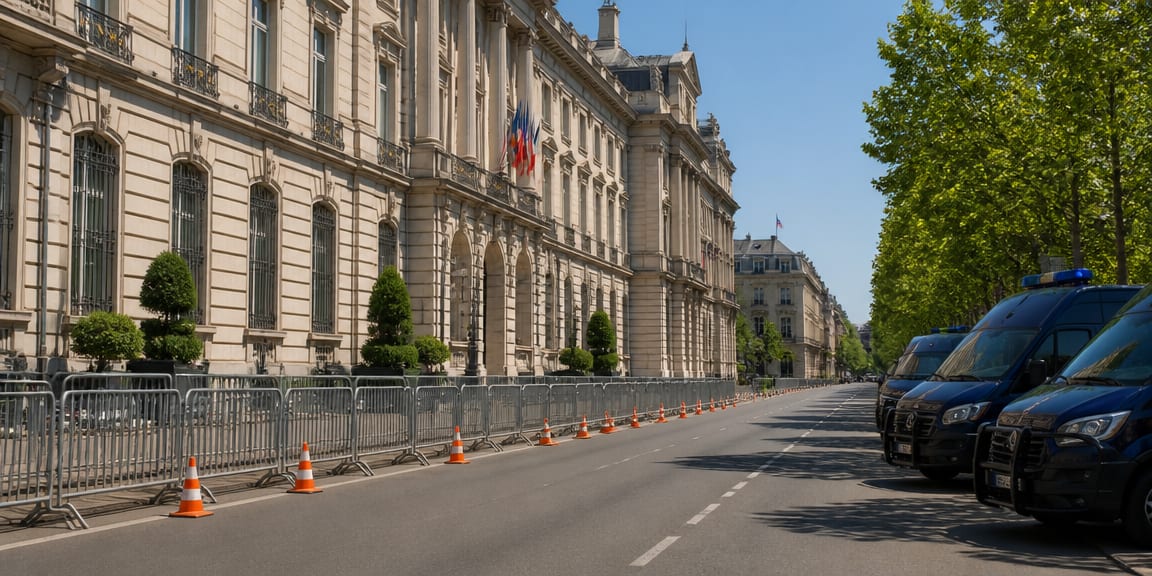
France braces for Nov. 5 general strike as unions mobilize nationwide and authorities deploy 70,000 police
Narrative Snapshot
Across outlets, there is broad agreement on scale and timing: more than 220 demonstrations are planned nationwide on Nov. 5, with participation expected across multiple sectors and youth movements (Le Monde, New York Times, France24, The Guardian). Where coverage diverges is in emphasis. French reporting centers on the state’s security posture and the unions’ organizing grievances. Interior Minister Laurent Nuñez’s pledge to deploy 70,000 officers and to tolerate no “débordement” anchors the official line, while the CGT criticizes Paris police for failing to negotiate the march route seriously, tying the day’s stakes to protest rights and movement discipline (Le Monde).
Anglophone and Latin American outlets lean harder into risk and context. Telesur highlights intelligence warnings about radical groups “exploiting” protests and situates the deployment in reference to serious incidents on Oct. 17, claiming thousands of businesses were damaged in prior unrest. Fox News elevates the U.S. Embassy’s security alert to American travelers, warning of disruptions, sudden curfews, and potential spillover beyond planned routes. The Guardian widens the aperture to fiscal politics and cost-of-living pressures, linking sectoral participation to a strained budget process and high public debt, while France24 frames the day as a live test of the government’s response to household hardship.
What Happened
French trade unions called nationwide strikes and demonstrations for Thursday, Nov. 5, advancing demands for wage increases, protection of public services, and defense of the right to protest (Le Monde). Authorities anticipate “a bit more than 220” actions, most declared by the intersyndicale, and Interior Minister Laurent Nuñez announced a deployment of 70,000 police and gendarmes, warning that no disorder would be tolerated (Le Monde). Intelligence services have flagged calls for violence and possible attempts by radical groups to exploit the protests, with security measures repeated from recent weekends after serious incidents on Oct. 17 (Telesur). Participation is expected from hospital workers, air traffic control, postal services, teachers, and rail staff, alongside high school and university students and “gilets jaunes” supporters (Le Monde; The Guardian). The U.S. Embassy issued a security alert warning Americans in France of severe disruptions, potential curfews, and risks of violence (Fox News).
Why It Matters
The confrontation sits at the intersection of protest policing and social policy. The Interior Ministry’s large deployment and hard line on “débordement” reflect a security-first posture after previous unrest, while unions’ complaints about poorly negotiated march routes and explicit calls to defend the right to protest signal friction over assembly management and civil liberties (Le Monde). Substantively, the action channels pressure over inflation and public services into an already difficult fiscal environment: the government is struggling to pass a belt-tightening budget in a divided parliament, with public debt near 120% of GDP (The Guardian). Internationally, the U.S. Embassy’s warning underscores potential disruptions to travel and commerce and highlights how France’s domestic unrest reverberates through consular risk assessments (Fox News). For policymakers, the balance struck between maintaining order and accommodating mass mobilization will shape both immediate service continuity and the credibility of forthcoming social and budgetary measures.
Diverging Narratives
Security framing varies in intensity. French authorities emphasize control and scale—70,000 officers and a pledge to tolerate no overflow—while Telesur stresses intelligence warnings about radical groups and links the deployment to “serious incidents” on Oct. 17, asserting that thousands of businesses were looted or damaged (Le Monde; Telesur). Anglophone coverage ranges from quantification and context to travel risk. The New York Times foregrounds the breadth of mobilization—over 220 demonstrations—without dramatic language, whereas Fox News centers the U.S. Embassy’s alert, warning of curfews, potential violence, and protests spilling beyond planned routes (NYT; Fox News). Labor and rights framing is more pronounced in French reporting: Le Monde reports the CGT’s charge that Paris march logistics were not seriously negotiated and highlights unions’ inclusion of the right to protest among their core demands. The Guardian connects the strike to macroeconomic governance and politics, citing sectoral breadth, cost-of-living protests among students, and a fraught budget process in a divided parliament with high debt levels, situating the unrest within President Emmanuel Macron’s constrained final months (The Guardian; Le Monde).
What Happens Next
Two decision points will shape outcomes. First is operational: whether authorities’ deployment and route management keep declared marches on track without expansive curfews or restrictions. Signals include the use of short-notice curfews flagged in the U.S. Embassy alert and any police–union adjustments to march routes after the CGT’s criticism (Fox News; Le Monde). Second is policy: whether the government edges toward measures that “support households struggling with rising living costs,” as urged by unions and tracked in live coverage, or maintains fiscal restraint amid a divided parliament (France24; The Guardian). Analysts should watch participation across the sectors named by The Guardian, the extent to which protests remain within the “declared” actions referenced by the Interior Ministry, and transport disruption given rail unions’ involvement reported by Fox News. These indicators will clarify whether the strike consolidates a broad social front or remains episodic pressure within ongoing budget negotiations.